A Tongzhi Brushpot: Reconsidering a “20th-Century” Attribution.
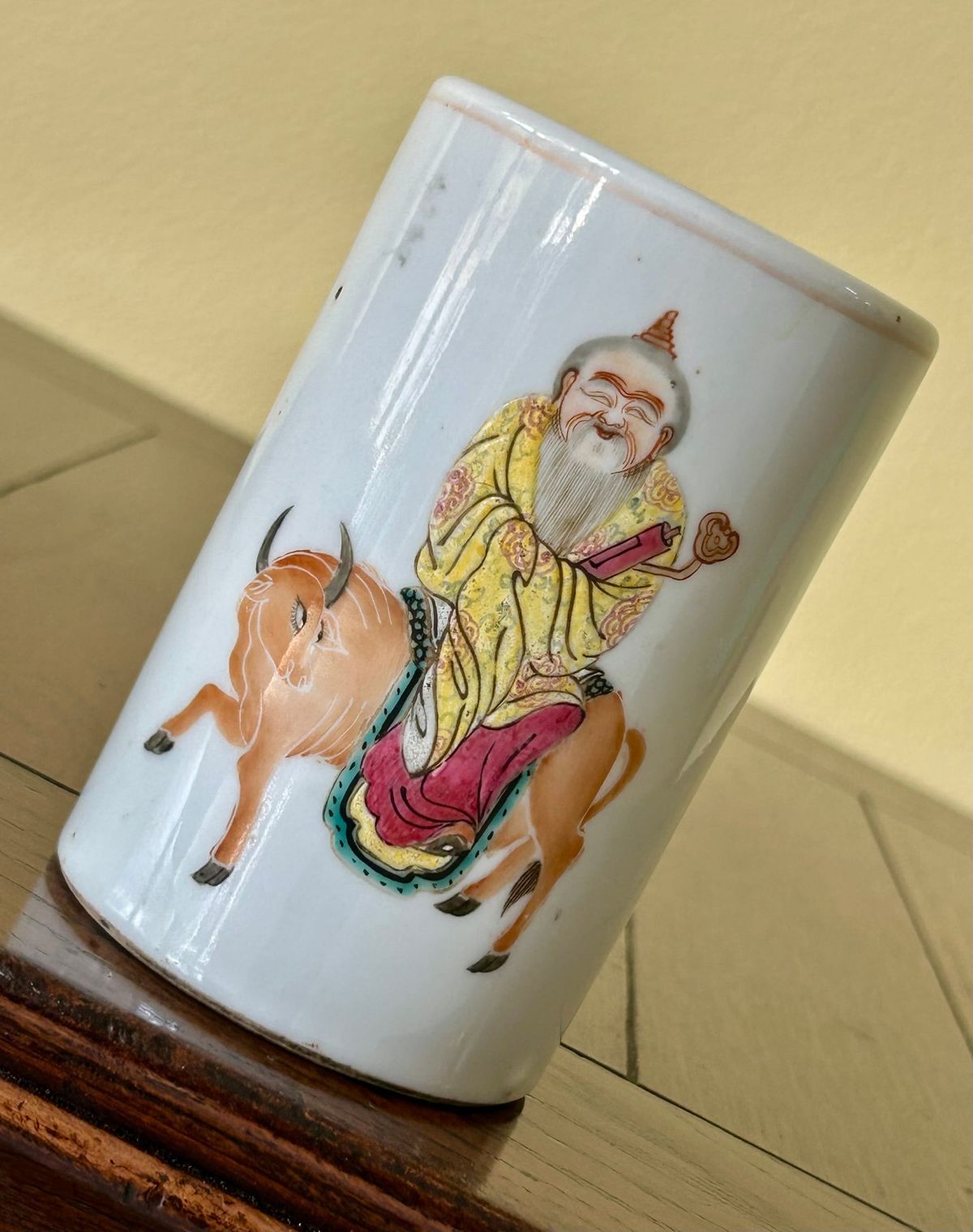
I bought this small Chinese porcelain brushpot at auction in Thailand, where it was catalogued simply as twentieth century. At 1,200 baht it was hardly presented as an undiscovered Qing treasure.
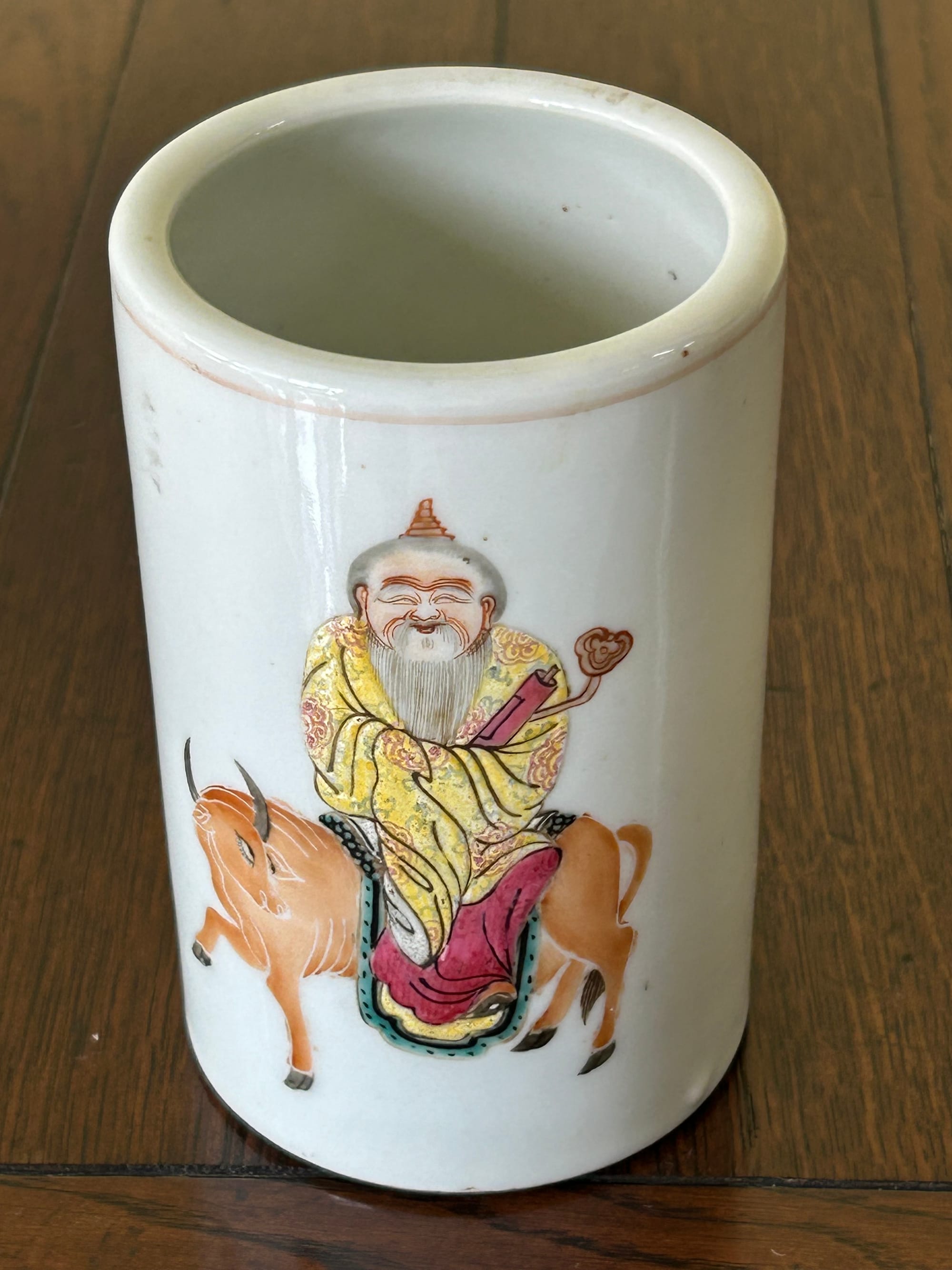
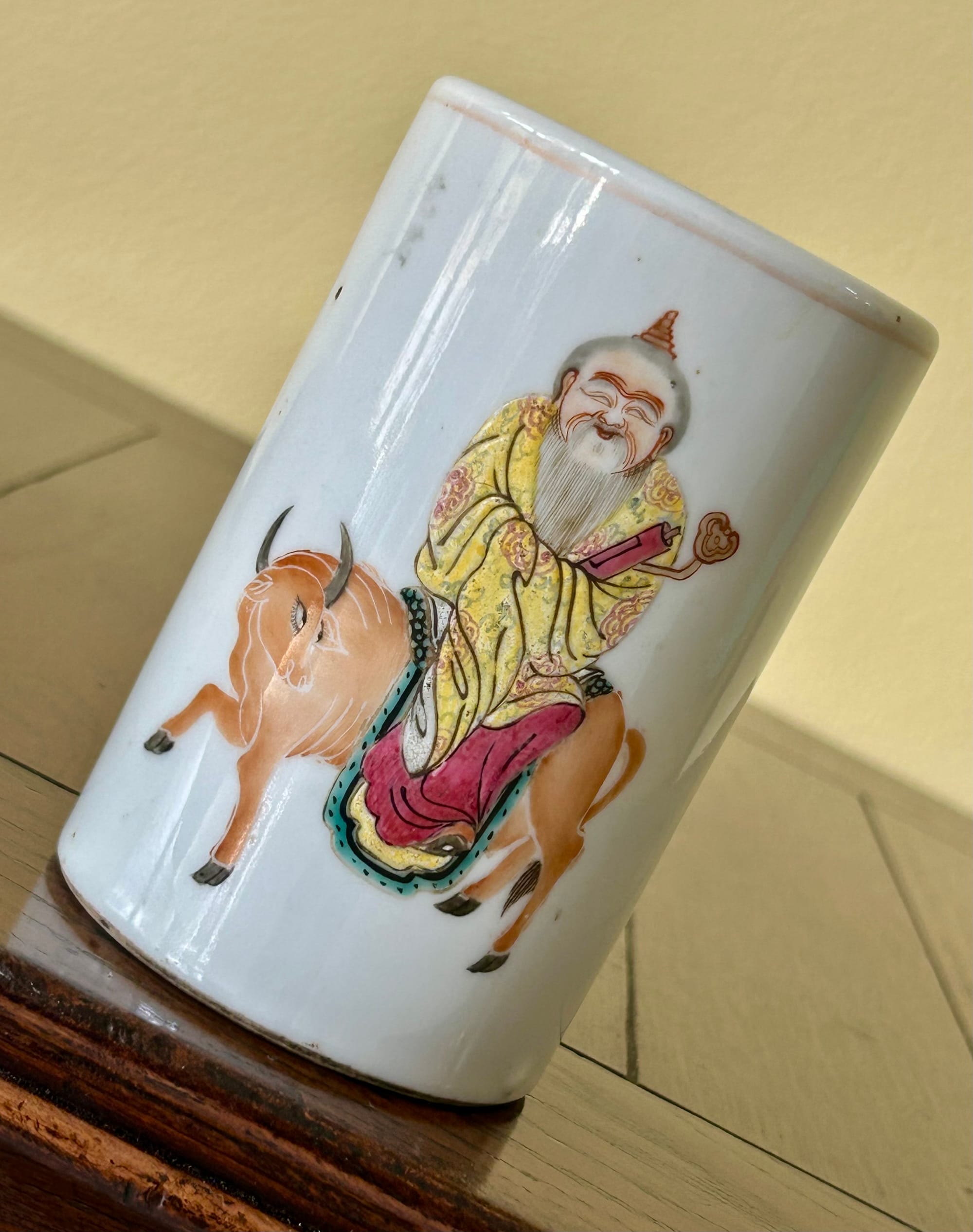
It measures 12 cm high and 7.5 cm in diameter and is decorated in famille-rose enamels with an elderly figure riding an ox, accompanied by calligraphy and two small iron-red seals.
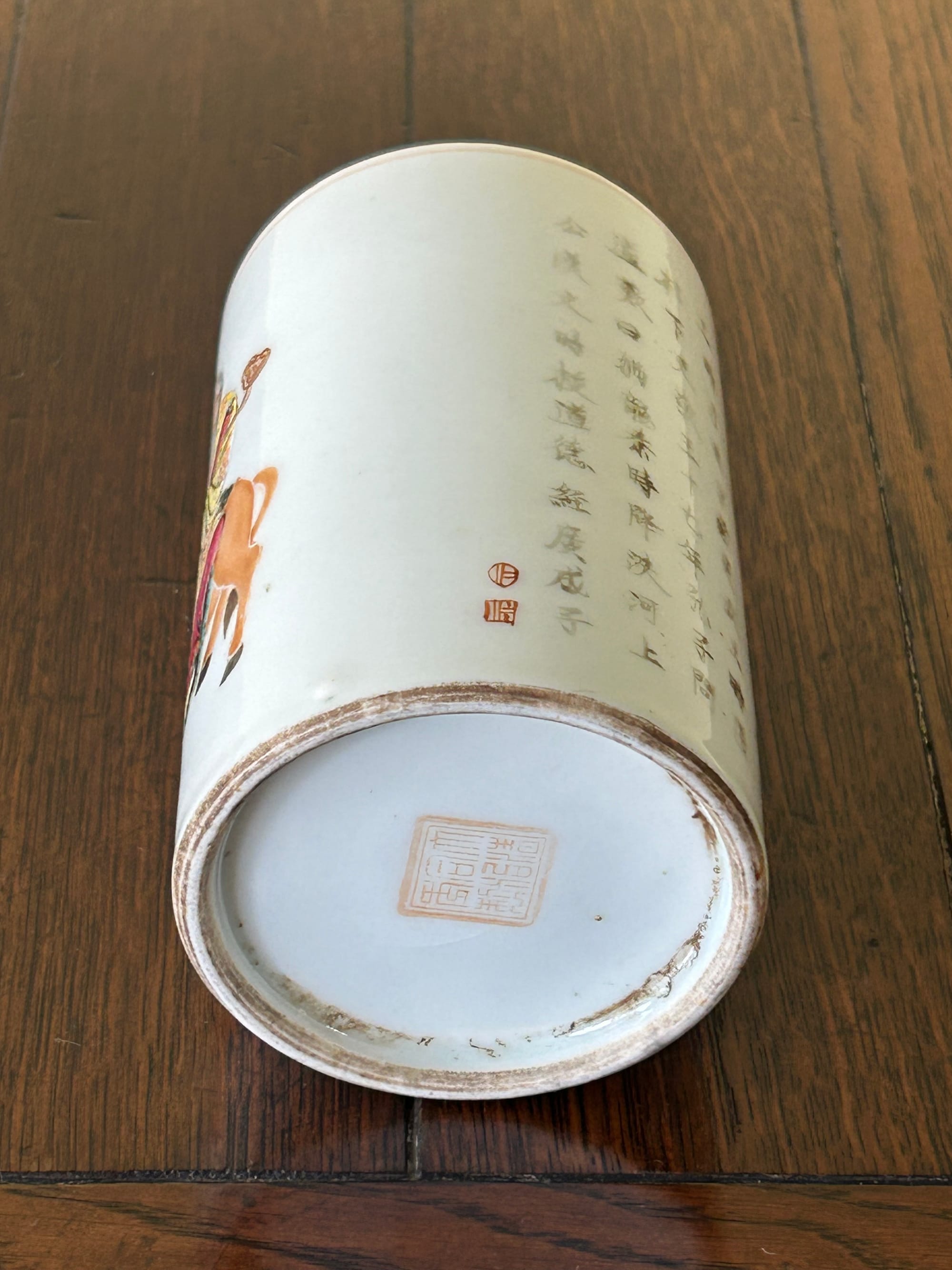
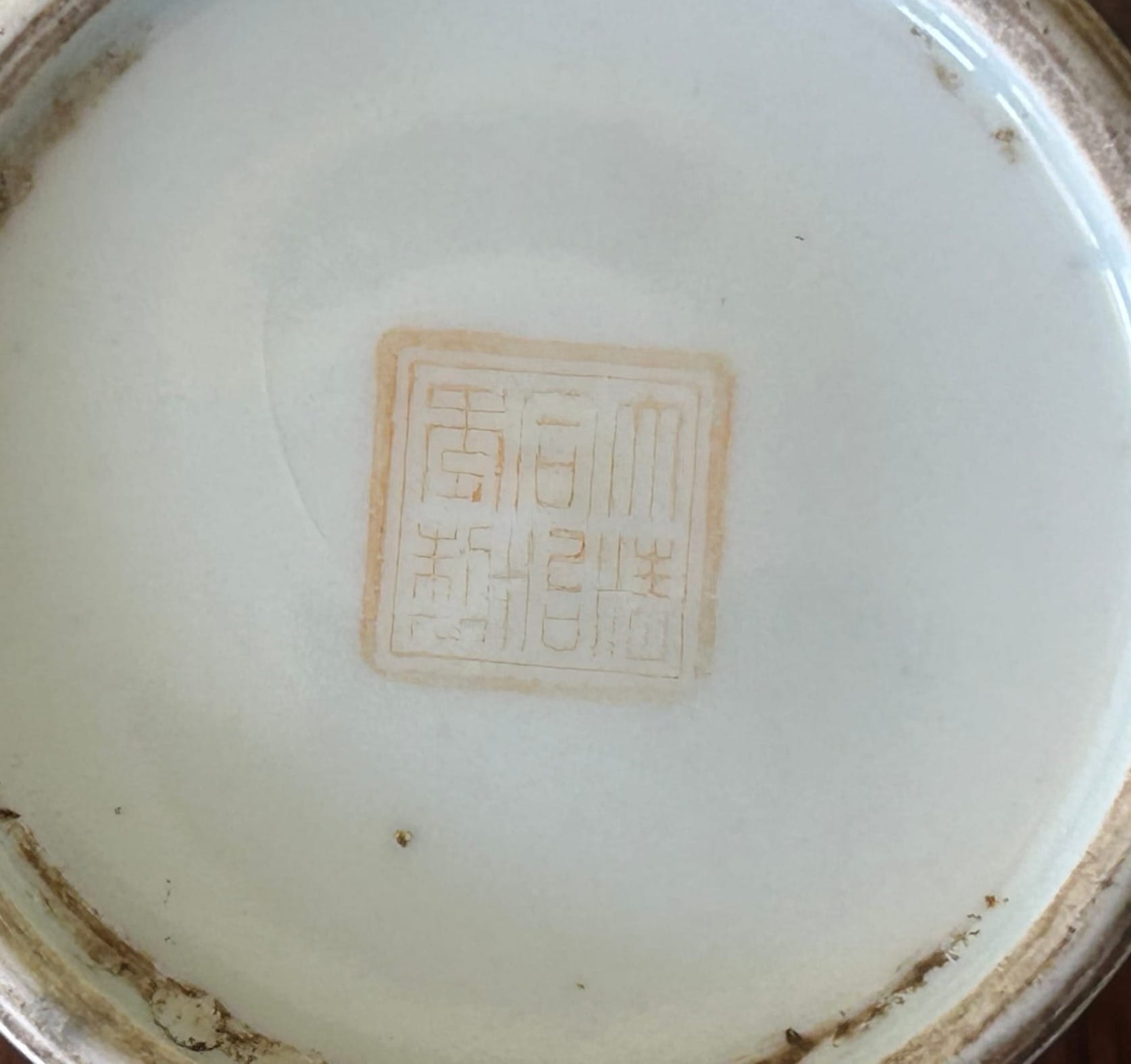
On the base is a six-character iron-red seal mark:
大清同治年製
Da Qing Tongzhi Nian Zhi — “Made during the Tongzhi reign of the Great Qing.”
The Tongzhi Emperor reigned from 1862 to 1874.
That immediately presents the obvious problem.
A Tongzhi mark does not make an object Tongzhi. Reign marks were copied, retained and revived, and the original auction house was perfectly entitled to regard the mark as apocryphal and catalogue the object conservatively as twentieth century.
So the question I wanted to answer was not simply, what does the mark say?
It was:Does the rest of the object agree with it?
And, after spending considerable time examining the brushpot in natural light, under magnification, in raking light and under 365 nm ultraviolet light, I increasingly think that it does.
Laozi and the ox
The decoration appears to represent Laozi riding an ox, one of the enduring images associated with the legendary Daoist philosopher.
According to the later tradition, Laozi departed westward from the declining Zhou realm and was persuaded by the keeper of the frontier pass, Yin Xi, to commit his teachings to writing before disappearing into the west.
The ox became one of the philosopher's familiar attributes.
This is not merely a convenient identification based on the present brushpot. There are excellent museum references for the subject.
The Art Museum of the Chinese University of Hong Kong holds a late-Ming porcelain dish decorated in overglaze enamels with Laozi mounted on a buffalo. The museum notes that the buffalo became an established icon associated with Laozi and that the motif could also carry associations with longevity.
The Metropolitan Museum of Art provides another superb reference: a late-Ming bronze by Xue Mingyang showing Laozi riding an ox, dated either 1569 or 1629.
The Metropolitan Museum of Art — Xue Mingyang, Laozi riding an ox
The subject on my brushpot therefore belongs to a well-established Chinese iconographic tradition. More importantly, it is entirely appropriate decoration for a bitong — an object belonging historically to the scholar's table.
Looking at the painting
The decoration does not pretend to imperial refinement.
Indeed, part of its attraction for me is precisely the opposite.
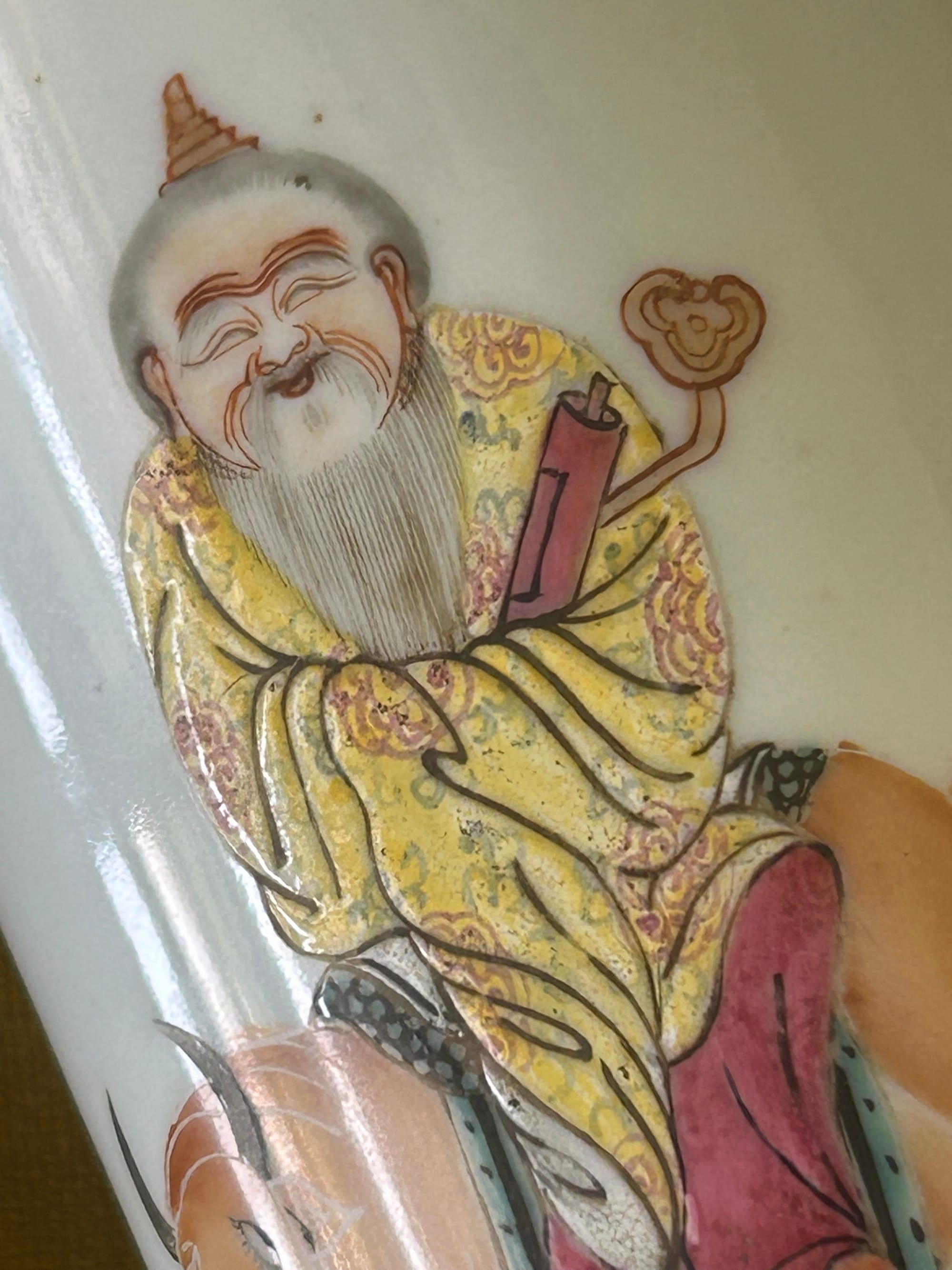
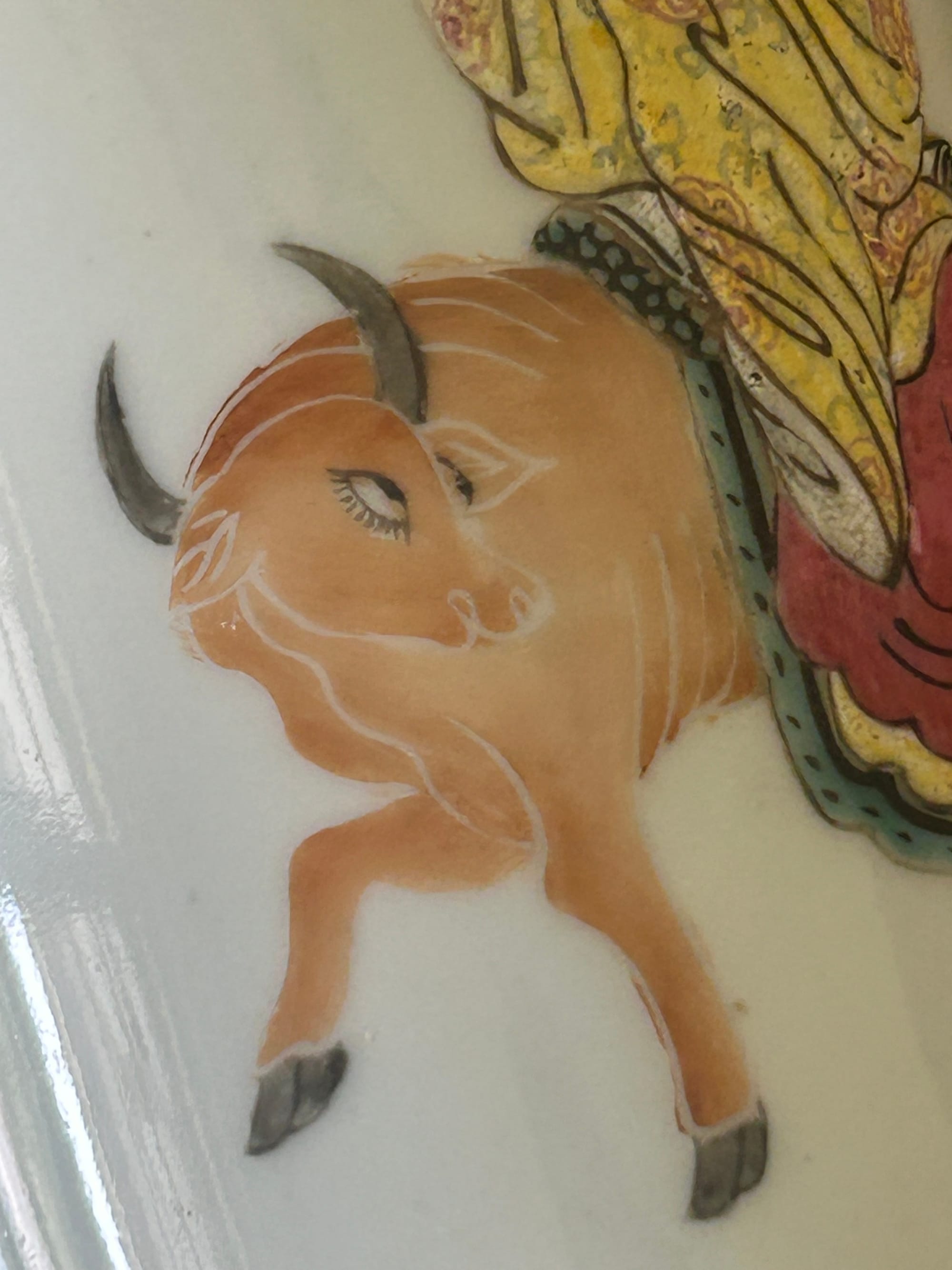
The elderly figure is lively and slightly naïve. His face and beard are drawn economically in fine grey and reddish lines. He wears a yellow robe decorated with small floral motifs over stronger maroon clothing. The saddle cloth introduces turquoise, while the ox itself is rendered predominantly in a thin orange-brown wash.
What initially interested me was how differently these colours behaved.
The yellow, maroon and dark outlining appear relatively substantial and opaque.
The body of the ox does not.
That difference became considerably more apparent under magnification.
The yellow enamel
Under approximately 20–40× magnification the yellow is not a perfectly uniform modern-looking field of colour.
It is granular and somewhat blotchy.
There are stronger yellow passages and other areas that become much paler, almost approaching white. Numerous minute dark inclusions are visible within the yellow and also within some of the reddish decoration.
More interestingly, at a number of boundaries between the yellow enamel and the white porcelain glaze there is a minute pale margin.
The enamel appears to have pulled slightly back from its boundary during firing.
In one or two areas I can also see extremely fine fissures — almost minute crazing — within the thicker enamel.
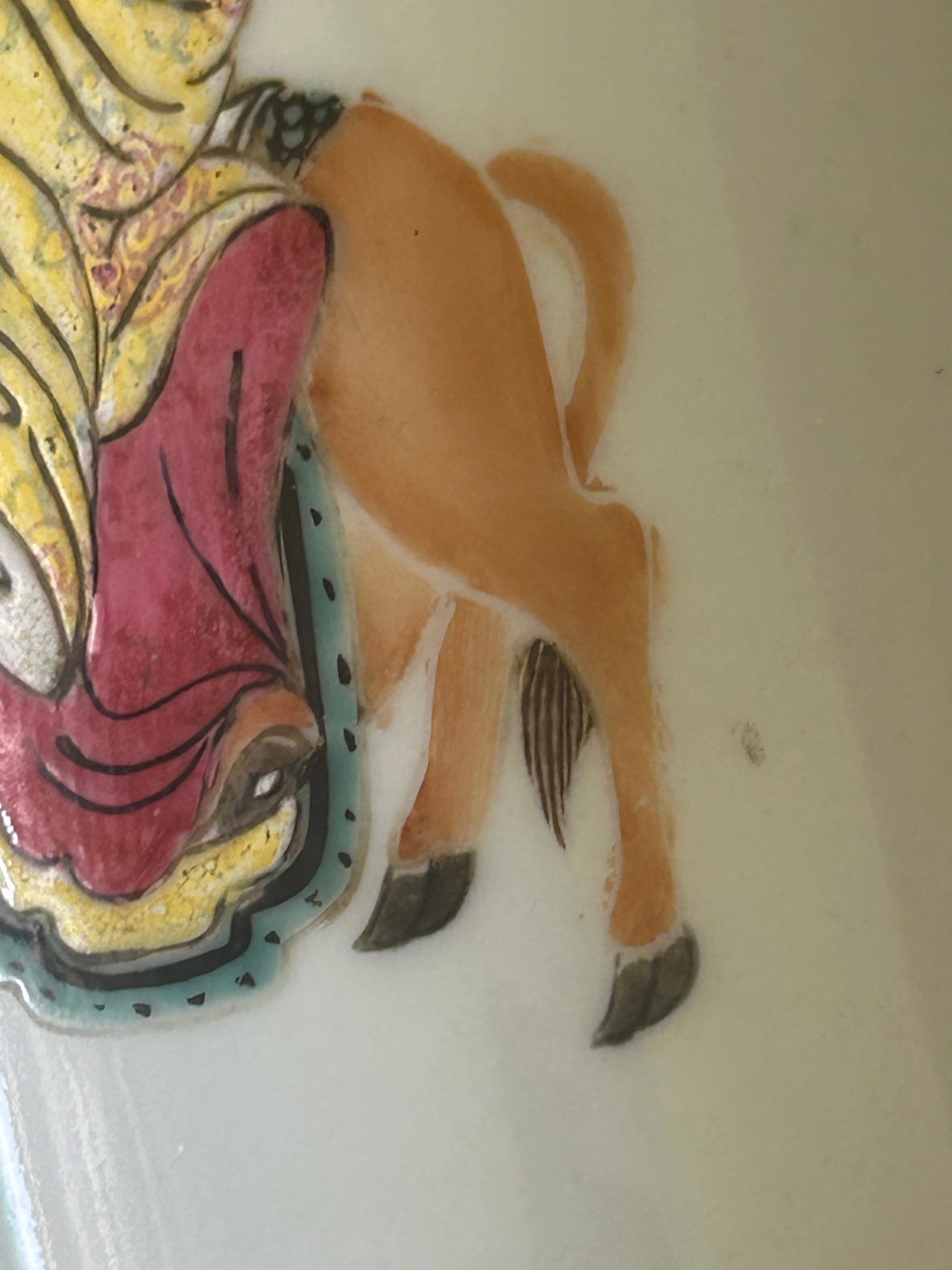
The same broad characteristics occur in the maroon-red passages.
Under raking light the yellow and maroon decoration is unmistakably raised above the underlying glaze. It can even be detected very gently by touch.
The ox behaves differently
The orange-brown colouring of the ox is quite different.
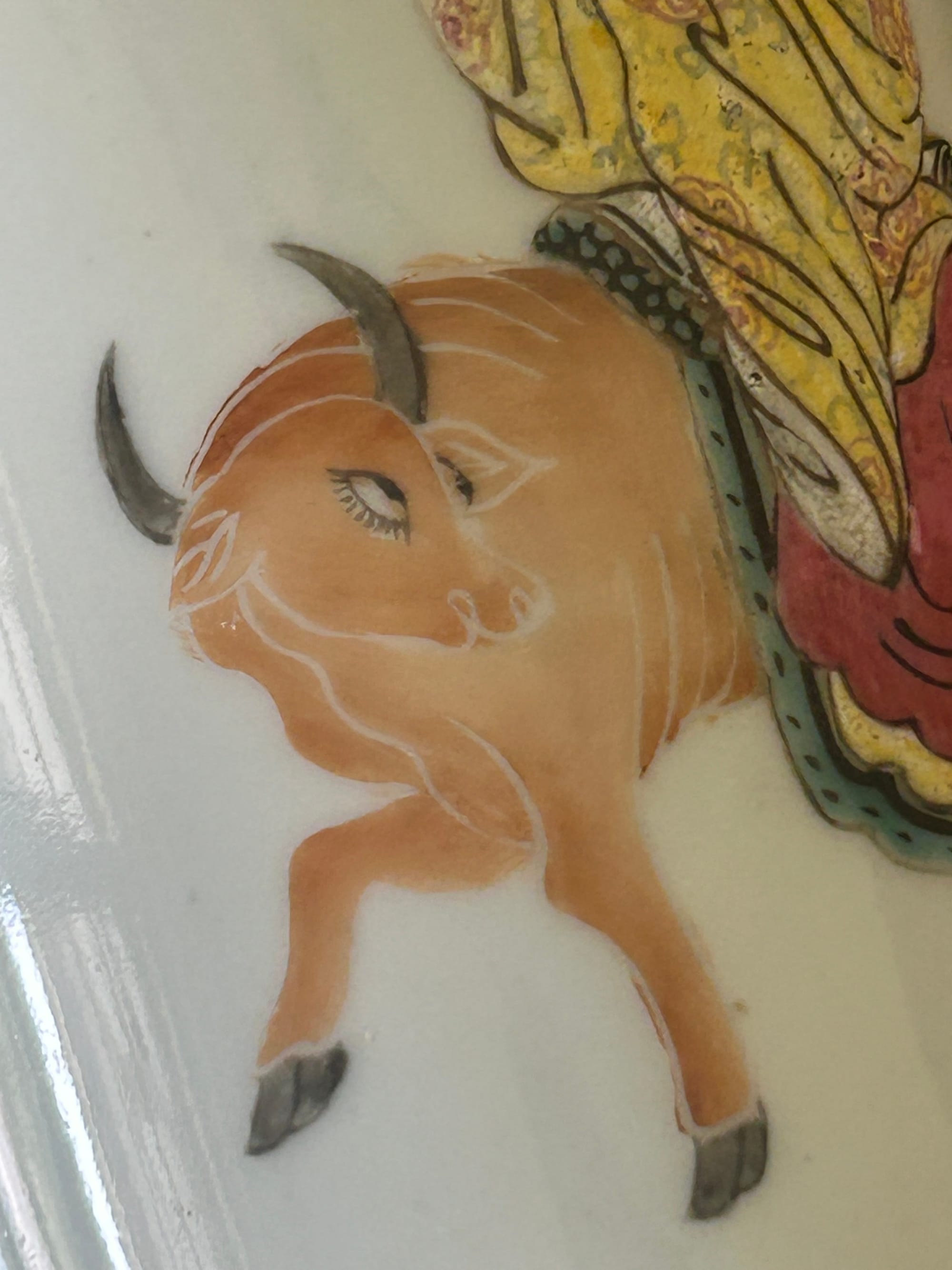
It is thin, translucent and essentially smooth with the underlying surface.
This is significant, although again it should not be exaggerated.
What I am seeing is not one uniform decorative material applied mechanically across the vessel. Different parts of the image have been produced using different concentrations and applications of overglaze colour.
The robe is constructed from relatively substantial enamel.
The animal is largely constructed through wash.
The physical behaviour corresponds to the painting technique.
That is exactly the sort of internal coherence I want to find when examining an old piece of porcelain.
What the enamels can — and cannot — tell us
It would be tempting to say that granular enamel, minute contraction and raised colour prove nineteenth-century manufacture.
They do not.
Overglaze enamels contract during firing regardless of whether that firing occurred in 1870 or considerably later. Pigment granularity is similarly useful evidence to record, but it is not a clock.
The significance lies in the combination.
Here we have differing enamel thicknesses corresponding logically to different painting techniques; irregular pigmentation; microscopic inclusions; local contraction at enamel boundaries; minute fissuring in thicker passages; and hand-painted lines displaying changes in density and width.
Nothing about that requires a modern explanation.
The question then becomes whether the other evidence points in the same direction.
Examination under 365 nm UV
I examined the brushpot thoroughly using a 365 nm ultraviolet lamp.
The yellow, maroon, turquoise and reddish enamels remain essentially inert.
So does the dark calligraphy.
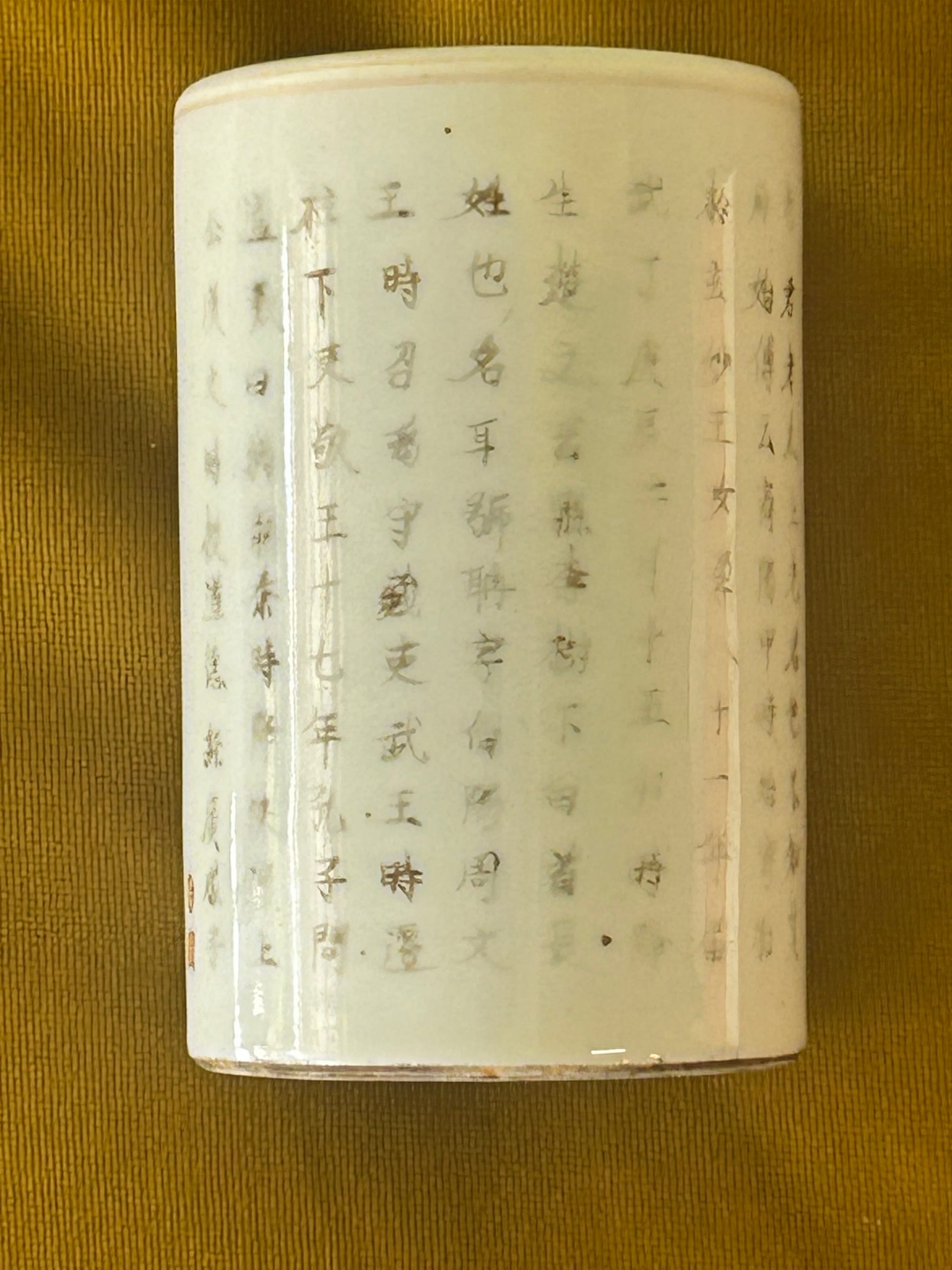
There are no conspicuous isolated fluorescent passages and nothing that immediately indicates a later restored section, organic coating or obviously different campaign of decoration.
Again, caution is necessary.
Non-fluorescence is not proof of nineteenth-century enamel.
Many inorganic pigments, old and new, are relatively inert under long-wave UV. What the test can sometimes reveal very effectively is difference: restoration materials, coatings, adhesives or retouched areas may respond differently from their surroundings.
I found no such obvious anomaly here.
So UV examination does not date the brushpot. It simply gives us another result that does not contradict the late-Qing hypothesis.
Brushwork
The close photographs are particularly useful here.
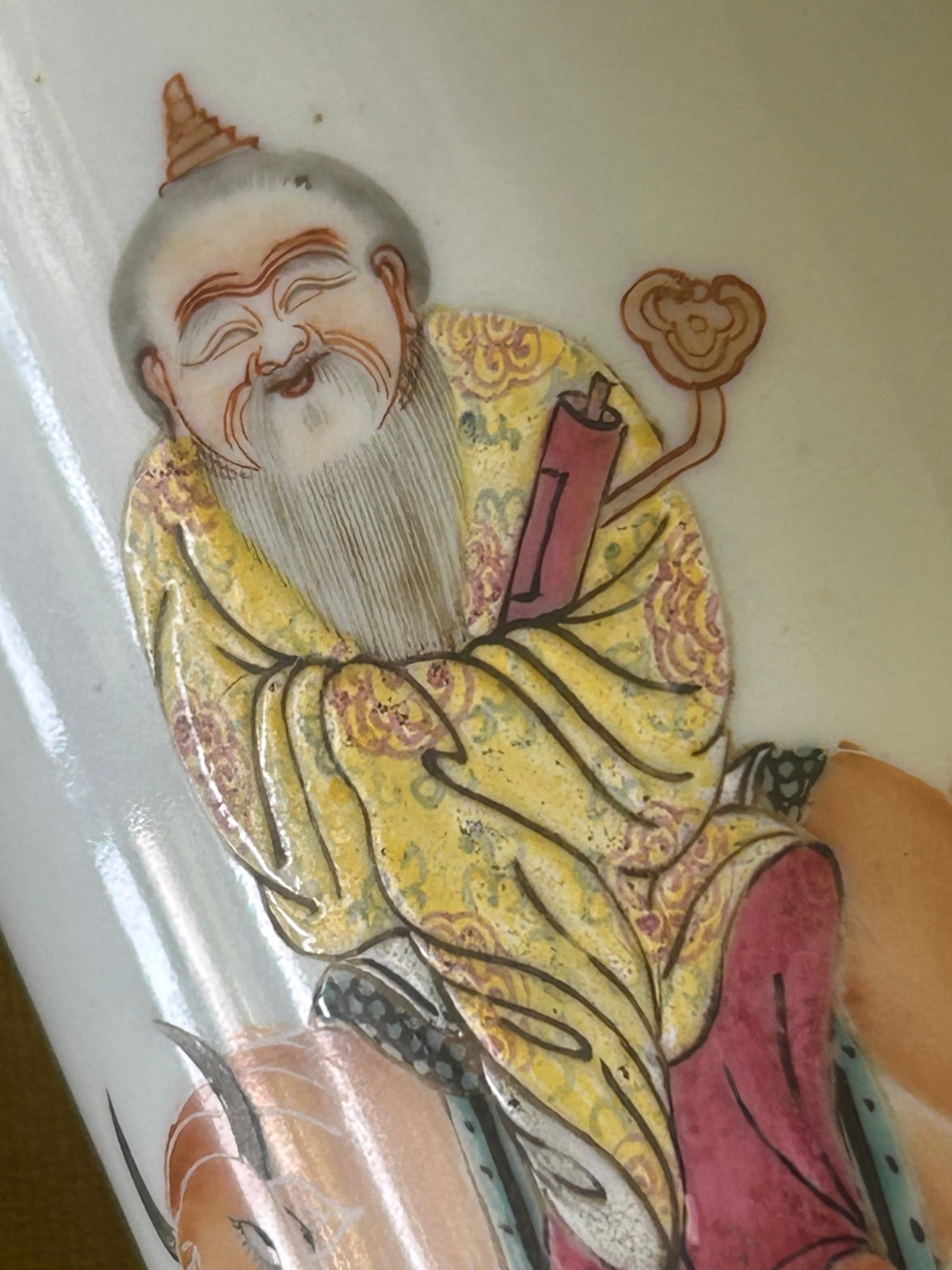
The beard consists of individually applied grey strokes. The facial lines vary naturally in width and density. The outlines of the clothing are not mechanically uniform. Pigment accumulates slightly in places where the brush has slowed or terminated.
The ox shows overlapping washes rather than a flat block of colour.
The dark band beneath the robe is raised, whereas the thin body colour of the animal is not.
The decoration therefore makes sense not only pictorially but physically.
It has been constructed by a painter using different materials and techniques for different purposes.
The calligraphy
The inscription deserves separate attention.
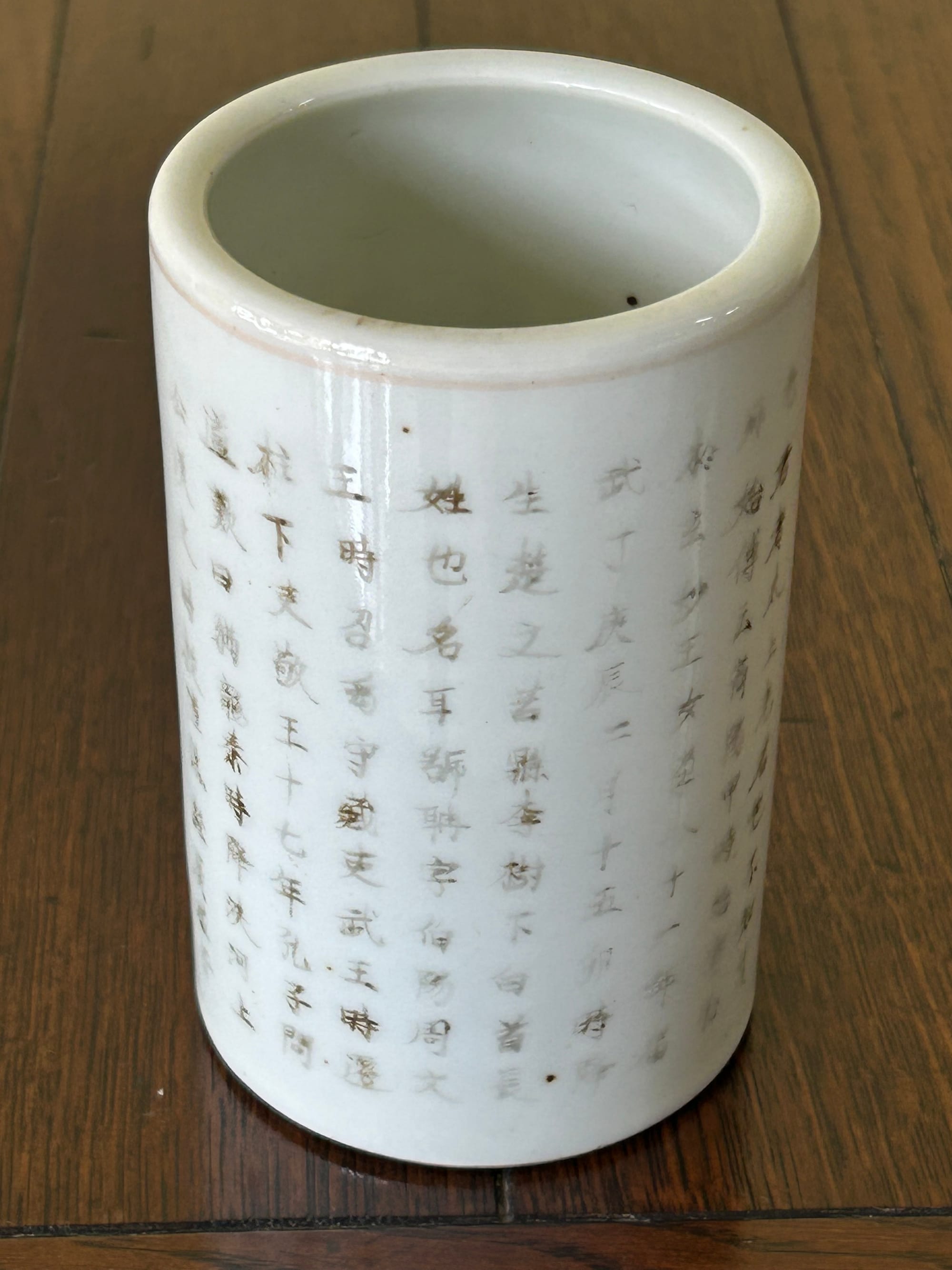
It is hand executed, with irregular but natural spacing between characters and variations in stroke density. I can see no evidence of transfer printing.
Beside it are two small iron-red seals, one more rounded and one approximately square.
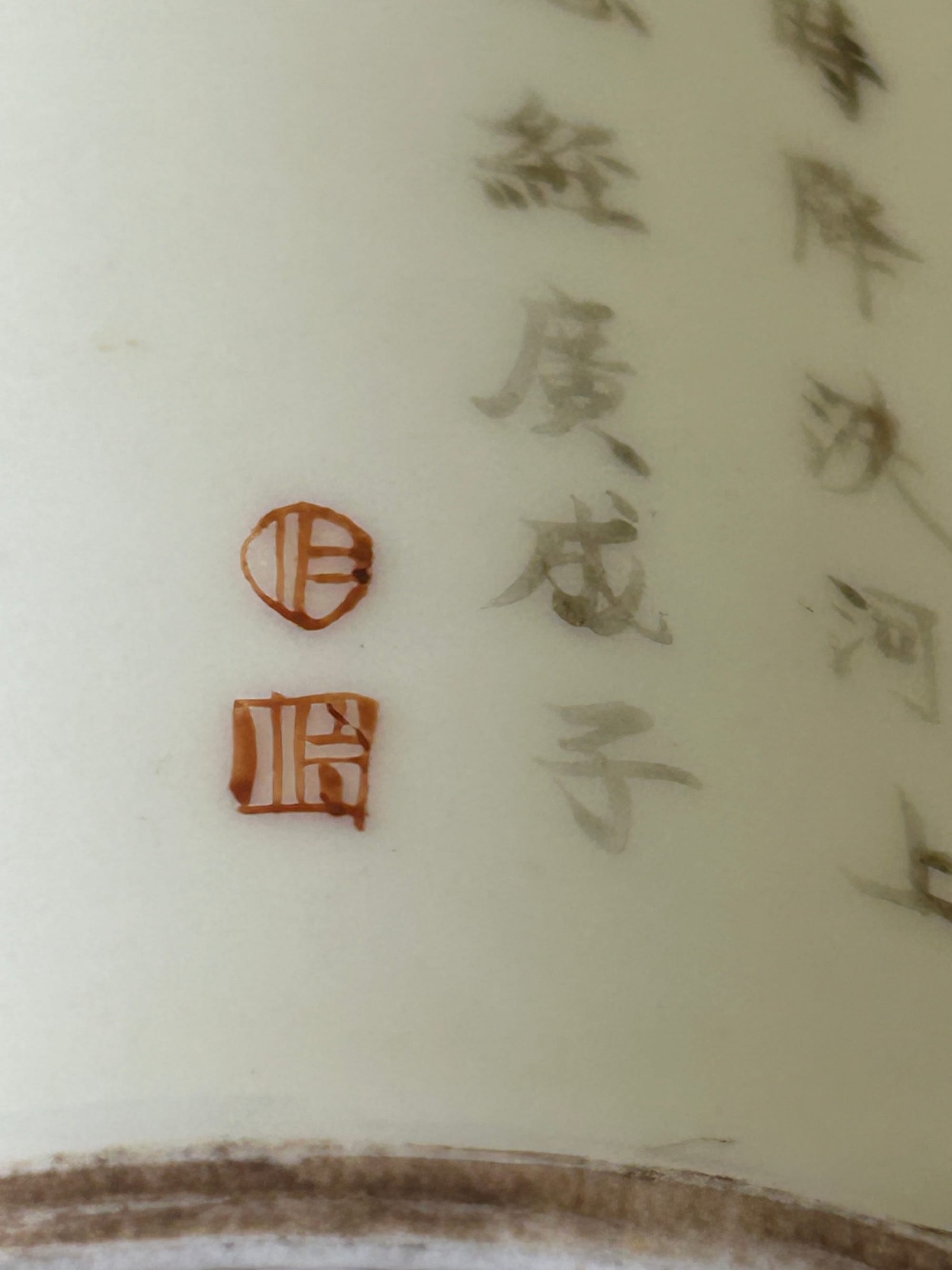
These are not reign marks. They belong to the inscription and pictorial composition in the manner of artist, studio or leisure seals.
I have deliberately not attempted to identify an individual hand from photographs alone. That would take the attribution beyond the evidence presently available.
But the calligraphy, seals and painted scene form a coherent decorative programme rather than appearing to be unrelated elements assembled to manufacture an impression of age.
The foot and the Tongzhi mark
The underside is one of the most useful parts of the examination.
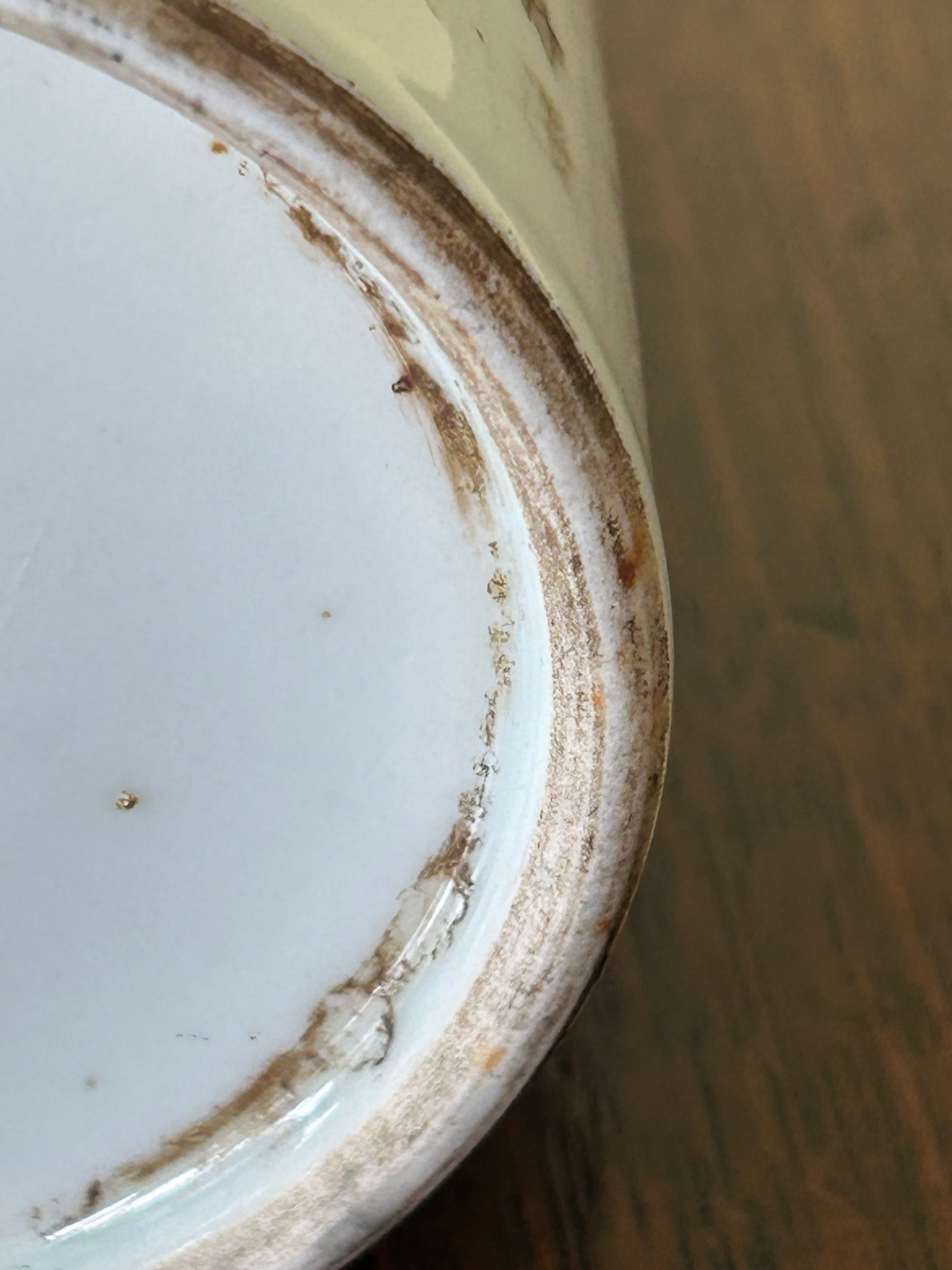
The foot is individually trimmed and slightly irregular rather than clinically uniform. The exposed porcelain is warm white, with variations in colour and small areas of brownish discoloration. There are small particles and firing irregularities around the foot, while the glaze within the recessed base varies subtly in thickness.
At its centre is the six-character Tongzhi seal mark in iron red.
大清同治年製
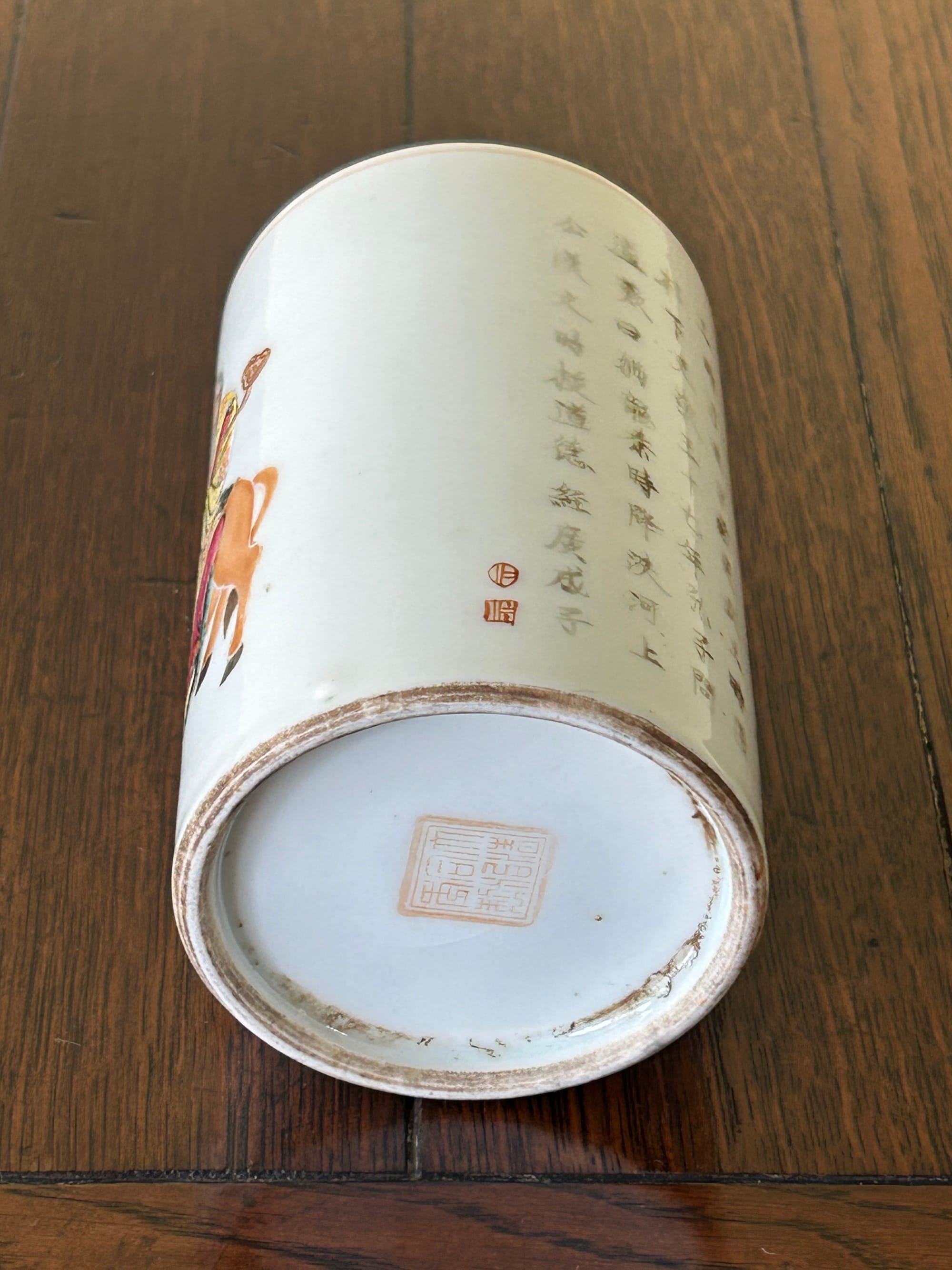
The mark itself is convincing in character, but I would never authenticate the brushpot from the mark alone.
Marks can be copied.
Foot wear can be created.
Brown staining can be introduced artificially.
The more useful question is whether the mark, foot, porcelain body, glaze and decoration appear to belong to the same object and the same manufacturing tradition.
On this brushpot, I believe they do.
Comparing it with accepted Tongzhi brushpots
This is where the argument becomes more useful, because there are securely catalogued Tongzhi-period brushpots against which we can test the proposition.
Christie's — Tongzhi mark and period brushpot
Christie's has published a cylindrical brushpot catalogued explicitly as:
“Tongzhi six-character seal mark and of the period (1862–1874).”
It measures 12.7 cm high — remarkably close to the 12 cm height of the present example.
Even more importantly, its inscription contains a date corresponding to 1864, firmly within the Tongzhi reign.
Its decoration is quite different — a relief riverscape rather than famille-rose figures — and I am not presenting it as a decorative twin. Its importance is that it establishes the cylindrical scholar's brushpot, the six-character Tongzhi seal mark and this small scale within securely attributed Tongzhi production.
Roseberys — famille-rose brushpot, 12 cm high
An even closer comparison in technique was sold by Roseberys London on 11 November 2020, Lot 261.
Roseberys catalogued it:
“A Chinese porcelain brush pot, Tongzhi mark and period, painted in famille rose enamels...”
It is decorated with birds, chrysanthemums and peonies rather than a Daoist figure, and bears a four-character iron-red seal mark.
But its height is 12 cm — exactly the height of my brushpot.
It realised £494 including buyer's premium, against an estimate of £200–300.
Roseberys London — Lot 261, famille-rose brushpot, Tongzhi mark and period
This is particularly useful because it demonstrates that genuine Tongzhi-period famille-rose brushpots of modest scale and relatively modest commercial value exist. We should not expect every reign-period object to possess imperial quality or an imperial price.
Galerie Zacke — a dated 1873 Tongzhi brushpot
Galerie Zacke sold another particularly useful example in Vienna on 30 June 2022, Lot 781.
It is a cylindrical bitong, 10.6 cm high, decorated with the god of literature Kui Xing and bearing a Tongzhi reign mark. Crucially, the inscription dates it to the twelfth year of Tongzhi — 1873.
It sold for €506 including buyer's premium.
Once again the decorative technique differs from my example, but the object belongs to exactly the same broad world: a small cylindrical porcelain scholar's brushpot, figural decoration, inscription and Tongzhi dating.
Galerie Zacke — Lot 781, Kui Xing brushpot, Tongzhi mark and period, dated 1873
Looking beyond brushpots: securely attributed Tongzhi enamels
Christie's also provides useful reference material for the enamels and iron-red reign marks of the period.
A yellow-ground bowl bearing a four-character iron-red Tongzhi mark is catalogued “and of the period (1862–1874)”. Christie's identifies it as part of the celebrated group of porcelain associated with the wedding of the Tongzhi Emperor.
Christie's — Iron-red-decorated yellow-ground xi-character bowl, Tongzhi mark and period
Another Christie's example, also bearing an iron-red Tongzhi mark and catalogued as of the period, uses iron-red bats against a bright yellow ground.
Christie's — Iron-red-decorated yellow-ground bowl, Tongzhi mark and of the period
A pair of famille-rose bird-and-flower bowls bearing six-character iron-red Tongzhi marks and catalogued as of the period provides another useful reference for reign-period famille-rose decoration.
These are finer wares than my brushpot and should not be treated as direct quality comparisons. They are useful instead for establishing the legitimate palette, overglaze techniques and iron-red marking traditions operating during the reign.
An interesting warning from a later brushpot
There is also value in looking at objects that specialists do not accept as reign-period pieces.
Roseberys offered a 12.3 cm famille-verte dragon brushpot in 2023 carrying an apocryphal Shunzhi mark. They catalogued it as late Qing dynasty/Republic period, rather than accepting the reign mark at face value.
It remained unsold against an estimate of £500–800.
Roseberys — Late Qing/Republic dragon brushpot with apocryphal Shunzhi mark
I include this because it demonstrates precisely why the mark on my brushpot cannot settle the question. Auction specialists routinely distinguish between a reign mark and the period in which they believe the porcelain itself was manufactured.
That is exactly the distinction being investigated here.
So what do I think it is?
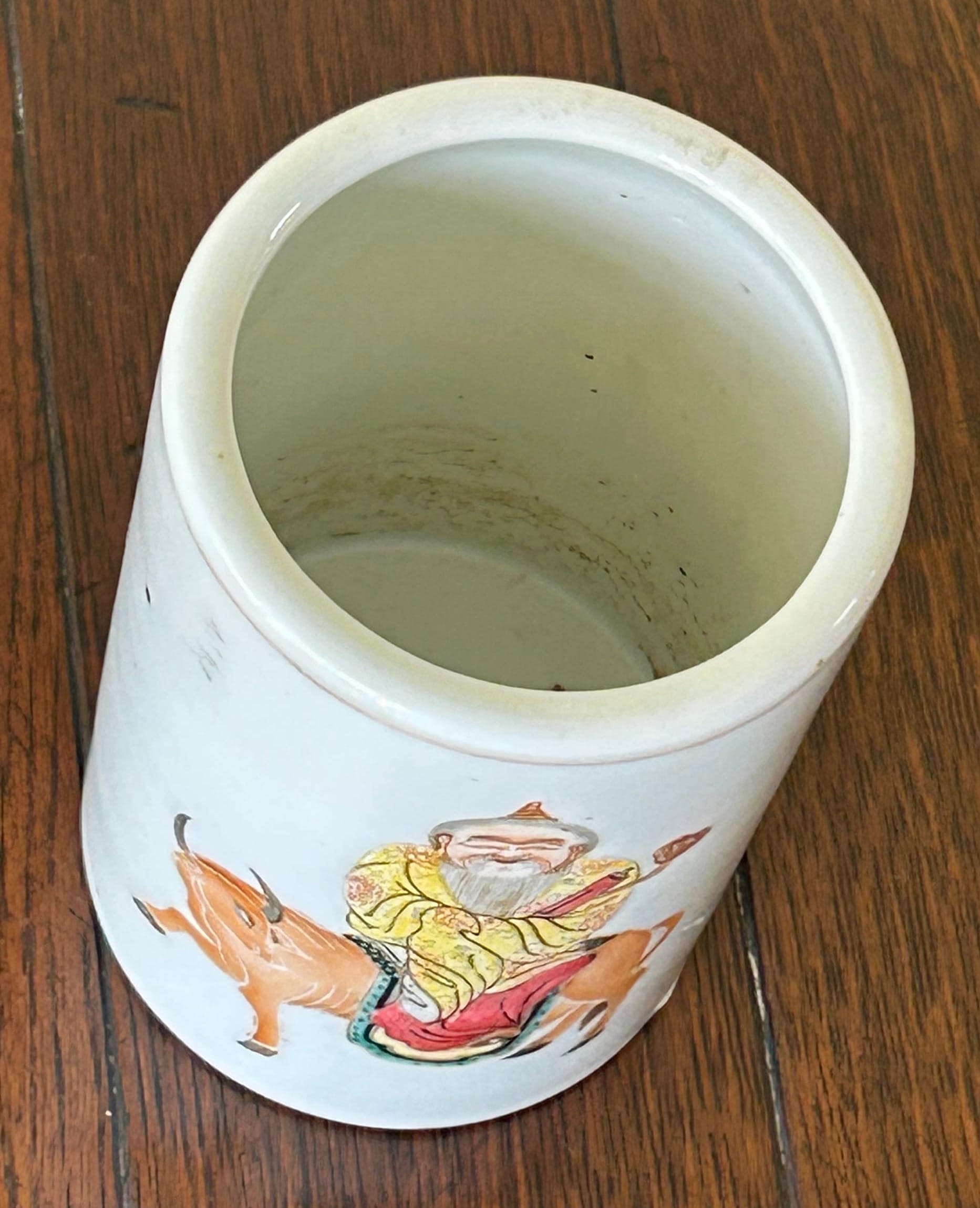
After examining the brushpot closely, I find the original twentieth-century attribution increasingly difficult to reconcile with the object.
The case for an earlier date is cumulative rather than dependent upon one supposedly decisive clue:
- a correct six-character Tongzhi seal mark in iron red;
- an appropriate scholar's-object form;
- a traditional Laozi-and-ox subject with a long history in Chinese art;
- genuinely hand-executed figural painting;
- hand-written calligraphy and associated seals;
- different enamel applications behaving differently according to technique;
- granular and locally contracted thicker enamels;
- very fine fissuring within some enamel passages;
- a thin iron-based wash on the ox behaving quite differently from the raised robe enamels;
- no obvious anomalous restoration or later decoration under 365 nm UV;
- foot, body, glaze and decoration that appear materially coherent;
- and securely attributed Tongzhi brushpots of almost exactly the same scale preserved in the published auction record.
None of those observations alone proves 1862–1874.
Together, however, I believe they make Tongzhi-period manufacture the most economical explanation of the evidence presently available.
My attribution
I would therefore now catalogue the piece as:
Chinese famille-rose porcelain brushpot (bitong), decorated with Laozi riding an ox, calligraphy and iron-red seals; six-character Tongzhi seal mark in iron red; likely Tongzhi period (1862–1874).
If I wanted to introduce one additional degree of caution:
Tongzhi mark, late Qing dynasty, probably of the period.
A very early Guangxu date remains a credible alternative and should not simply be wished away.
A twentieth-century date remains possible.
But, having examined the object rather than merely its mark, I now regard the latter as the substantially less convincing explanation.
That is quite different from saying the matter is closed.
Why publish the uncertainty?
This is increasingly the point of these investigations for me.
I am not particularly interested in another internet post saying:
This is Ming.
This is Qing.
This is nineteenth century.
Those statements are easy.
The interesting part is showing why.
What does the body tell us?
What does the foot tell us?
How were the colours applied?
What happens when they are magnified?
Does UV examination reveal anything inconsistent?
Does the subject belong to the proposed period's artistic vocabulary?
Can we find securely attributed objects against which to compare it?
And, perhaps most importantly, what evidence would make us change our minds?
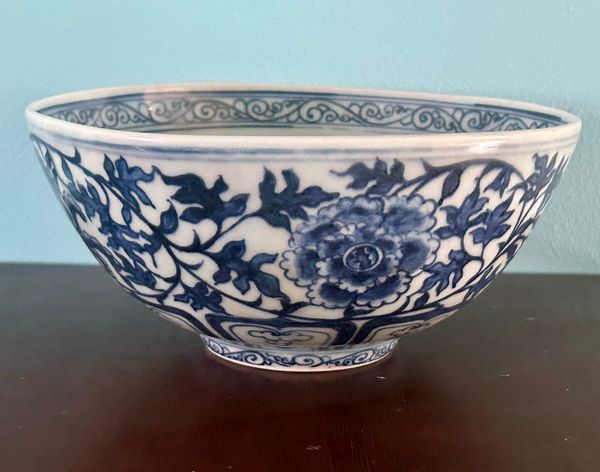
That was also the approach I took recently with the Hongzhi bowl. The object should be allowed to argue with our expectations — including the expectations created by an auction catalogue.
This little brushpot was sold to me for 1,200 Thai baht as twentieth century.
Its price proves absolutely nothing about its age.
But that modest purchase has produced a surprisingly interesting investigation.
At present, the evidence leads me back to the six characters painted beneath it:
大清同治年製
Perhaps, on this occasion, they actually mean what they say.
I remain entirely open to evidence that they do not.
References and comparative material
Christie's — Tongzhi mark-and-period brushpot, 12.7 cm, inscription dated 1864
https://onlineonly.christies.com/sso?from=siteindex&intobjectid=5964044&lid=1&objectid=10987.123&sc_lang=en
Roseberys London — Lot 261, 12 cm famille-rose brushpot, Tongzhi mark and period; realised £494
https://www.roseberys.co.uk/a0470-lot-494355
**Galerie Zacke — Lot 781, Tong
(c) Stephen Ford 2026.