The $250 Bowl: Testing a Possible Middle Ming Blue-and-White Attribution.
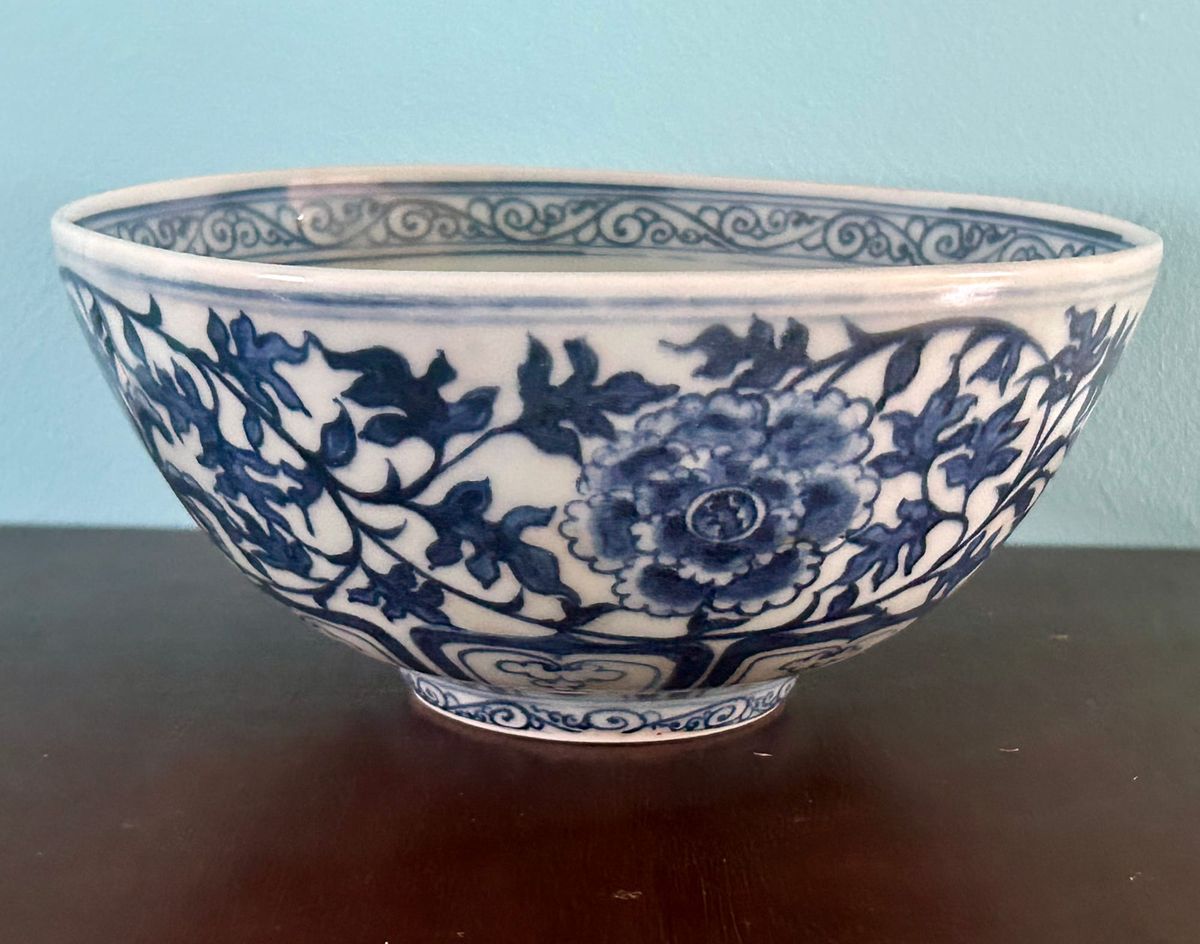
I bought this bowl for around US$250 from an older French collector who had lived in Thailand for many years.
I did not buy it believing I had discovered an important Ming bowl. His collection contained a considerable amount of nineteenth-century bleu de Huế, together with some clearly period, though damaged, Wanli kraak-style porcelain. This particular bowl simply felt sufficiently unusual to warrant investigation.
That distinction is important.
For US$250, I was quite happy for it eventually to prove to be late Qing or even a sophisticated modern reproduction. Either result would teach me something. What interested me was that, having handled Chinese and English porcelain for many years, the bowl did not feel quite comfortable as either.
It still does not.
The bowl
The measurements are:
Diameter: approximately 18.6–19.1 cm
Height: 8.5 cm
Foot diameter: 7 cm
Internal foot diameter: approximately 6.25 cm
Foot thickness: approximately 3.5 mm
Weight: 601 g
The variation in diameter is real. Viewed from above, the rim has approximately 5 mm of gradual oval distortion.
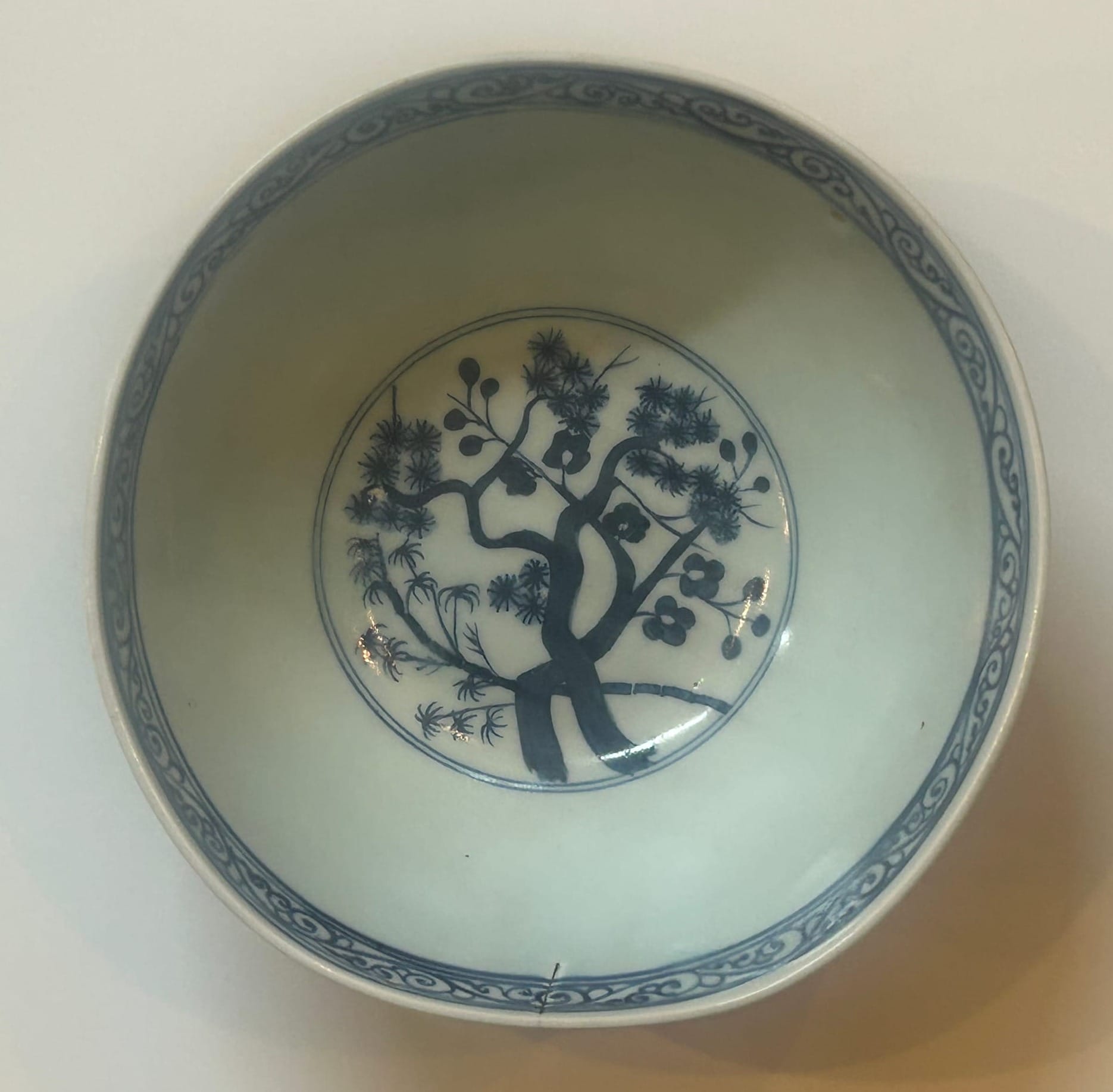
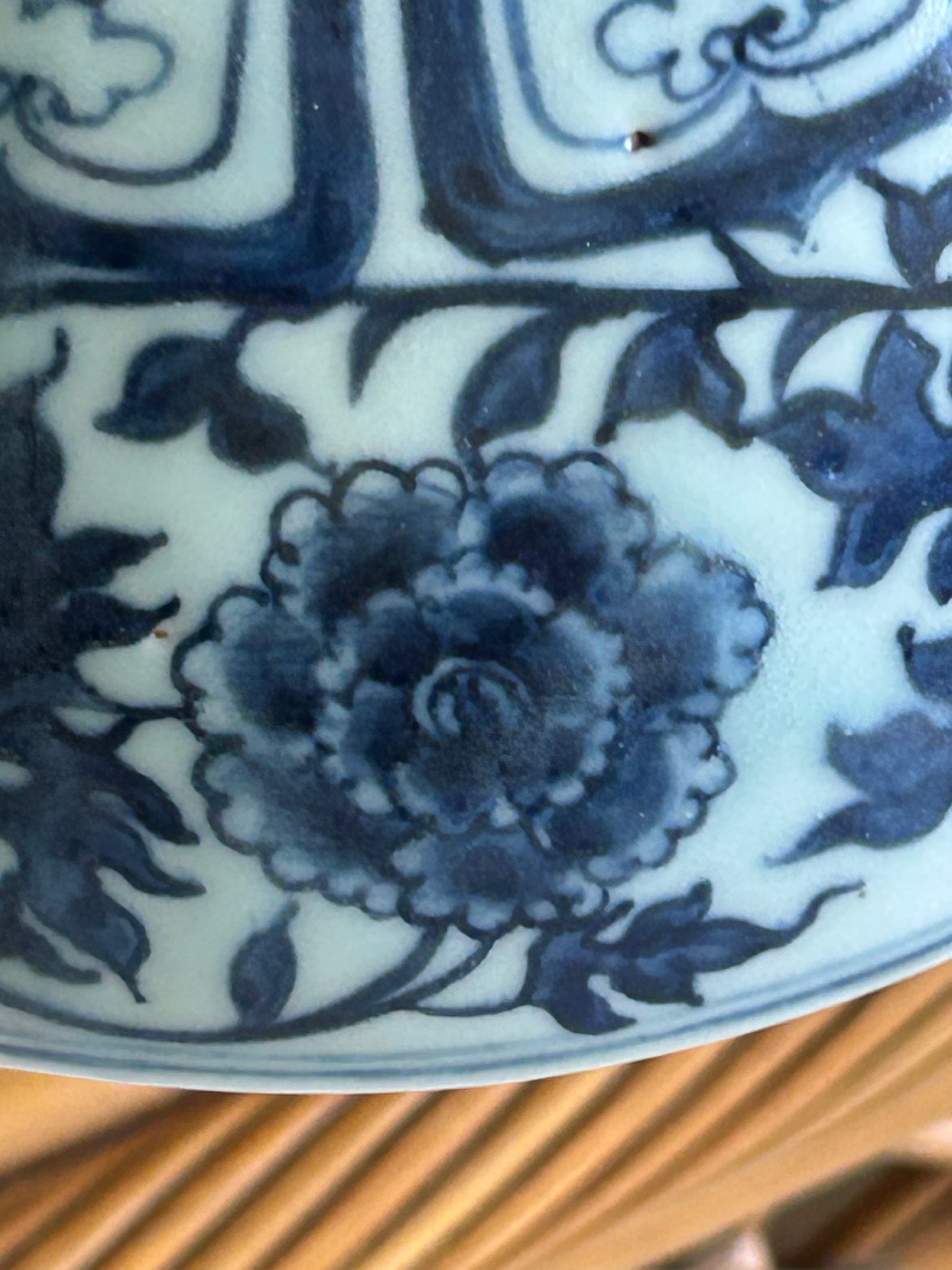
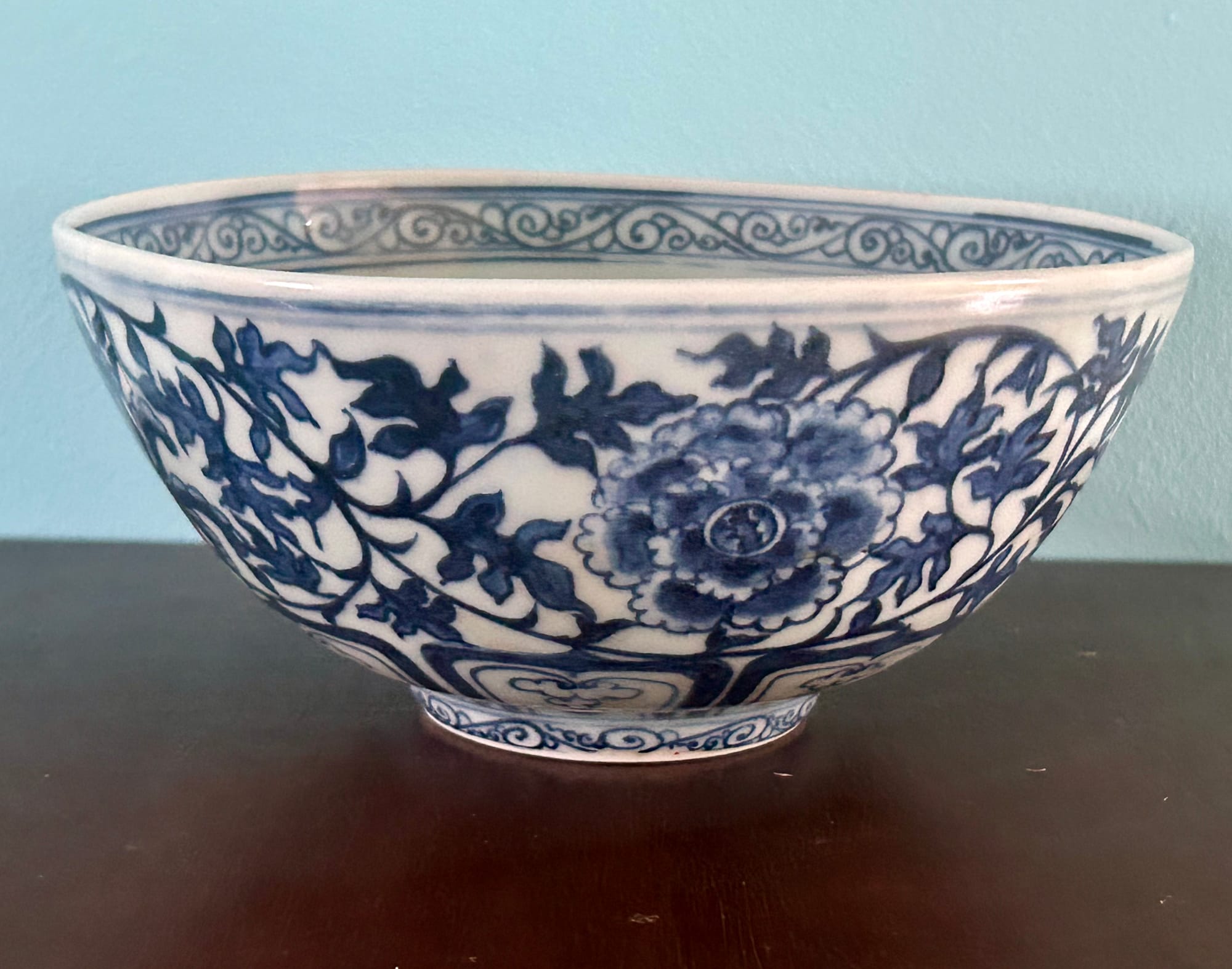
The exterior is painted in an unusually dark underglaze blue with scrolling flowers above a series of lappet-like panels containing ruyi heads. Inside is a central medallion which appears to represent the Three Friends of Winter — pine, bamboo and prunus — surrounded at the inner rim by a scrolling border.
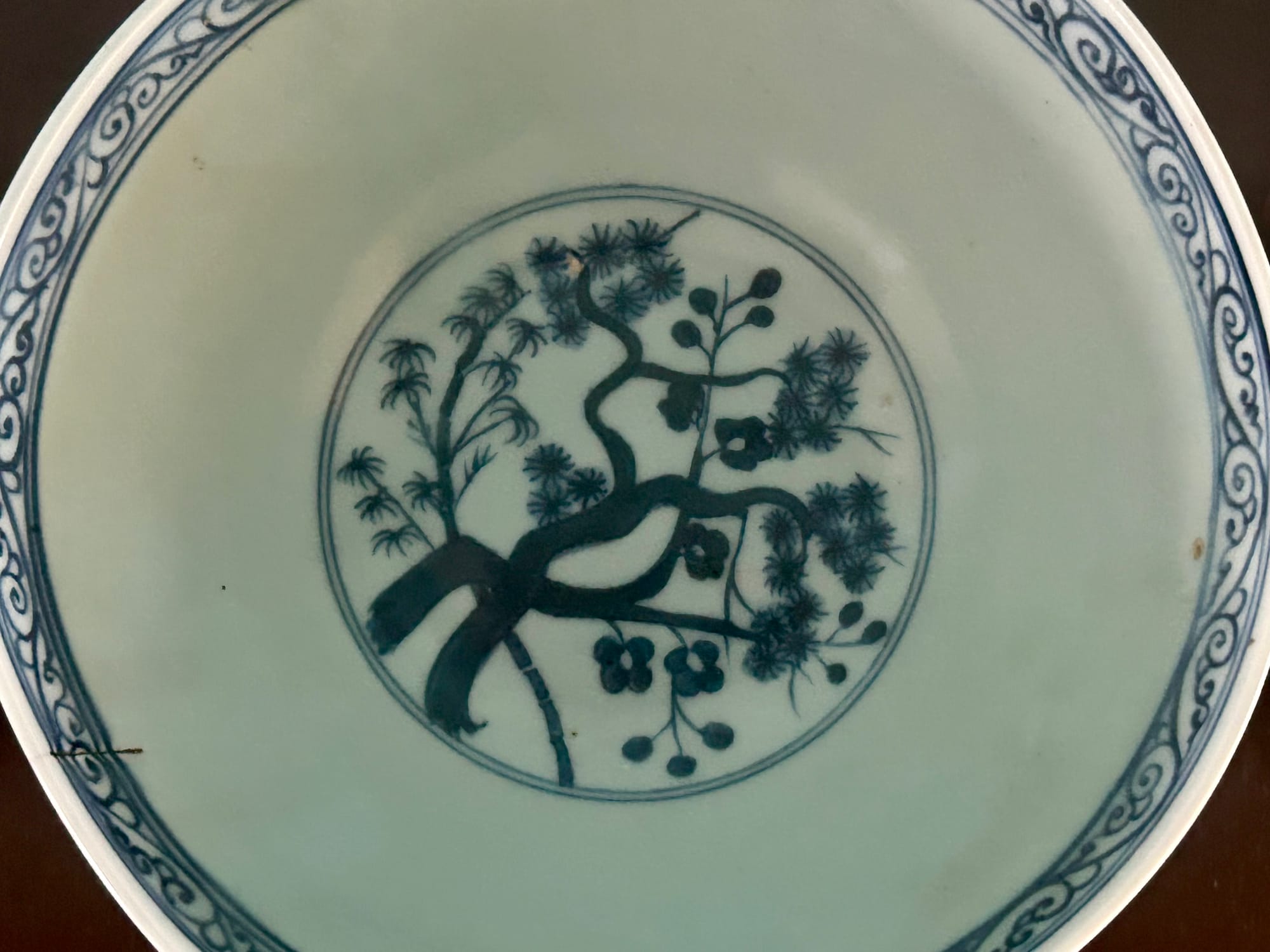
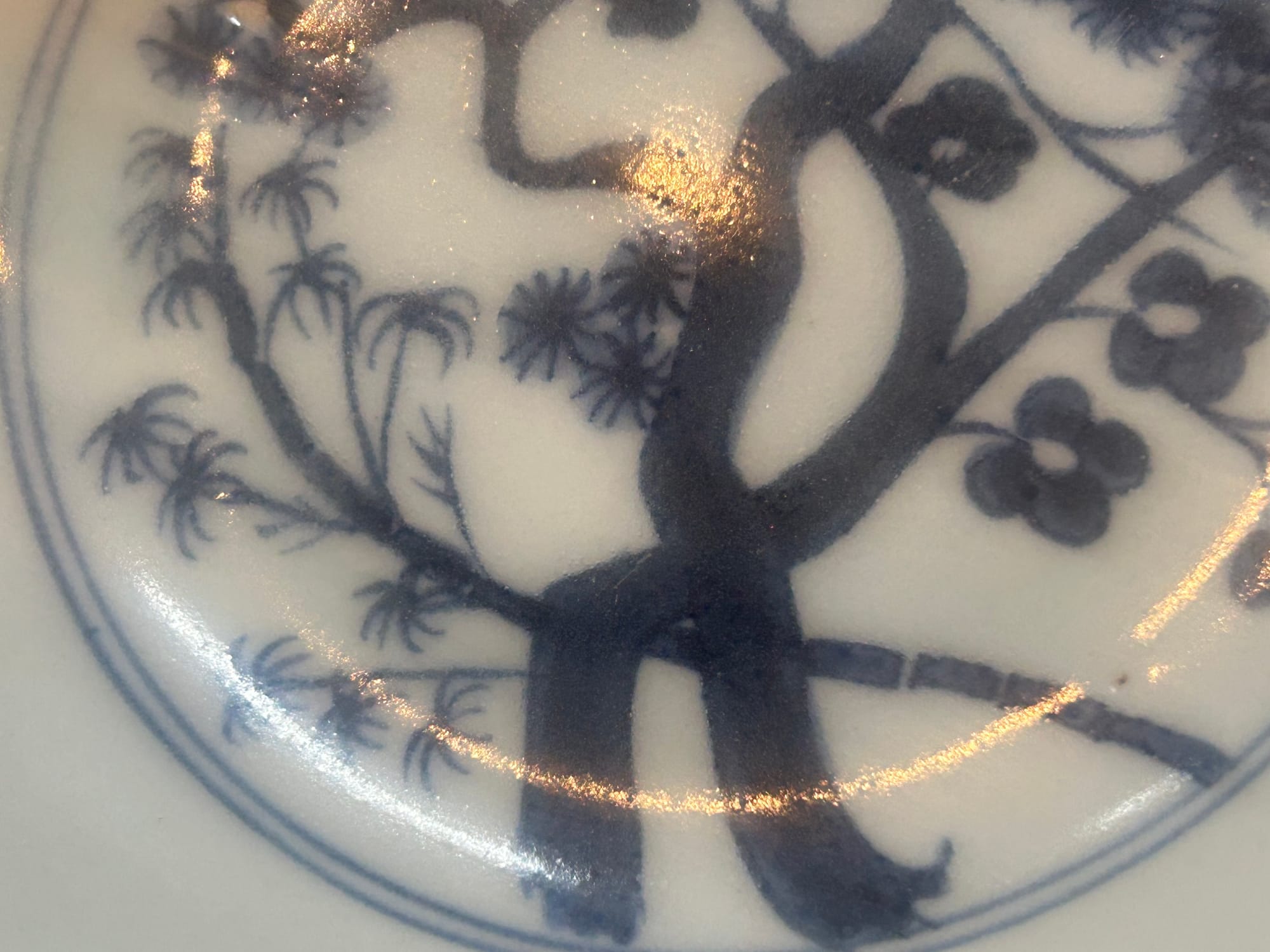
Some passages of cobalt are so heavily loaded that at first sight they appear almost black.
That was one of the reasons I hesitated.
The obvious alternative: late Qing or modern
Before trying to make the bowl early, I wanted to make it late.
Late Qing Jingdezhen potters were perfectly capable of producing sophisticated Ming revival porcelain. Decorative vocabulary alone proves very little. Lotus scrolls, ruyi heads and consciously archaistic forms all survived or were revived later.
The British Museum itself has a Qing dynasty Yongzheng bowl described explicitly as Ming-style, demonstrating how deliberately earlier Ming ceramic language could be recreated.
British Museum — Ming-style Qing bowl PDF C.649
So “the decoration looks Ming” is not enough.
The better question became:
Does the bowl behave like a late Qing or modern imitation when examined physically?
Increasingly, I found that it did not.
The foot
The foot was one of the first things that made me uncomfortable with a late Qing attribution.
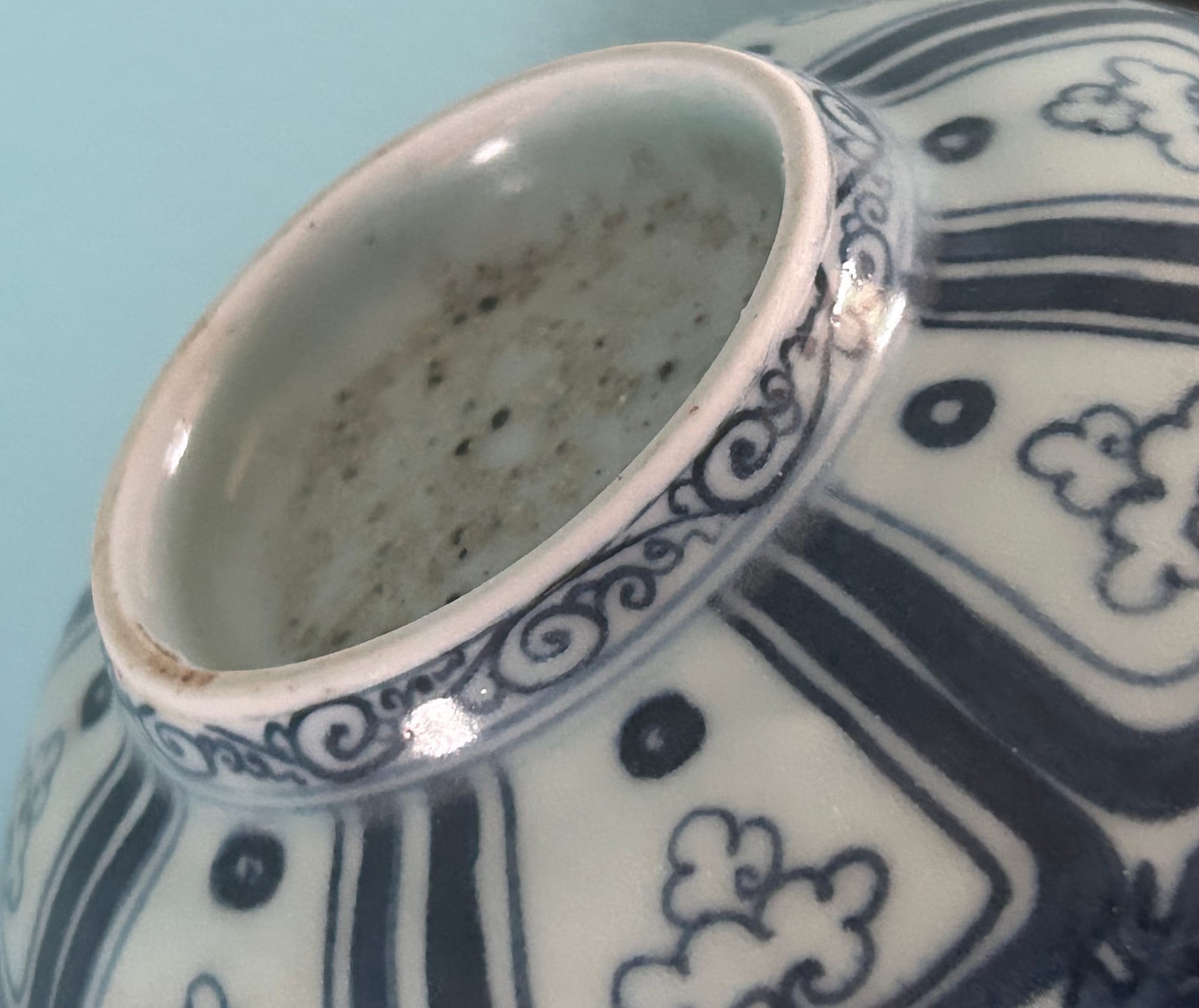
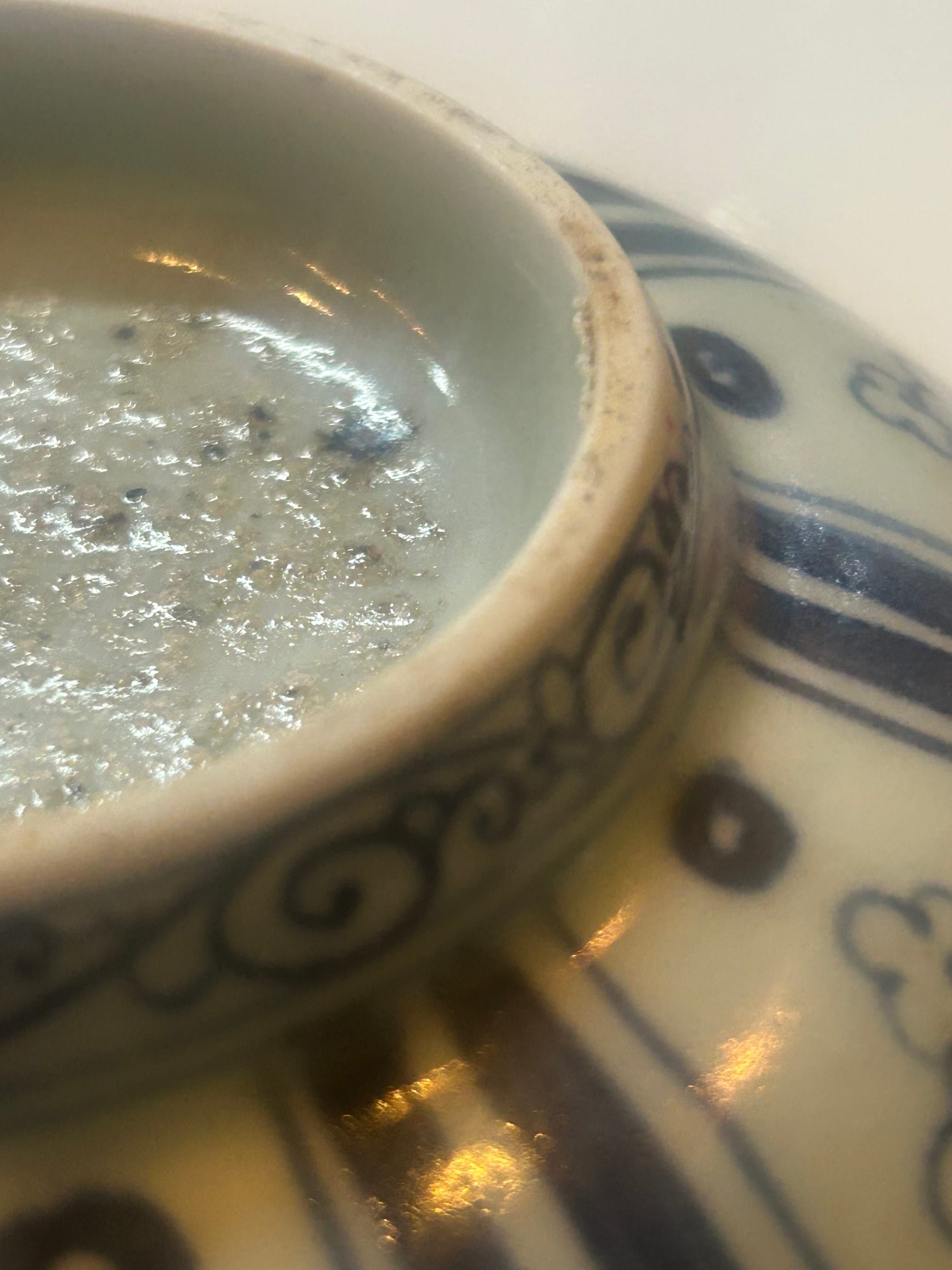
It is distinctly tapered rather than upright, with a narrow exposed edge and a pronounced transition into the body. Under 30× magnification the trimming is remarkably smooth, although in a couple of places I believe I can detect extremely fine, irregular tool chatter. What I cannot find is a repetitive mechanical rhythm.
More striking is the foot well.
It contains numerous particles of different sizes and colours: pale siliceous material, brownish particles and a smaller number of very dark inclusions. Under magnification these do not appear to have been rubbed into the surface to manufacture age. They are incorporated into the fired surface, with glaze flowing around and in places over them.
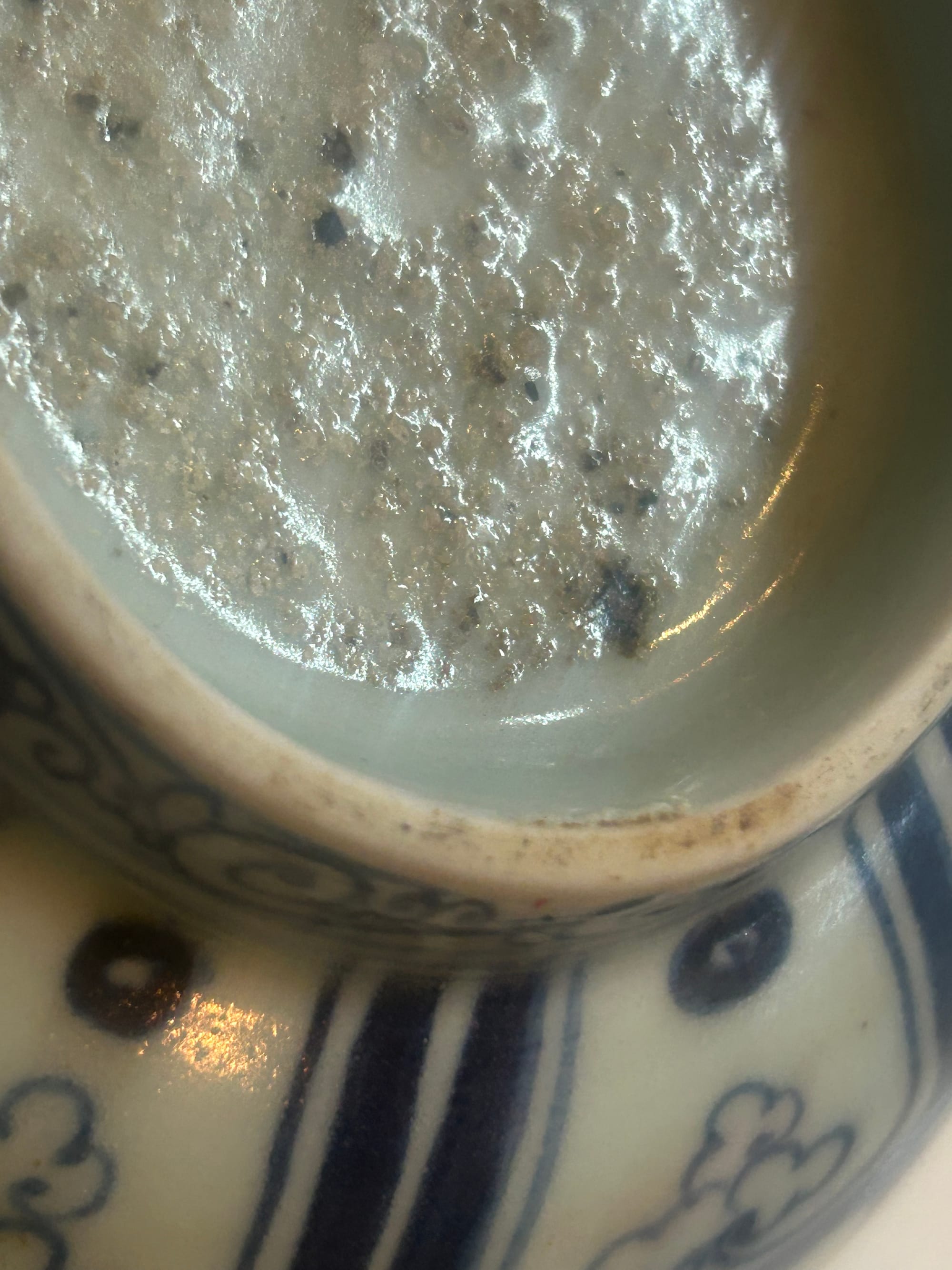
Some of the darkest inclusions appear almost open at their centres.
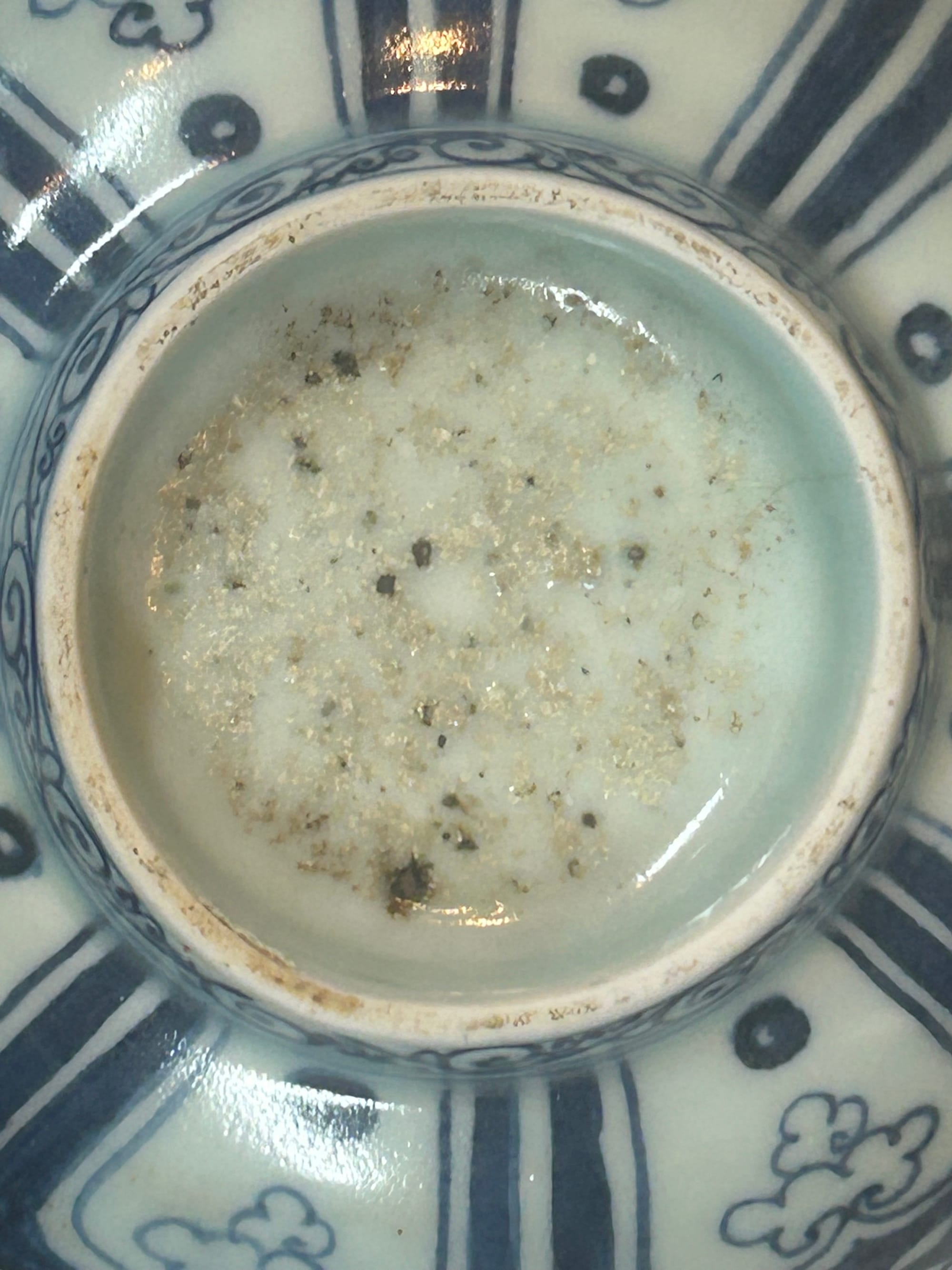
I do not regard kiln debris as an authentication test in itself. A determined reproducer could introduce debris before firing. What interests me is its relationship with all the other evidence.
The glaze
In daylight the glaze is not a brilliant cold white.
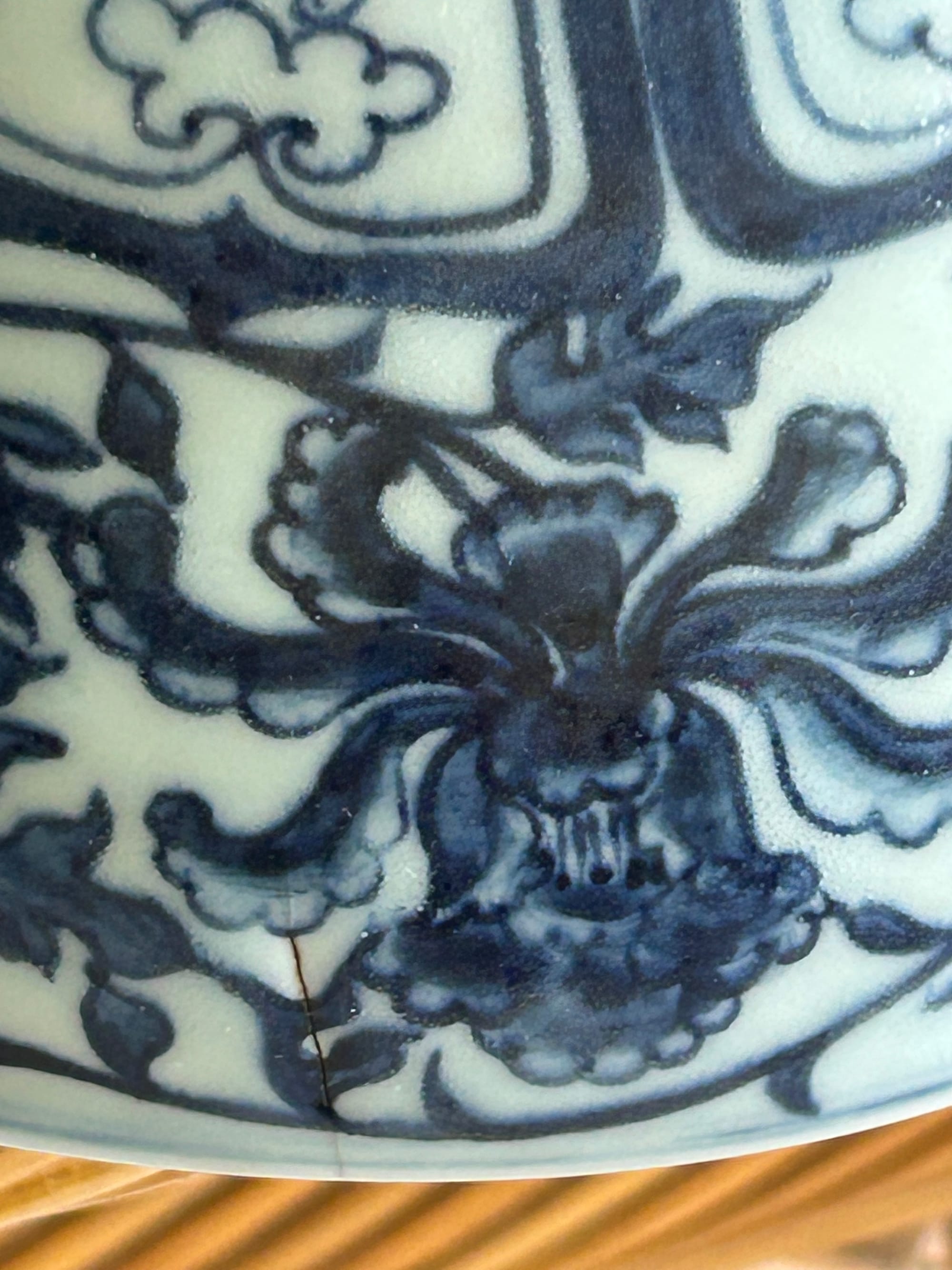
It has a slightly blue cast in reflected daylight, but when strong white light is transmitted through the rim the porcelain changes noticeably towards a warm yellow. Translucency is good around the rim, variable through the wall, and becomes almost imperceptible towards the lower body.
At 30× the glaze is not perfectly glassy. There are subtle undulations, approaching a fine orange-peel texture, together with numerous minute bubbles or voids trapped within the glaze.
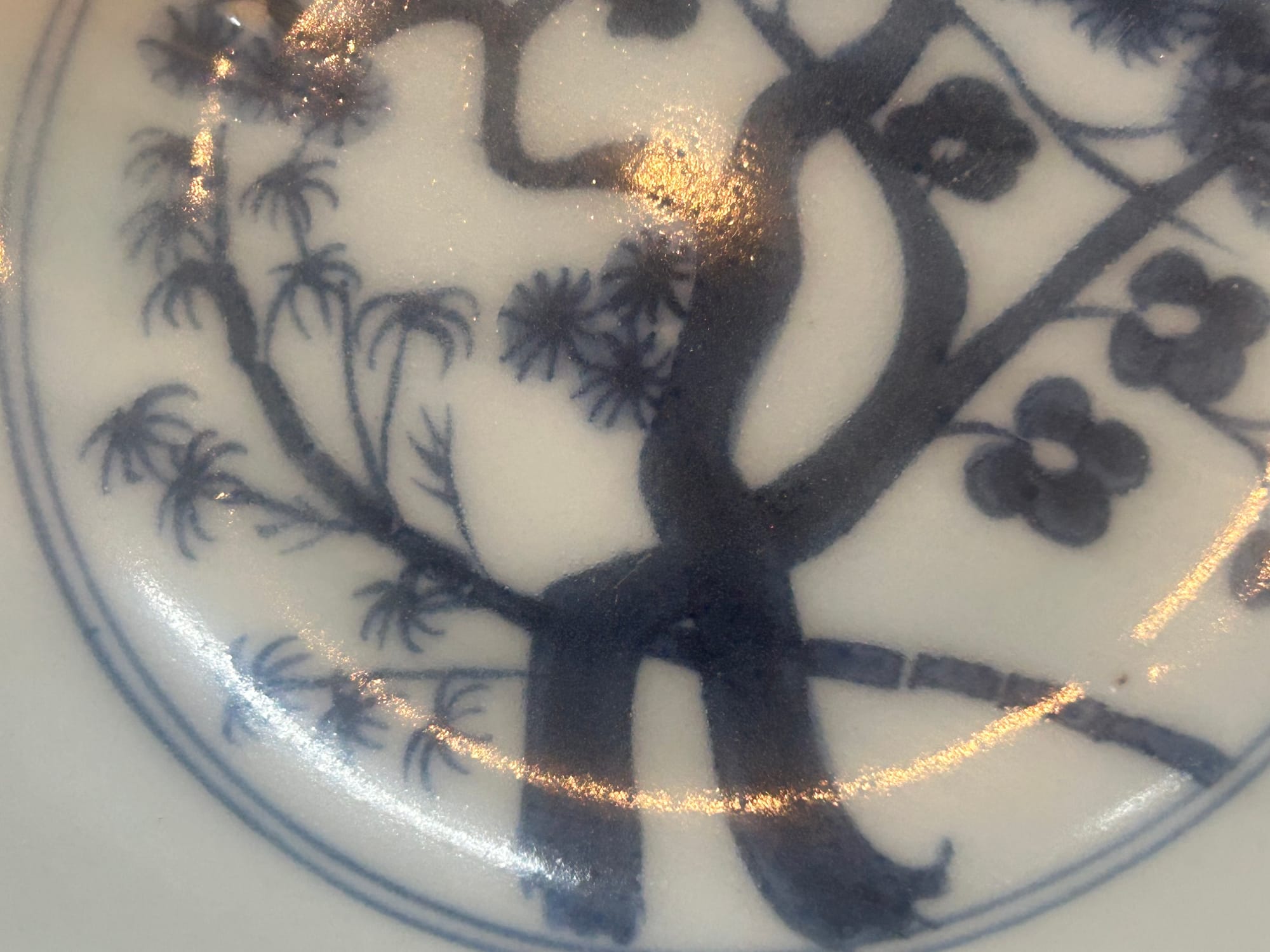
None of this proves age.
The significance lies in the fact that these observations do not contradict one another.
The cobalt: the feature that worried me most
The cobalt remained my greatest concern.
Some passages — particularly the heavy floral painting and parts of the central medallion — are extraordinarily dark. Someone who saw photographs suggested almost equal odds between Ming and modern manufacture.
Initially I understood why.
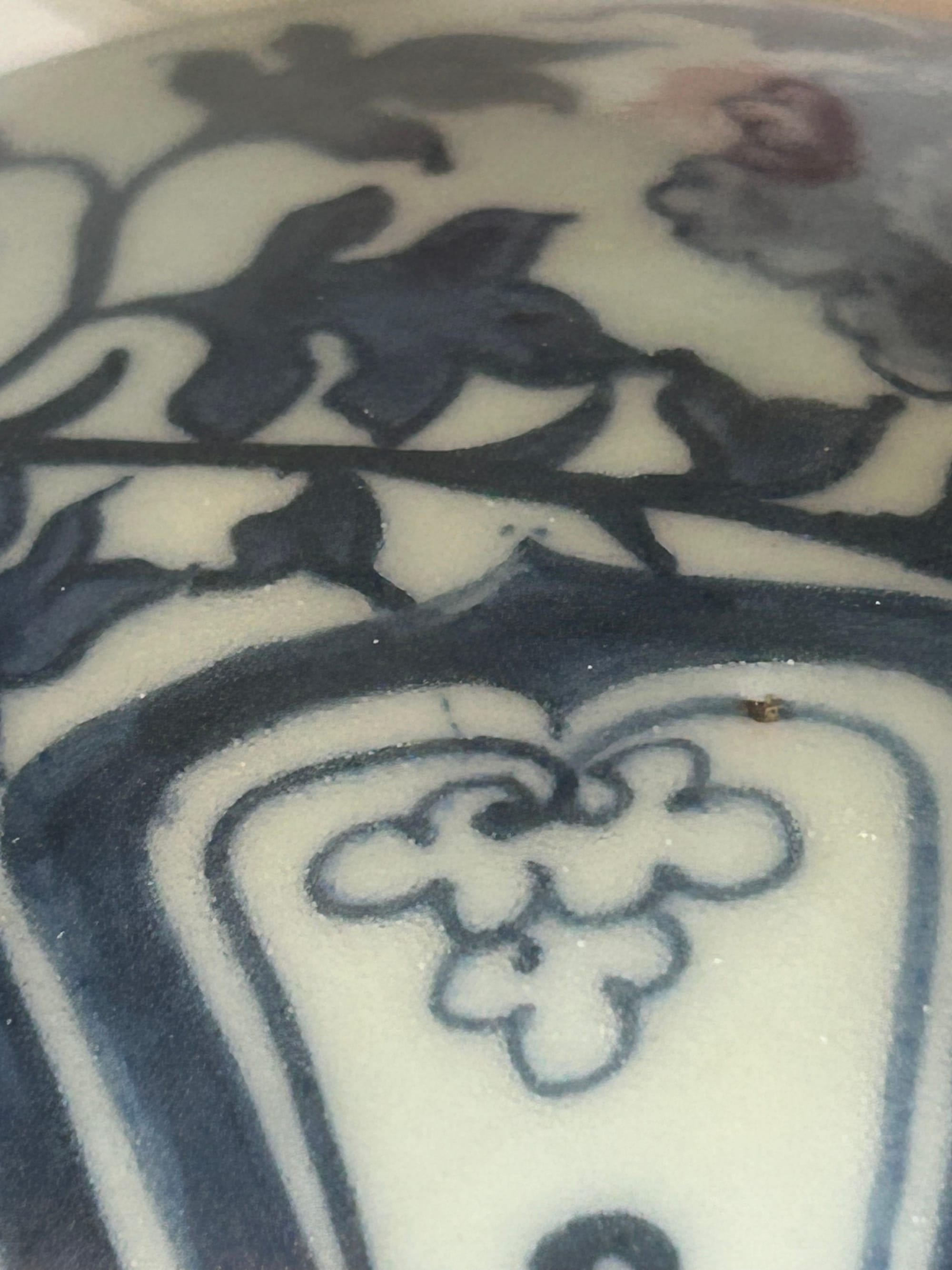
Then I returned to published Middle Ming material.
Yeo and Martin, in Chinese Blue and White Ceramics, define their Middle Ming period as 1488–1566, covering Hongzhi, Zhengde and Jiajing. Their illustrated examples show precisely the phenomenon that worried me: areas of cobalt becoming extremely dark, in places approaching an inky blue-black, alongside much lighter blue passages.
The same plates also show vigorous scrolling floral decoration, lotus-derived forms and ruyi-type ornamental vocabulary.
The dark blue therefore cannot reasonably be treated by itself as evidence of nineteenth- or twentieth-century manufacture.
That point is reinforced by the British Museum.
One Hongzhi bowl, museum number 1971,0519.1, is described as a Jingdezhen minyao or popular-kiln bowl with unevenly painted cobalt. The museum's curatorial notes specifically state that the blue varies from pale blue through bright blue to black, and describe that uneven cobalt as characteristic of Hongzhi-period production.
British Museum — Hongzhi bowl 1971,0519.1
That is a particularly useful comparison because it directly addresses what initially seemed the most suspicious feature of my bowl.
Under 30× magnification the cobalt on my bowl is not uniformly black. There is considerable tonal variation, slight granulation and soft diffusion where heavily loaded brushwork interacts with the glaze.
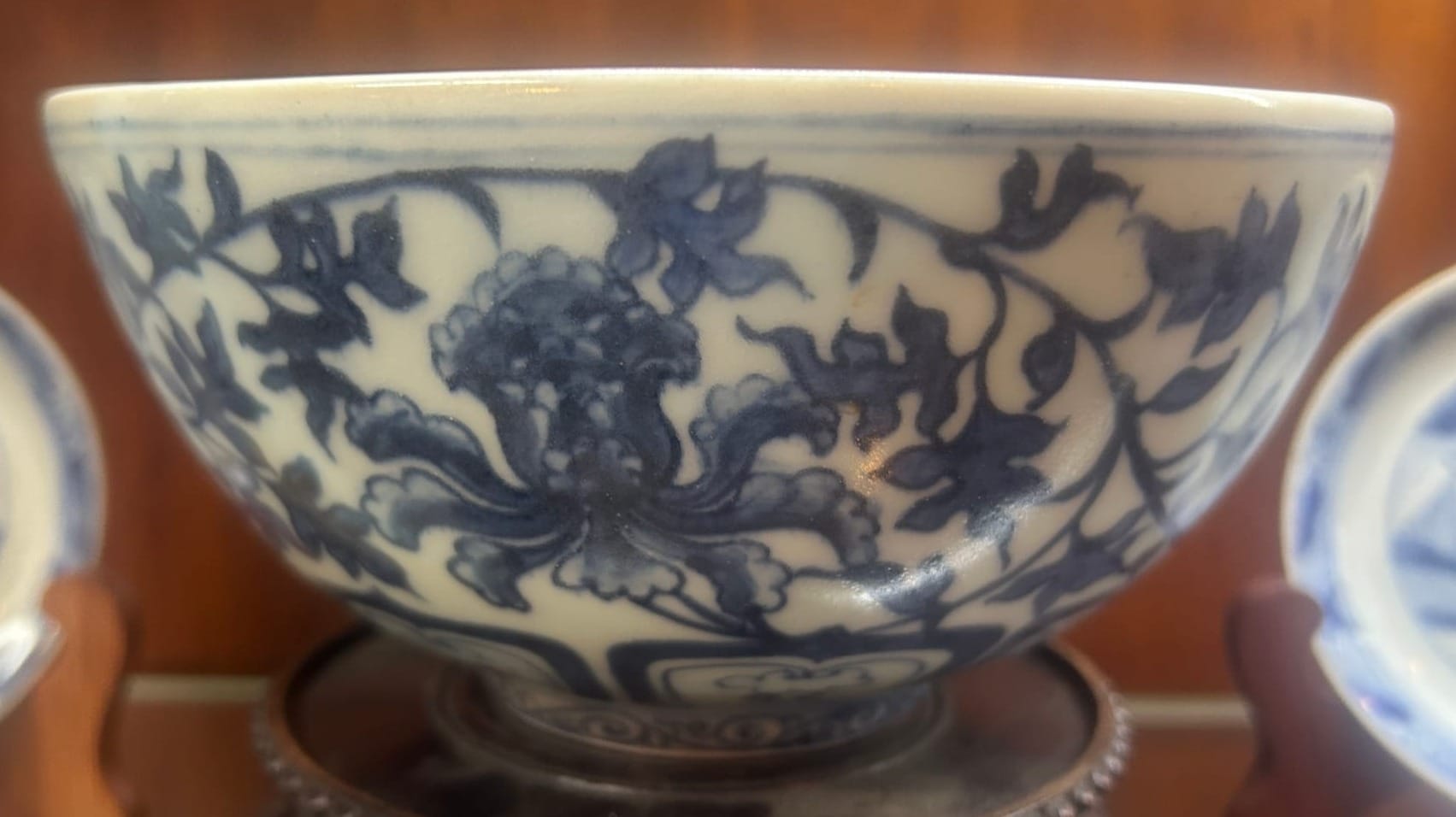
The exterior flowers, ruyi panels, inner border and Three Friends medallion all appear to belong to the same decorative and firing language.
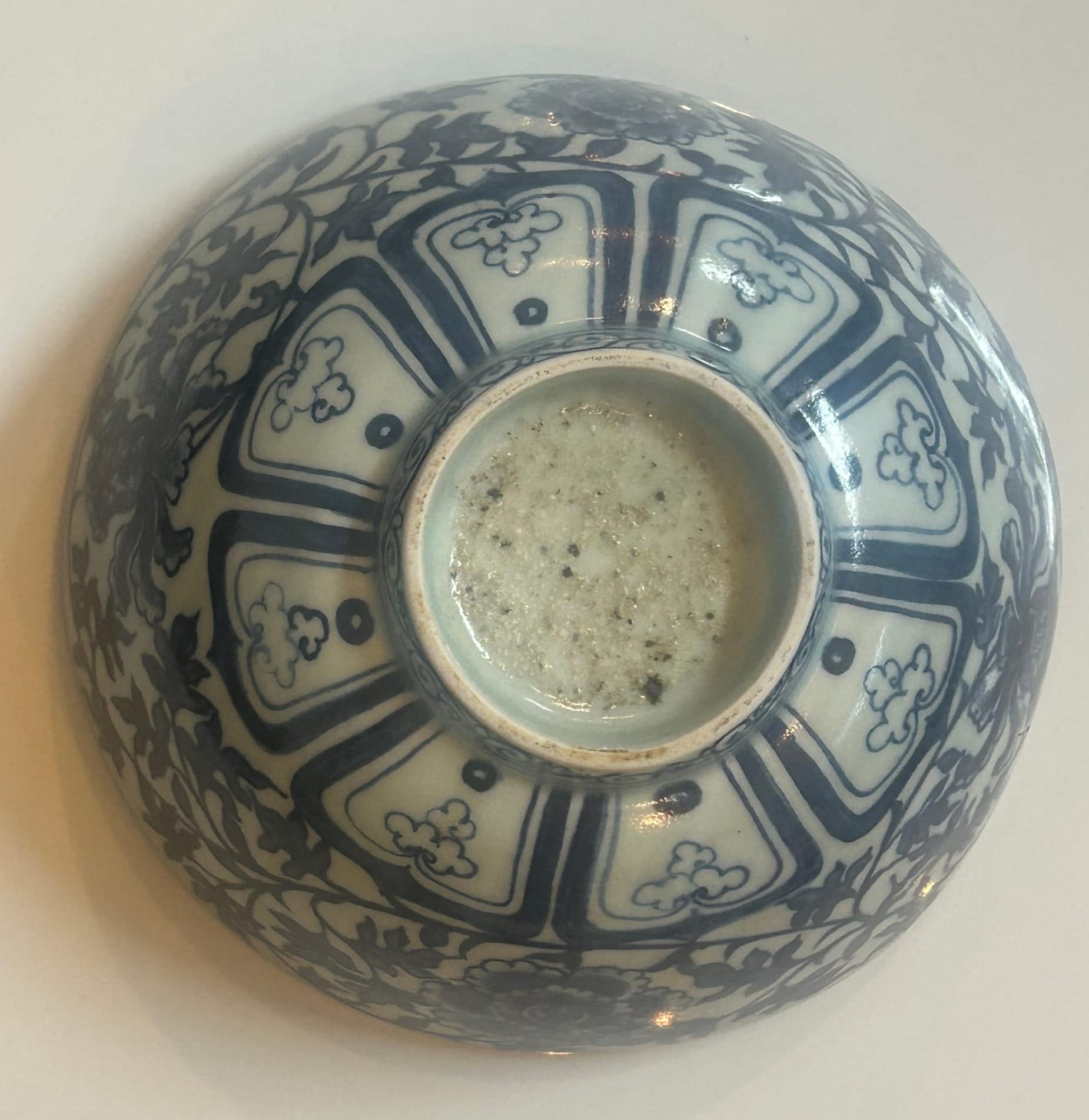
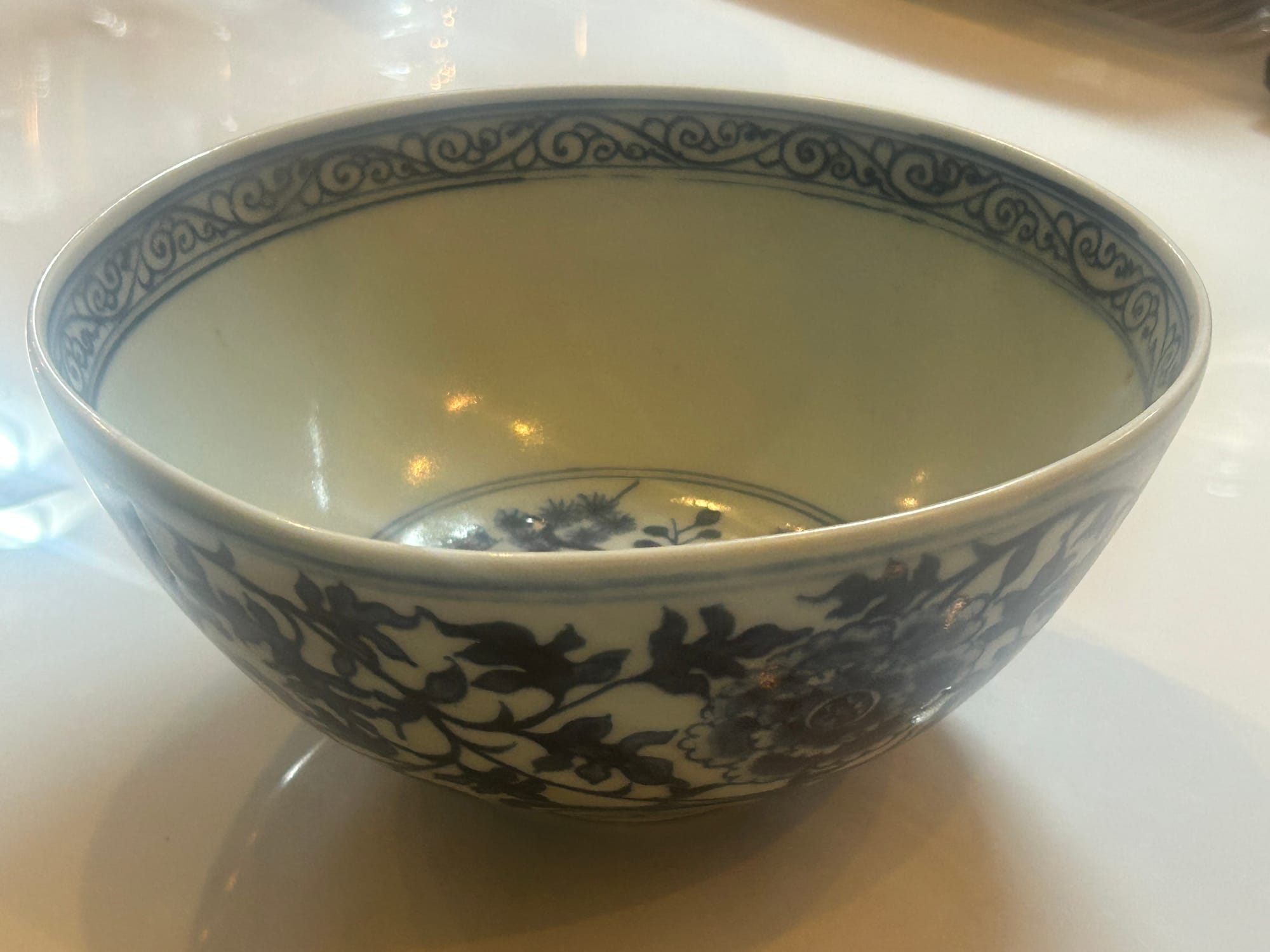
That coherence matters more to me than the absolute darkness of the pigment.
A defining British Museum comparison
The closest museum comparison I have found in overall decorative language is British Museum PDF A.623, a blue-and-white warming bowl made at Jingdezhen and dated specifically to the Hongzhi period, 1488–1505.
British Museum — PDF A.623, Hongzhi blue-and-white warming bowl
The museum describes it as an unmarked domestic-market bowl with underglaze-blue scrolling lotus and stylised petals or lappets around the foot. It measures 16.2 cm in diameter and 8.4 cm high.
The comparison should not be overstated. PDF A.623 is a warming bowl with an internal liner and is smaller than mine; its interior subject is also different.
But the structural and decorative relationship is important:
- a high rounded body
- scrolling lotus
- formalised lower panels
- an unmarked Jingdezhen domestic-market attribution
- a distinctly Middle Ming visual language
The British Museum's Hongzhi holdings are not limited to a single example. Its collection database currently lists numerous Hongzhi bowls and related forms, including PDF A.623, PDF C.625 and 1971,0519.1.
Another particularly relevant comparison is PDF C.625, a Hongzhi minyao bowl painted with scrolling Buddhist emblems and leaves above a band of overlapping ruyi heads.
British Museum — PDF C.625, Hongzhi bowl with ruyi-head band
That object is useful because it confirms that a wide decorative band combined with overlapping ruyi-head ornament belongs comfortably within documented Hongzhi popular-kiln production.
The warp and the crack
The bowl is not perfectly circular.
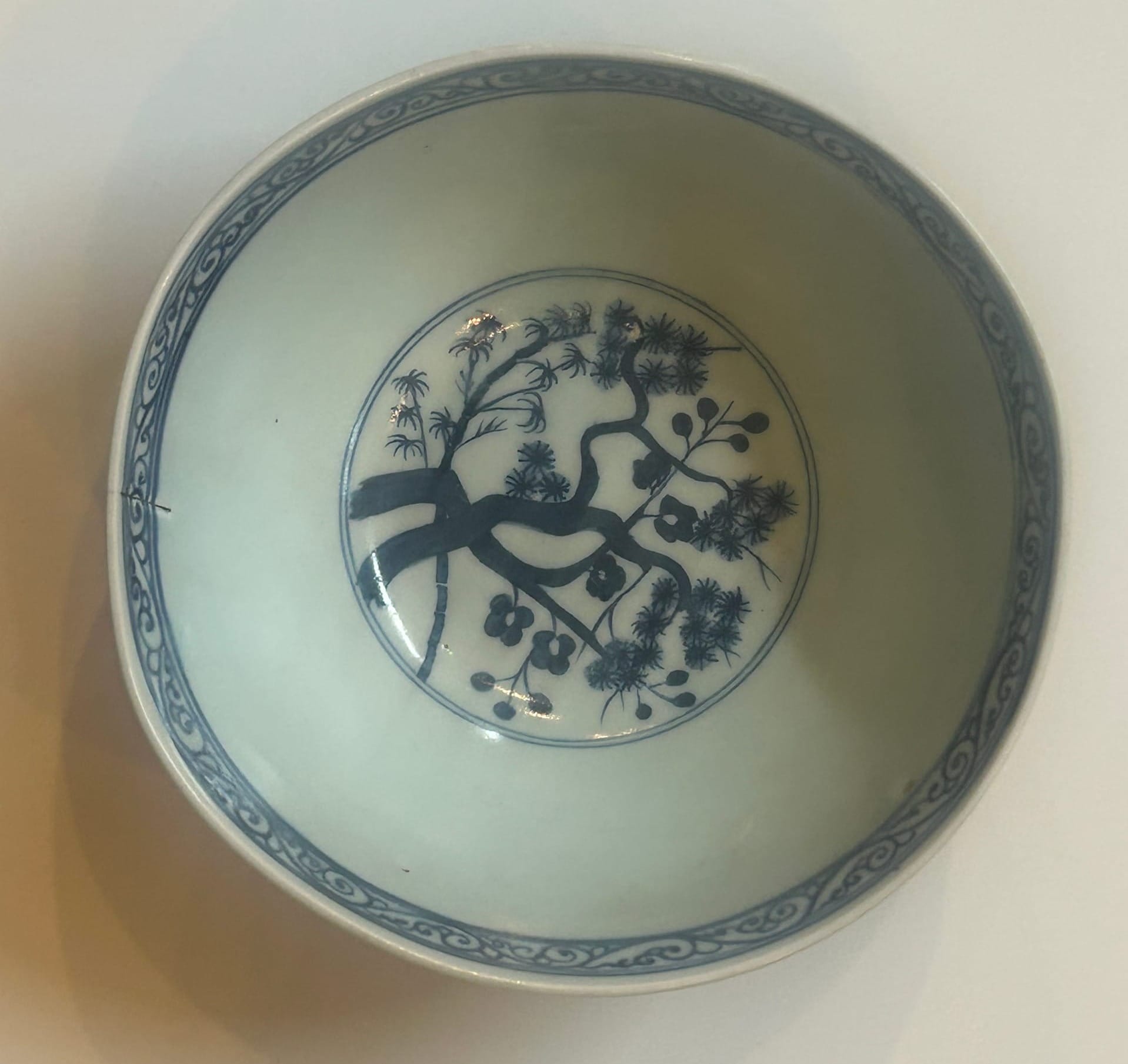
Its rim varies by approximately 5 mm across the diameter. The distortion is gradual rather than angular, and the painted inner border participates naturally in that distorted geometry.
That is consistent with deformation during firing.
There is also an old hairline extending from the rim through the inner scroll border. Under magnification the cobalt remains beneath the glaze and is simply interrupted by the fracture. I can feel virtually nothing when running a finger across it.
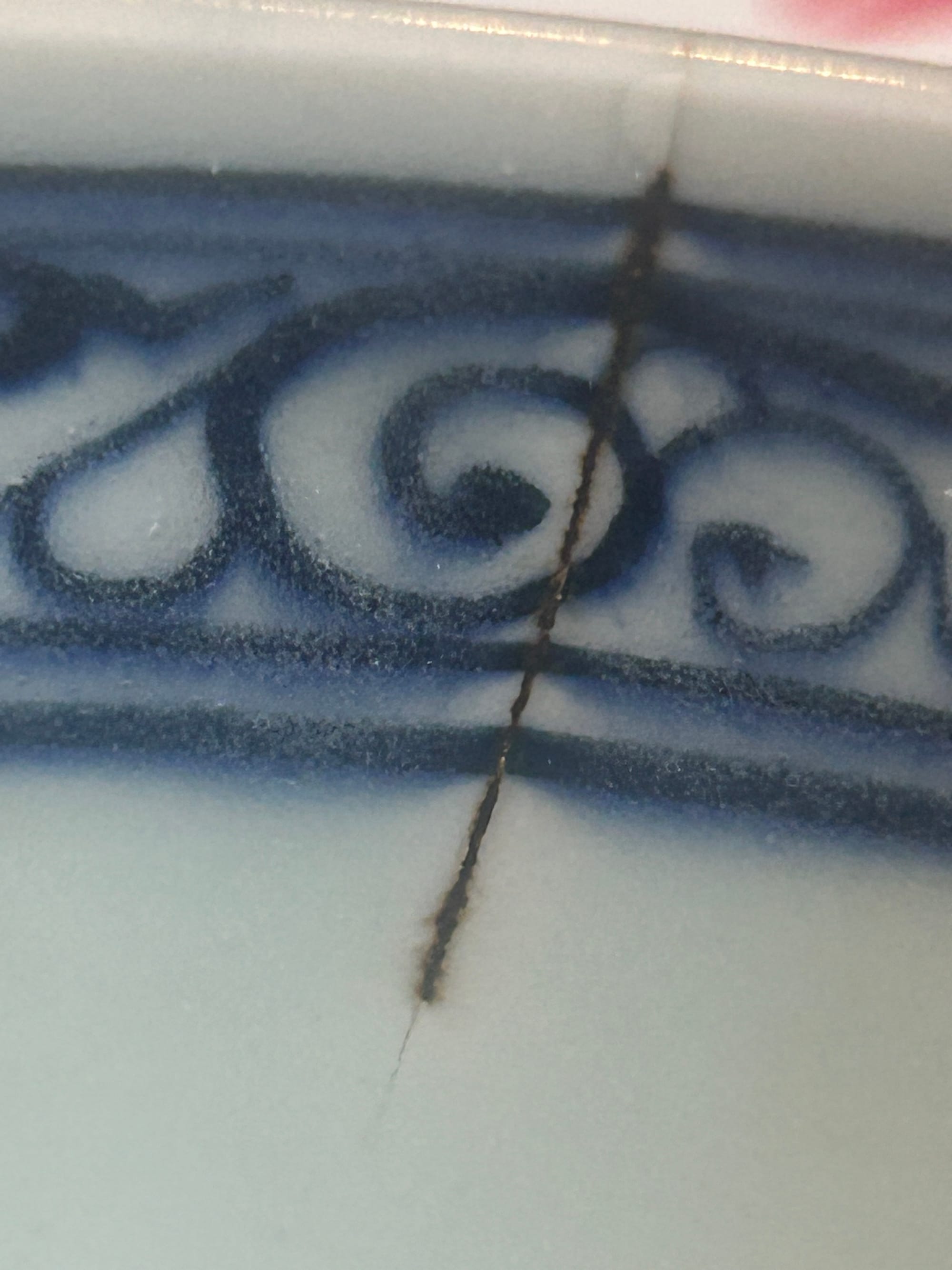
Under a 365 nm ultraviolet lamp the crack does not fluoresce, and I see no obvious evidence of resin or restoration.
The bowl also rings remarkably clearly when lightly tapped — almost like a small bell — despite the hairline.
I regard the crack primarily as a condition issue rather than dating evidence. Its smooth and stained appearance is compatible with considerable age, but an old crack cannot distinguish a fifteenth-century bowl from a nineteenth-century one.
Could it still be a sophisticated reproduction?
Absolutely.
This is the alternative that has to remain on the table.
A skilled late Qing Jingdezhen workshop could deliberately imitate earlier Ming decoration. A sophisticated twentieth-century workshop could go further: hand throw the body, use carefully selected cobalt, introduce grit before firing, distort the vessel slightly and reproduce an early-looking foot.
Chinese ceramics have a long history of technically accomplished archaistic production. The existence of later Ming-style wares in major museum collections is itself a warning against easy attribution.
No individual observation I have made is therefore a magic authentication test.
The reproduction hypothesis has to explain the whole object:
- the distinctly tapered foot
- the absence, so far, of regular mechanical trimming
- the warm transmitted-light behaviour of the body
- the mature, slightly undulating glaze
- the varied vitrified inclusions
- the organically distorted rim
- cobalt ranging from blue to almost black
- and a decorative vocabulary demonstrably present in Middle Ming material
That remains possible.
It is simply becoming the less economical explanation.
Provenance — useful, but secondary
I also have to resist making too much of where the bowl came from.
The previous owner was a French collector who had lived in Thailand for many years. Much of his collection was nineteenth-century bleu de Huế. That alone would tell us almost nothing about a possible Middle Ming bowl.
However, the collection also contained several damaged but clearly period Wanli kraak-style pieces.
That does not authenticate this bowl.
What it does establish is that genuine Ming material was already present in the collection and that the owner was apparently quite willing to acquire imperfect early porcelain rather than only pristine nineteenth-century decorative wares.
A cracked Middle Ming bowl appearing in such a collection is therefore not an impossible contextual anomaly.
But the object itself still has to carry the attribution.
Where I have reached
When I bought the bowl, I had no need for it to be Ming.
At US$250 it was an inexpensive object through which to investigate precisely these questions. Had it turned out to be a clever modern reproduction, I would probably have learned just as much.
After examining it repeatedly, comparing it with known late Qing and twentieth-century pieces in my own collection, studying it under 30× magnification, transmitted light and UV, and returning to Yeo and Martin and the British Museum material, my present assessment is:
85–90% — Middle Ming, most probably Hongzhi–Zhengde, approximately 1490–1525
8–12% — later Ming-style revival, most plausibly late Qing
2–3% — sophisticated modern reproduction
Those percentages are not an authentication certificate.
They are simply my attempt to state uncertainty explicitly rather than hiding it behind words such as probably or possibly.
I would still welcome an experienced specialist handling the bowl and telling me where this reasoning fails.
Indeed, that is rather the point of the exercise.
Method
My approach prioritises structure over style. Proportions, foot trimming, glaze behaviour, cobalt diffusion and kiln response are examined as independent variables. When these physical criteria align coherently across an object, chronological probability increases significantly. Decorative style alone is never decisive. All assessments remain open to informed discussion.
(c) Stephen Ford 2026.