Late Qing Landscape Jar with Original Cover. A Probability Assessment of Age.
Overview
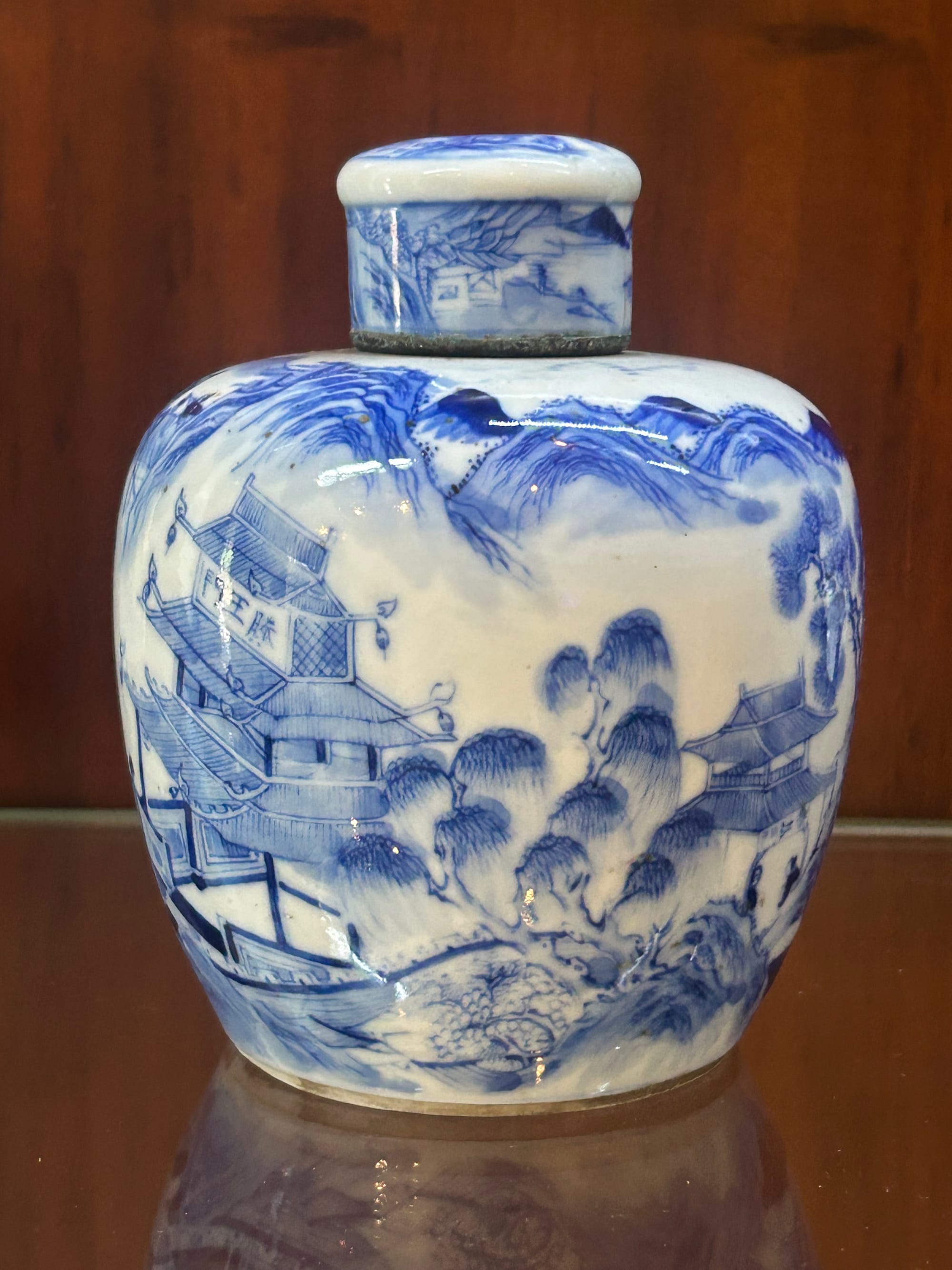
This small covered blue-and-white storage jar presents a compelling combination of structural integrity, original survival, and unusually competent landscape painting. Measuring 13 cm high with its original cover, the jar belongs to the long tradition of Chinese storage and ginger jars produced at Jingdezhen during the late Qing and early Republican periods.
What distinguishes this example is not rarity of form, but quality of execution. The continuous landscape scene, architectural detail, pine tree rendering, cobalt modulation, and complete original cover elevate it above the routine decorative jars frequently encountered in regional auctions.
Physical Characteristics
| Measurement | Value |
|---|---|
| Height (with lid) | 13 cm |
| Maximum diameter | 10.5 cm |
| Foot diameter | 8 cm |
| Mouth diameter | 3 cm |
| Total mass | 341 g |
| Lid mass | 29 g |
Construction
- Fully glazed interior
- Unglazed underside of lid
- Traditional wheel-trimmed foot
- Strong translucency with slight greenish cast
- No UV anomalies
- Original period metal collar to lid
- Original matching cover retained
The jar displays genuine wear to the mouth and footrim consistent with long-term use rather than decorative shelf display alone.
Decorative Analysis
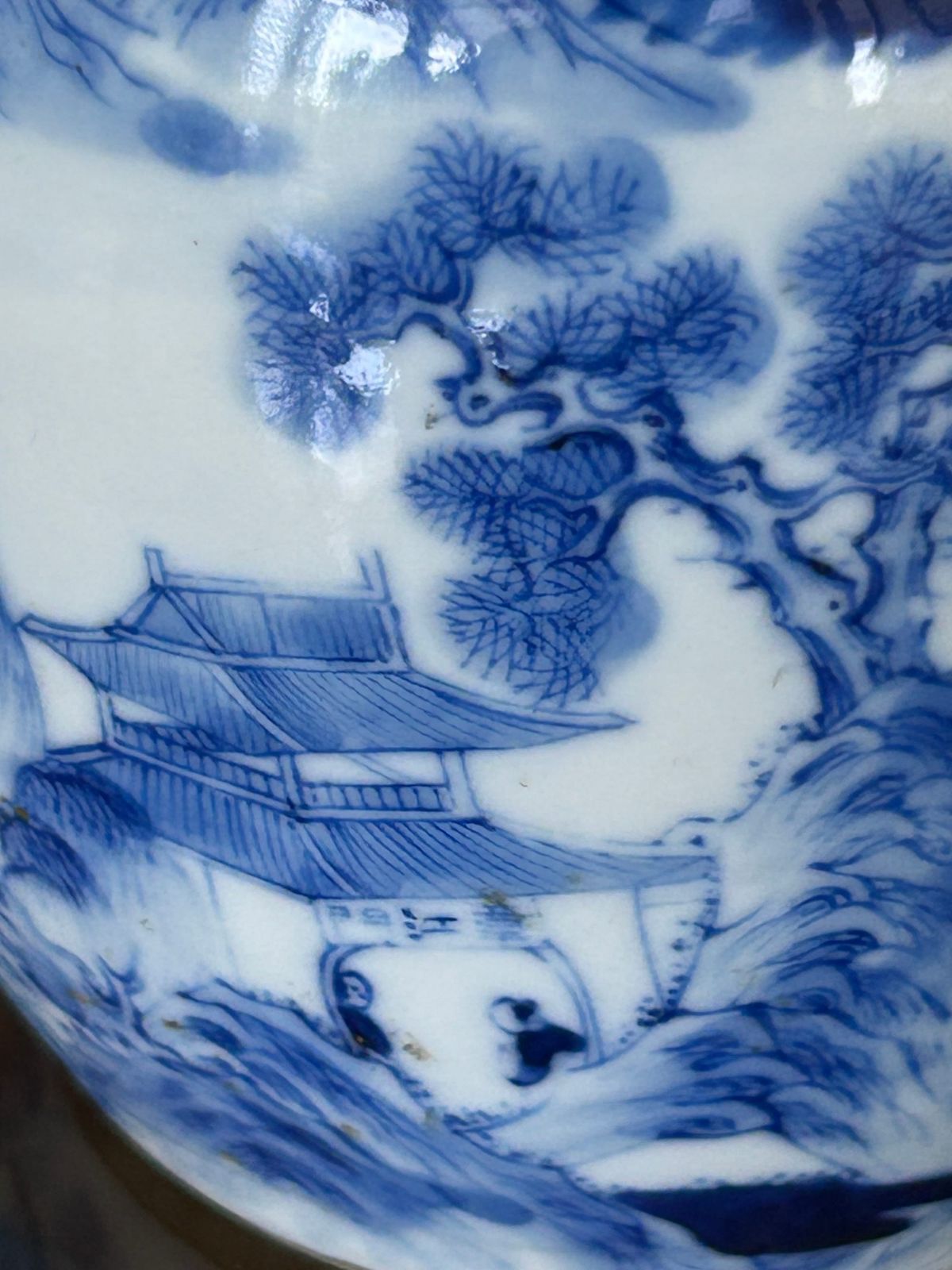
The decoration consists of a continuous literati landscape incorporating:
- Pavilions and temple architecture
- Pine trees
- Mountains rendered in layered washes
- Figures and narrative elements
- Water and rocky outcrops
The most impressive feature is the brushwork.
The pine trees are rendered with individually articulated needle clusters rather than the repetitive shorthand often encountered on routine late Qing production. Architectural lines remain controlled and proportionate despite the curved surface of the vessel.
The cobalt is bright but varied, with successful transitions between darker concentrations and paler washes.
This is workshop painting of noticeably higher quality than the average landscape jar encountered in regional auction catalogues.
Structural Assessment
The jar's proportions suggest a practical storage vessel rather than a purely decorative object.
Key Ratios
| Ratio | Result |
|---|---|
| Height / Diameter | 1.24 |
| Foot / Diameter | 0.76 |
| Mouth / Diameter | 0.29 |
| Lid Height / Total Height | 0.21 |
These proportions indicate:
- Stable stance
- Controlled storage opening
- Functional lid system
- Practical domestic purpose
The broad foot, narrow mouth, and fully glazed interior align with a storage or tea-jar function.
The painting quality of the present jar sits comfortably above the routine category and compares favourably with several jars catalogued by RCB as "finely painted."
The original cover is a further advantage, as many auction examples suffer from replacement lids.
Attribution Probability
Based on:
- Structural analysis
- Foot construction
- Glaze characteristics
- Cobalt behaviour
- Decoration quality
- UV response
- Comparative examples
The following attribution model is proposed:
| Period | Probability |
|---|---|
| Late Qing (c.1850–1910) | 60% |
| Early Republic (1912–1930) | 30% |
| Late Republic (1930–1950) | 7% |
| Post-1950 | 2% |
| Modern | 1% |
Working Attribution
Late Qing to Early Republic (c.1880–1925)
The balance of evidence favours production during the late Qing period, with the possibility that manufacture extends into the earliest Republican years.
Conclusion
This jar should not be viewed as a rare form or imperial object. Its significance lies instead in the combination of:
- Original cover
- Genuine age
- Honest use history
- Superior decorative execution
- Strong visual appeal
Among the many blue-and-white landscape jars encountered in the regional market, this example sits comfortably within the upper quality tier. The painting quality is noticeably above average, and the survival of the original cover adds significantly to both historical integrity and collector appeal.
Stephen Ford – independent. We analyse and observe. Nothing more.
Methodology
This assessment combines proportional analysis, structural review, glaze examination, UV testing, translucency testing, foot construction analysis, brushwork evaluation, comparative auction research, and probability-based attribution modelling. Conclusions are expressed as probabilities rather than certainties, recognising the limitations inherent in photographic and non-destructive examination.