The story of Davy Keo
The story of Davy Keo, who lived through the genocide of Pol Pot and the Khmer Rouge as a teenager in Phnom Penh, Cambodia.
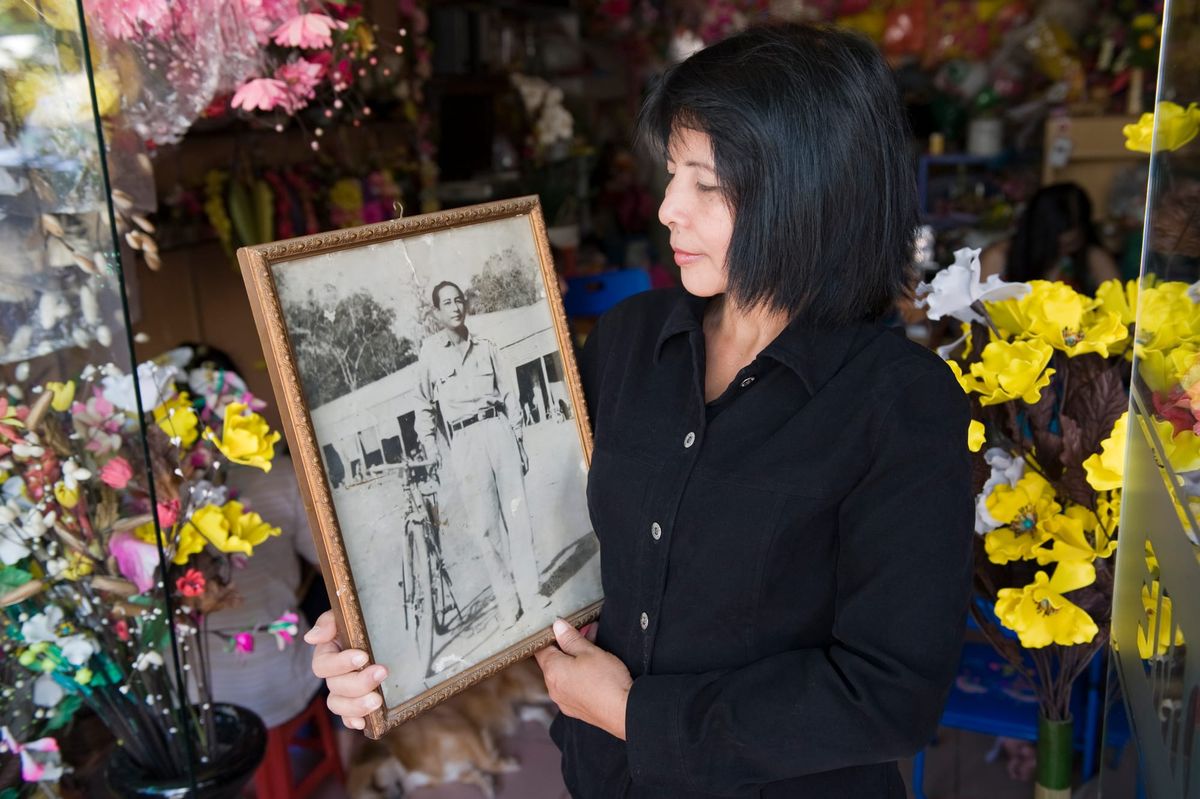
The story of Davy Keo, who lived through the genocide of Pol Pot and the Khmer Rouge as a teenager, and who now buttresses her community empowerment agenda with her business success, provides us with a unique insight into opportunities and challenges of women and girls in Cambodia, and into the contemporary Khmer society in which they live.
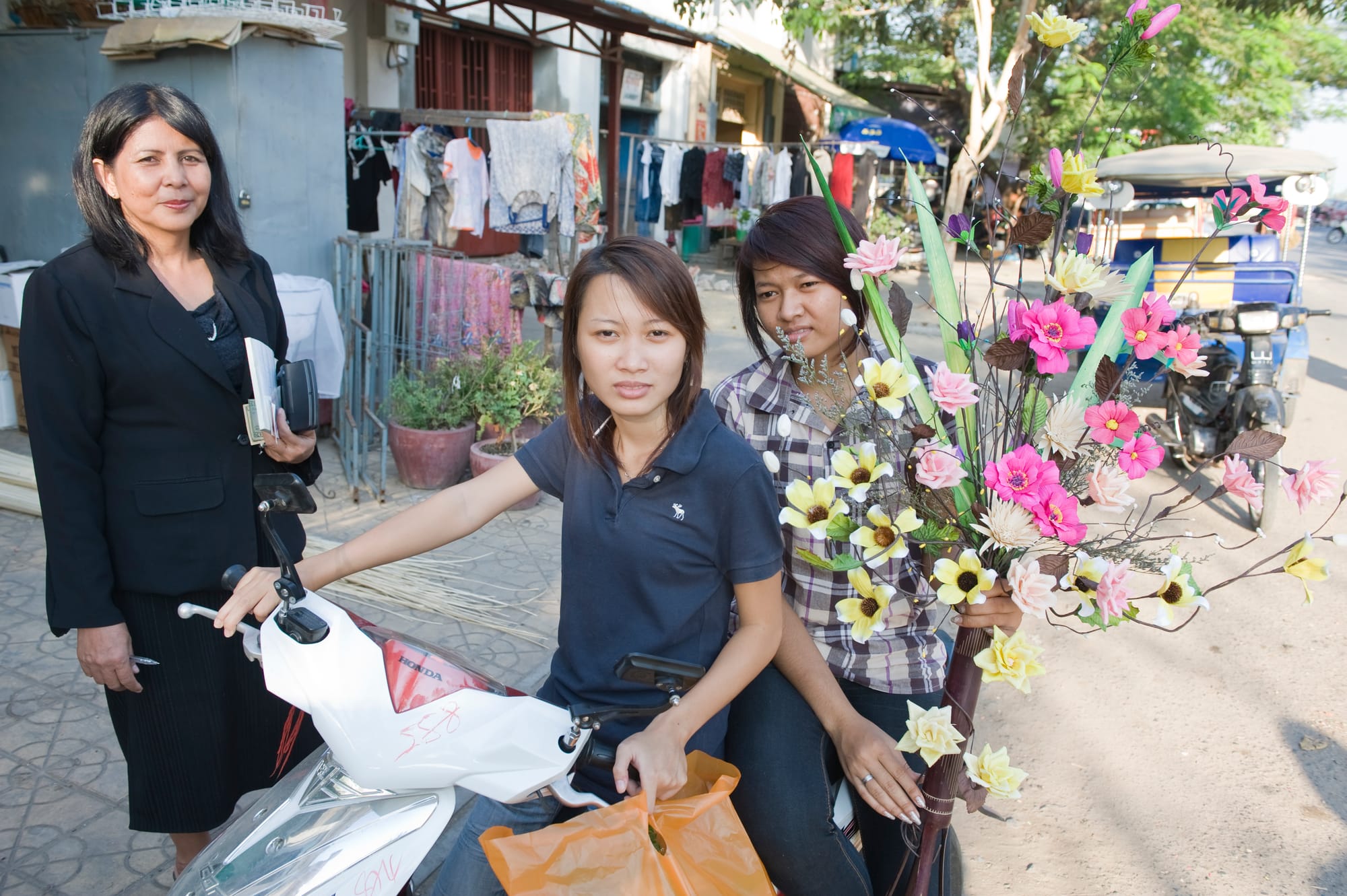
Davy Keo’s rugged determination enabled her to survive the brutal atrocities meted out by the Khmer Rouge dictatorship in Cambodia.
Pol Pot’s henchmen murdered her father, killed her brother and left her homeless. Her sister is now dying of AIDS, a direct consequence of a forced marriage conducted in the ‘Killing Fields’.
Three decades on Davy has a personal crusade. She strives to improve the lives of oppressed and poverty imprisoned Khmer women in Phnom Penh, training them in craft techniques and employing them in her business.
This is a pencil picture of the life and times of Davy Keo and of the Cambodian women she employs in the Phnom Penh Flower and Gift Shop. Phnom Penh, Cambodia. 6th April 2011.
It’s axiomatic that a picture taken on the streets of Phnom Penh today will almost certainly lack the presence of old Khmer men. Grimy young girls and boys begging from tourists, perhaps; midlife men and women selling snails or other delicacies from their steaming roadside stalls, probably; old women walking, possibly; a team of energetic fitness enthusiasts exercising on the riverside, maybe; young people riding motos, certainly; old menu - unlikely.
The legacy of the Khmer Rouge, whose followers and enforcers were responsible for killing millions of Cambodians, men in particular, it seems, is a fractured society and an asymmetric older population. Families were decimated; an ultra-communist, idealist and brutal dictatorship destroyed the whole community nexus. Davy Keo lives in Phnom Penh and her family is no different. A contemporary image would show vacant spaces where her brother, father, nephew and her brother-in-law should stand. She was born into a semi-bourgeoisie middle class Cambodian family in 1963. They owned a substantial property in Phnom Penh’s then District 3.
Sitting in a bustling riverfront café in Phnom Penh, I am privileged to quietly chat with Davy Keo – many Khmers will never discuss the Pol Pot atrocities – about her family and her extraordinary life. Surrounding us are happy young people, chatting on their mobiles and enjoying drinking with their friends. As we drink, I am acutely aware of the stark contrast between their apparently carefree lives and the existence of Davy Keo as a teenager, a slave, forced to labour all day in a Khmer Rouge camp with little food, water or sleep. It is only later that I reflect on the youngsters in the café. These are the fortunate Cambodians and, just a stone’s throw away from here, there are ‘contemporary slaves’, young people forced into horrible exploitative work, paid a pittance, hungry and living in abject squalor.
“Mr Sob Keo, my father, was the Chief of the Secret Police, working for the government in Phnom Penh. He had 3 wives. Pol Pot executed him in 1977,” she whispers, adding: “The only surviving souvenir of my father is an old black and white photograph of him in uniform next to his official bicycle.” The next day she brings the dusty and faded image of Sob Keo of which she is immensely proud for me to photograph.
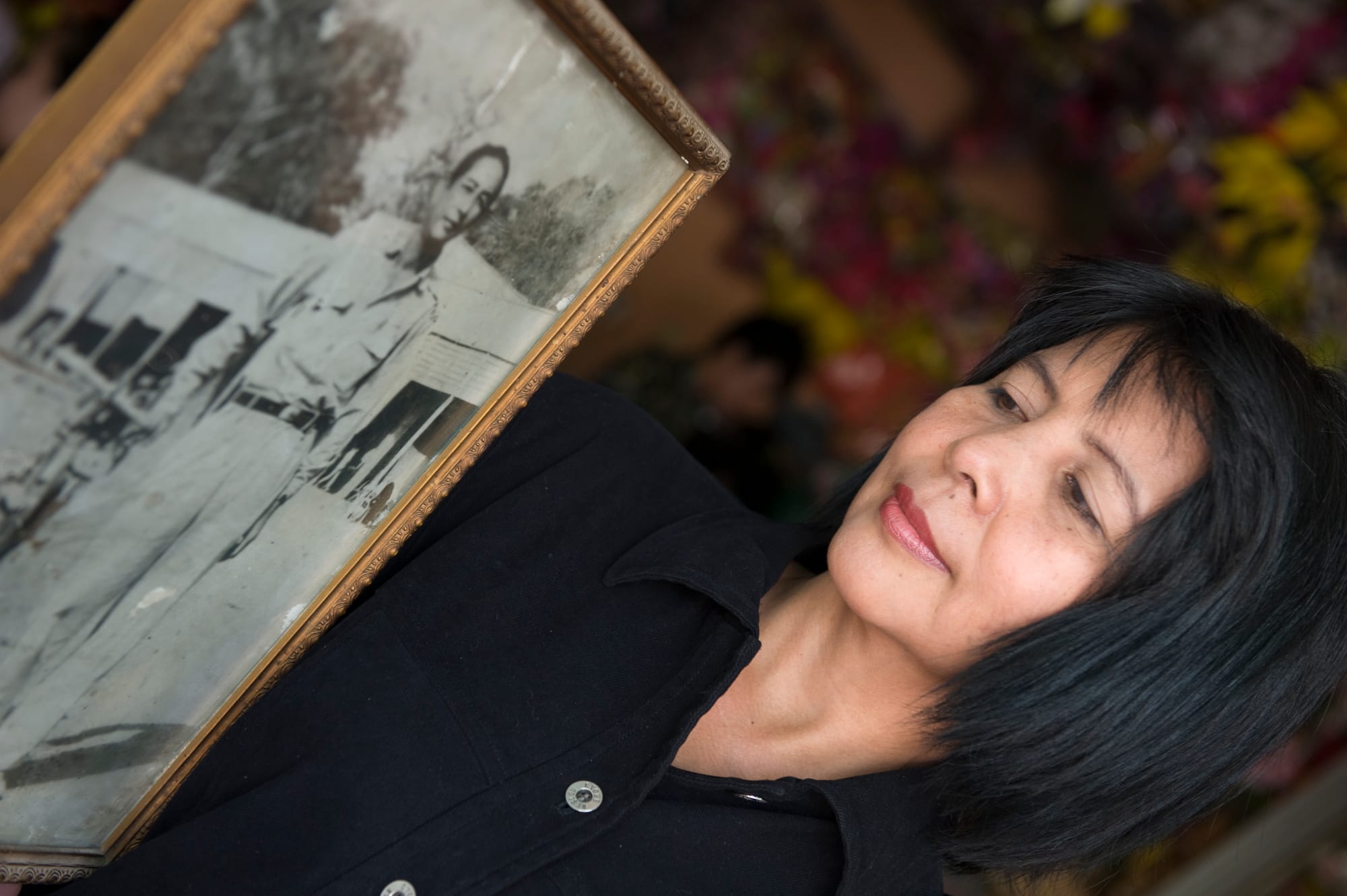
Davy’s ageing mother, 90, still lives in Phnom Penh. “She is now very frail and cannot walk without assistance,” adds Davy wearily, with a look on her face that would be instantly recognised by carers elsewhere.
Her eldest brother, fortunate to survive the 1970’s, now practices as a surgeon in the Cambodian capital.
Sob’s father, her grandfather, whose name eludes her, worked as a silversmith artisan for the king at the Longvek Palace in the Oden province.
During Cambodia’s communist rule by the Khmer Rouge, the core family, and traditional society in general, was deemed obsolete and problematical by the ruling dictatorship and individuals were forced to harsh camps in different locations of the country to work as slaves in ‘community’ camps, for the benefit of Pol Pot and the Khmer Rouge. Academics, monks, the educated or wealthy, together with others who posed any perceived opposition to the regime, were executed. Hundreds of thousands more, maybe millions, died in the work camps through exhaustion, dehydration, lack of food or from illness.
“Karim, my older brother died of malnutrition and disease whilst farming rice for Pol Pot in an area close to Battambang in 1976,” she tells me as another painful memory throws a shadow over Davy’s face.
“I was 13 years old when I was transported to the small village of Ouromehek in the Tangkork district of the Kampong Cham province. I was forced to work in a ‘woman’s group’ planting rice and constructing a canal. I was so homesick and missed my mother so much that I ran away and started to walk to find her but she was 80 km away in a different group,” she continues.
“Pol Pot’s men arrested me on the road to find her, they beat me and returned me to the camp. I thought they were going to kill me but I think one of the men liked me so they did not. To punish me more they increased my workload digging the canal. Now I had to dig 4 cubic metres of soil each day to get a little rice instead of 2 cubic metres which must do before I escaped,” she recounts. The memory of this period of her life is still clearly vivid.
Incredibly the young teenager survived the ordeal and after the Vietnamese army ousted Pol Pot in 1978, she returned to Phnom Penh in 1979. Her eldest brother had survived and somehow had found their mother. They started to rebuild their lives together with him. “Our family home had been looted and destroyed by Pol Pot. They stole our land and someone demanded 500g of gold for its return. Of course, we had no gold so they kept our land and we had to live somewhere else with my brother,” she informs me.
My older sister Romany, now 51 years old, was “forced to marry a peasant farmer” during the Khmer Rouge regime. Davy continues to explain that: “He was an uneducated lazy peasant labourer whose request to the ‘local Khmer Rouge committee’ to be allowed to marry Romany was granted. They married in a communal ceremony with lots of other couples. He never worked after the overthrow of the Khmer Rouge and was supported by my sister, and my family.”
“He repaid my sister and our family for the support we gave him by infecting her with HIV, now AIDS, which he presumably contracted from his frequent visits to sex workers in the capital,” she tells me. A palpable hint of sorrow taints her voice as she describes this tragedy. Romany still survives her husband, who died a few years ago at the age of 49 from AIDS and it’s complications.
In a country, however, where state social security is nonexistent, individuals who are in need of food, accommodation or healthcare rely on the support provided by NGO’s, charities and more importantly and naturally by their close family. “My sister’s illness means that she is now unable to support herself or her six children,” she says, continuing: “Romany would perhaps by now have followed her husband to the grave if we did not purchase medication for her illness and provide other assistance for her including caring for her children.”
Davy is her sister’s social security, this being routinely seen as the duty of any loyal sibling in Cambodia, and more generally across South East Asia. She, alongside her older brother provide ‘parental’ support for all Romany’s children, of which now only five survive as one “boy was killed in a tragic brawl, aged 18, when he was attacked on a street in Phnom Penh”.
Davy tells me: “Like many Khmer women, I am married to a man who refuses to fund his children’s education or properly provide for his family.” Thus she was pressed into earning additional money to supplement the low monthly wage she receives from her employment at the Government’s City Hall offices.
“I started my business, The Phnom Penh Flower and Gift Shop, in 2001, initially to earn more money to support my 3 children. I want my children to have a better life and to study at University. I also want to give work to my dying sister’s children; now I employ them - Kolyan, Seng who is now 27-years-old and Darareaksmey Seng who is 19 - at my shop,” she continues.
“When I left school I gained a scholarship to a Russian University in 1981 to study Electrical Engineering and my degree was funded by the Russian Government. I also took an advanced management study course in Sweden in 2001. I think this training helped me to start my own business,” Davy recounts, quite clearly and rightly proud of her educational achievement and her creative intellect.
“Firstly I made greeting cards and picture frames. These I decorated with dried flowers. I taught myself to make artificial flower displays using waste materials such as dried leaves from corncobs and colouring them with natural dyes. I cut the leaves and glue them into colourful displays, which are then mounted in bamboo holders or locally potted ceramic vases. I sell them to local people to decorate their homes and to wholesalers who sell her products throughout Cambodia. Many people buy my flowers from my shop or from my night market stall,” she tells me. The flower designs are her own and are inspired from a variety of sources. She scours books - and now the Internet - for new designs and fresh ideas. Over the last decade Davy’s craft business has blossomed, resulting in the creation of a small artificial flower cottage industry around Phnom Penh.
It’s obvious that Davy is a driven businesswoman although this clearly rests alongside a principled and socially liberal viewpoint and stance. Her strategy is not only to develop a business, which provides for her own family, but also one which provides opportunity and empowerment for other Cambodian families who are sucked into a poverty trap. Her desired outcome of the Phnom Penh Flower and Gift shop is: “To help local Cambodian women and girls earn and live from well paid and good [ethical] employment,” she comments.
Davy’s broader vision is this: “To support and educate Khmer women enabling them to provide for themselves without reliance on charity or on bondage to a husband. To develop their skills and work ethos to provide the first step onto a ladder which will hopefully raise them, and their children, away from poverty, neglect and abuse.”
To realise this vision practically she trains young girls and women in the skills required for working in her business and then employs them in her craft shop or in their homes as out-workers. Furthermore, she provides training, education and accommodation placements for young girls from the rural provinces who she believes would have no other opportunity to escape a life chained to poverty.
“I must raise my workers’ skills and improve their ability to provide for themselves and to support their families. I train my employees in the craft techniques to construct the artificial flowers, skills that the women can then take away to work for themselves should they wish to do so. I want to give women the ability to buy rice to feed their families. This is more important than the success of my shop,” she reiterates categorically. Personally, I do believe that Davy truly wishes to raise the aspirations, ambition and independence of the women and girls who work for her.
A random straw poll conducted on working girls from poor families in and around Phnom Penh would lead to the conclusion that, in Cambodia and probably throughout South East Asia generally, many of their husbands financially or morally neglect them. It seems that some men will never work to provide for their wife and children. It appears that young wives are routinely beaten by drunken partners or suffer other abuse. It is normal that cash earned for the family is spent on beer and gambling.
To escape from this marital bondage, slavery and oppression, young women leave their husbands and return to their family home, to their mother’s home, carrying their young children and the few possessions they own with them. Relief and personal freedom is tempered with their new role as sole provider for their children and themselves. The young women and girls have no state social security net to support them and certainly no housing benefit in Cambodia. Their estranged husbands are never hounded by some governmental agency to pay for the maintenance of their offspring. Now they must survive and with little formal education the chance of respectable employment in a bank or office is negligible.
Managing this role as the sole provider for your children, and perhaps even your parents and grandparents, results in an inexorable pressure to work in poorly paid garment factories which are the largest employers in Cambodia, or perhaps even to try for more lucrative work in a bar, massage shop or in prostitution.
It appears to be common practice in South East Asia for the family matriarch to care for her daughter’s children, as the majority of young mothers must work far from their home. Young women work in clothing factories need to send a minimum of $30 each month, that is one dollar a day, to support their family. Factory workers in Cambodia earn around $65 every month for 6 days work each week, lasting maybe 12 hours each day. Many of the girls working in a clothing factory live in claustrophobic shared rooms close to their work and, having paid for the room rent and sent money home, they will almost certainly have less than a dollar leftover each day for food and transport.
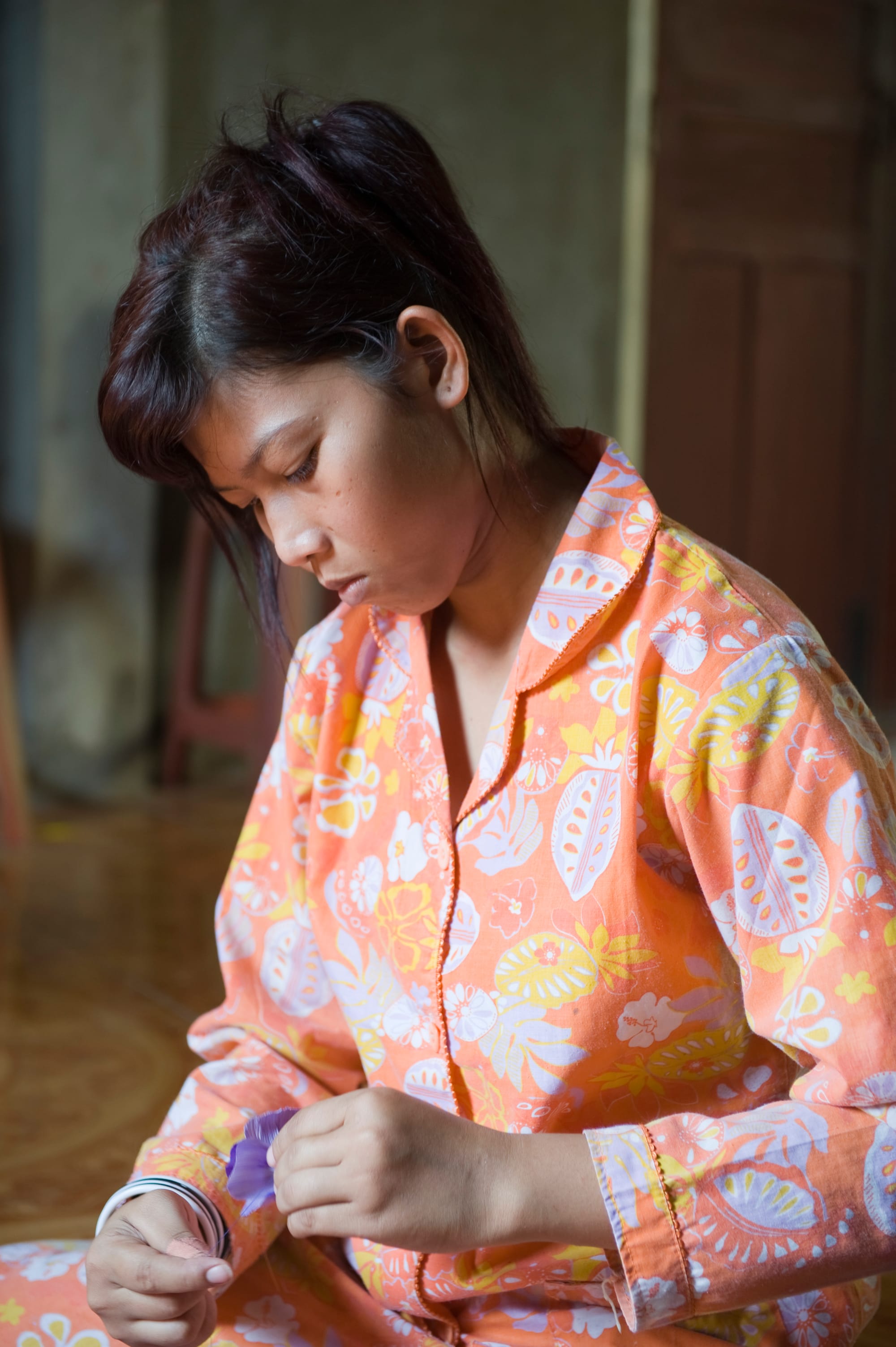
Davy aims to pay her workers in the flower shop a minimum of $100 a month after training and in some cases she pays in excess of $120. Some of Davy’s home workers can earn far more. In the flower shop wages are around double the factory salary and are considered “good” by the girls who work for Davy when I ask them.
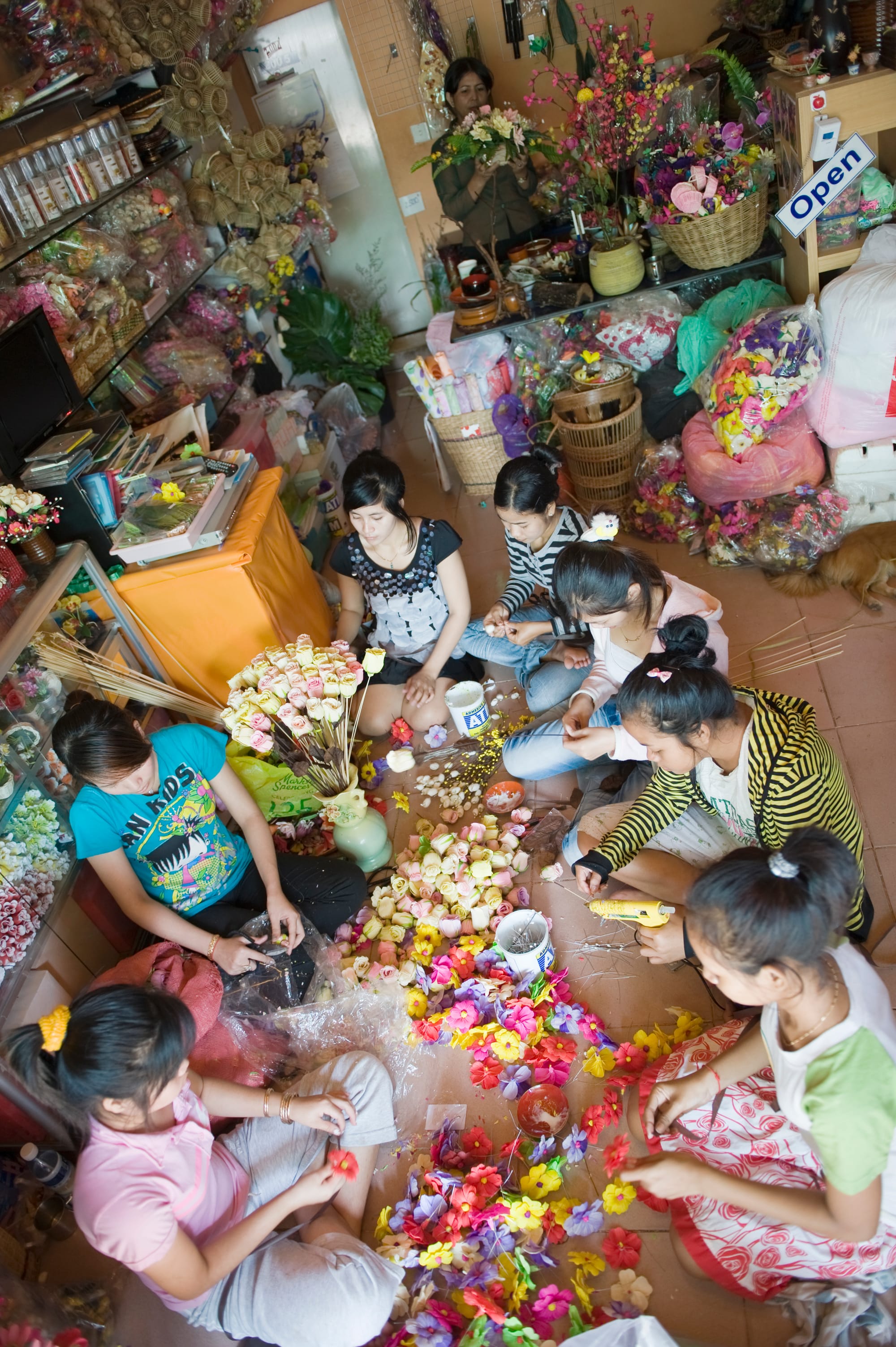
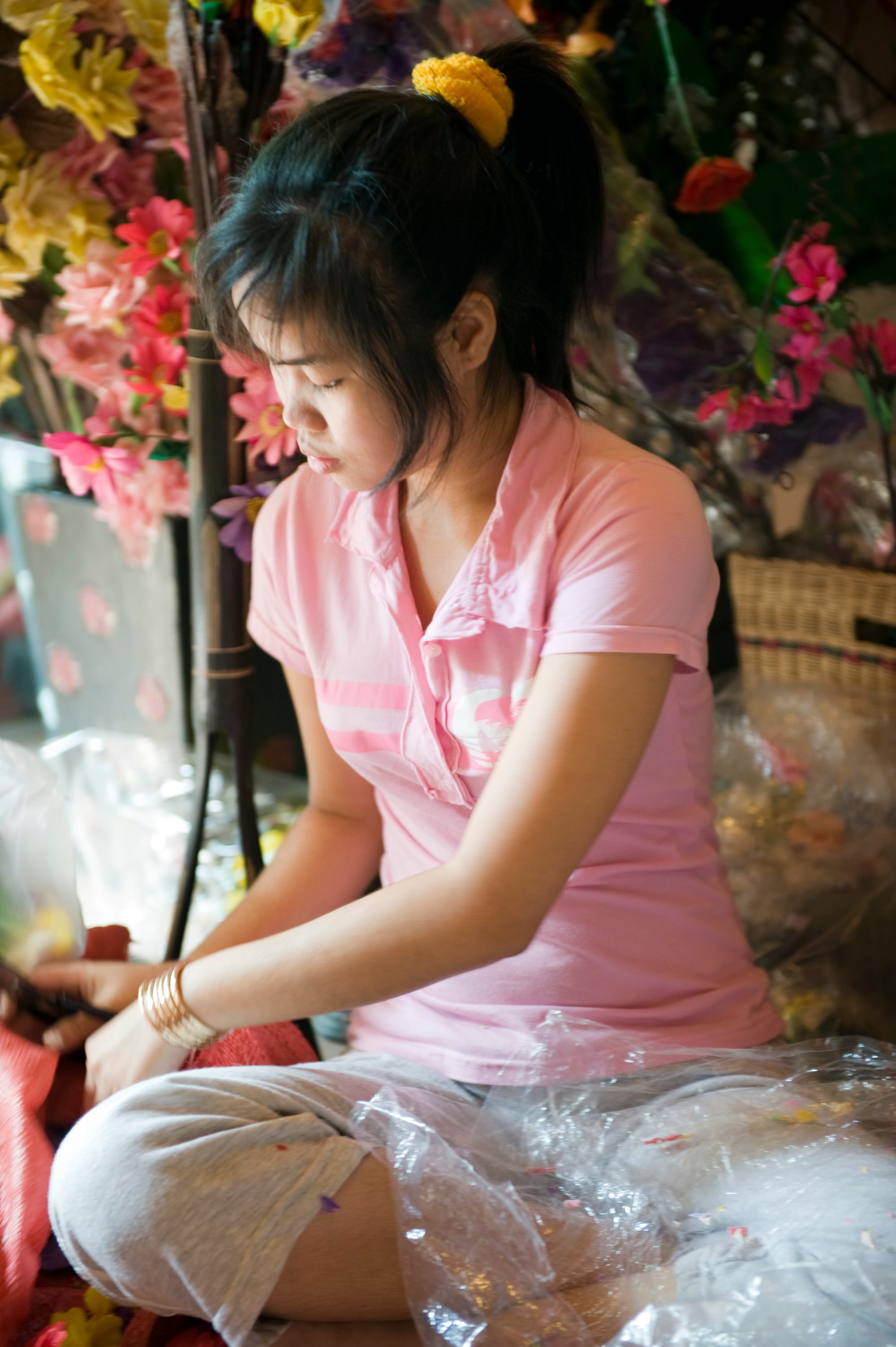
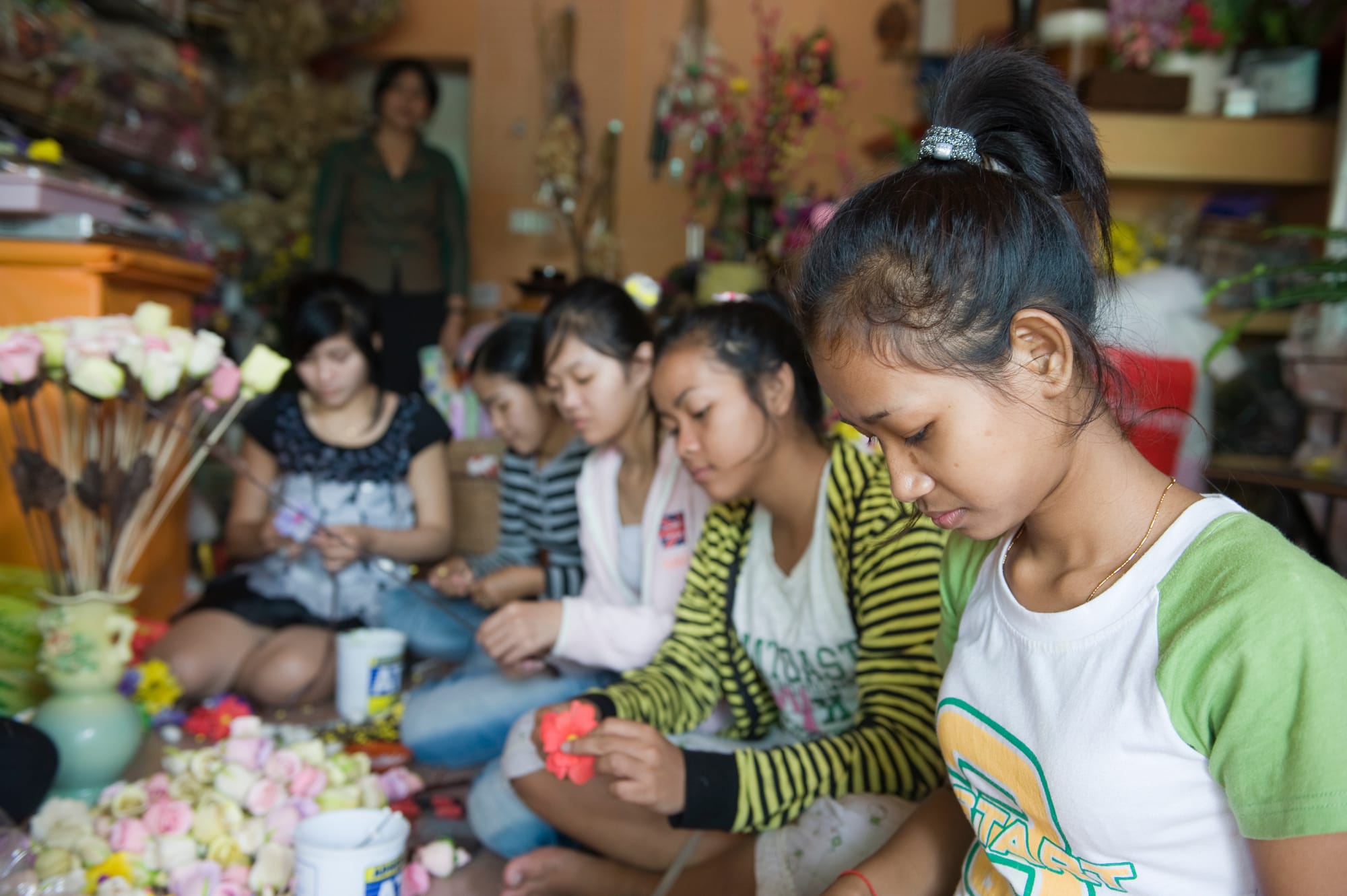
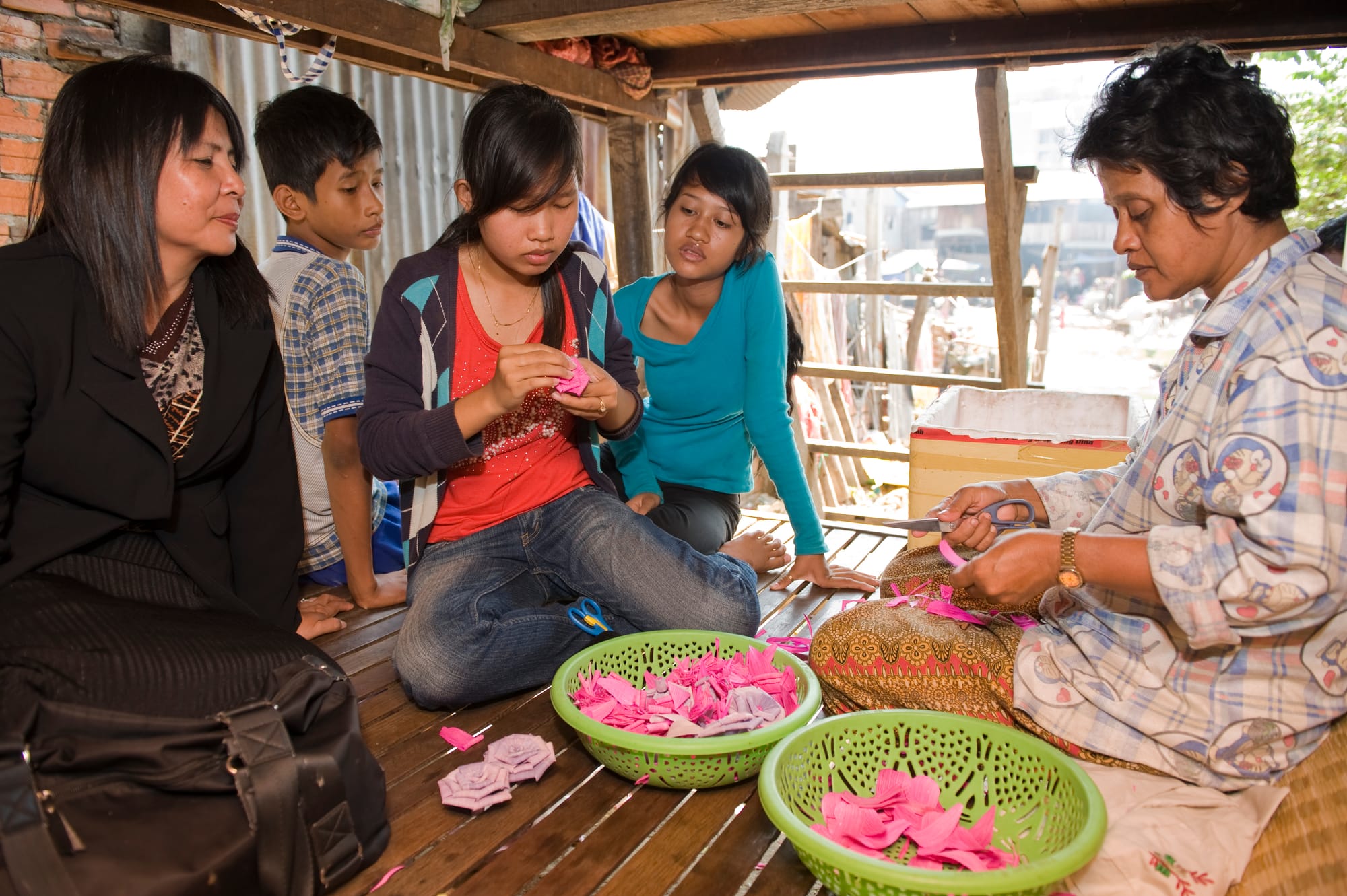
Inside, the Phnom Penh Flower and Souvenir shop is packed full with colourful artificial flowers, virtually hiding the seven girls working on the floor amongst the debris and raw materials of the production process. Virtually disguised they maybe but the noise inside is a cacophony of incessant chatter, clipping of flower petals and the ubiquitous ring tones of their mobiles.
The oldest girl working here today is Nareth Pin- 25 years old – whose family home is in the rural Kompong Cham province. “I like working in this shop making flowers,” she tells me. “In my village the only work I can find is in the rice fields working for my family. This work here is easy. It’s not hot and difficult like cutting rice in the Sun.”
Sitting next to her is Ith Kimsor – 19 years old – who originates from Battembang around 6 hours North West of Phnom Penh on a hot and bone jarring bus journey. “I worked in a snooker bar before I worked in this shop,” she says as she clips the coloured flower heads to shape. “I worked all day from 8am until 9pm with little pay unless the customer gave me a tip. Here the work is easy and I now have time to do other things in the evening.”
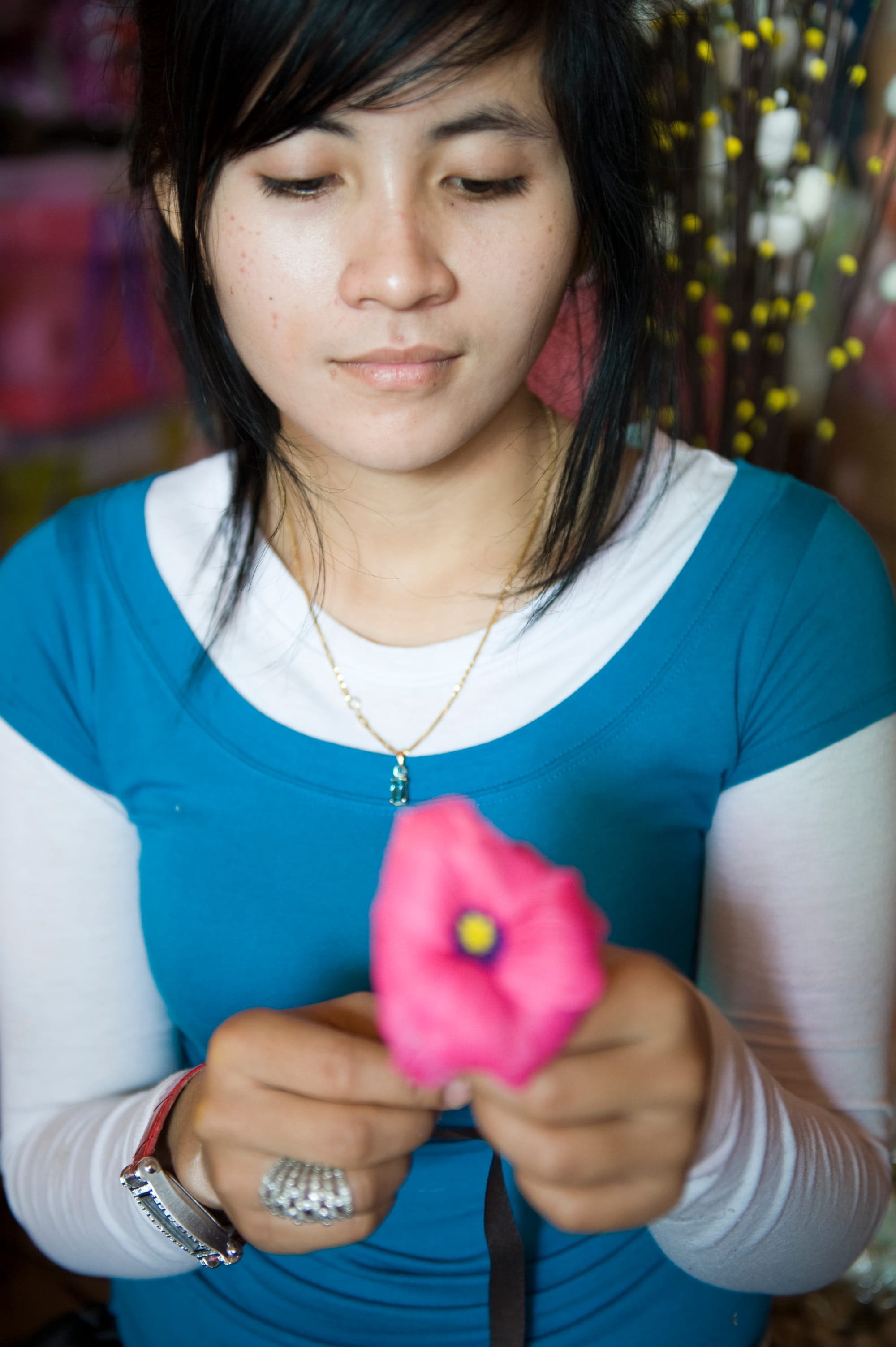
Nimul Sambath, 23-years-old, lives in Phnom Penh with her mother and younger brother. Her father died a couple of years ago aged around 50 years. Remember, there are very few old men to be seen in Phnom Penh. “Before working in the shop I worked as a ‘Beer Girl’ in a local [Khmer not tourist] bar. I had to sit with the customers to encourage them to drink more of the [local brand] beer I sell. Sometimes the customers were not nice to me... unpleasant,” she tells me, continuing: “Working here for [Davy] is easy and I don’t use too much energy.”
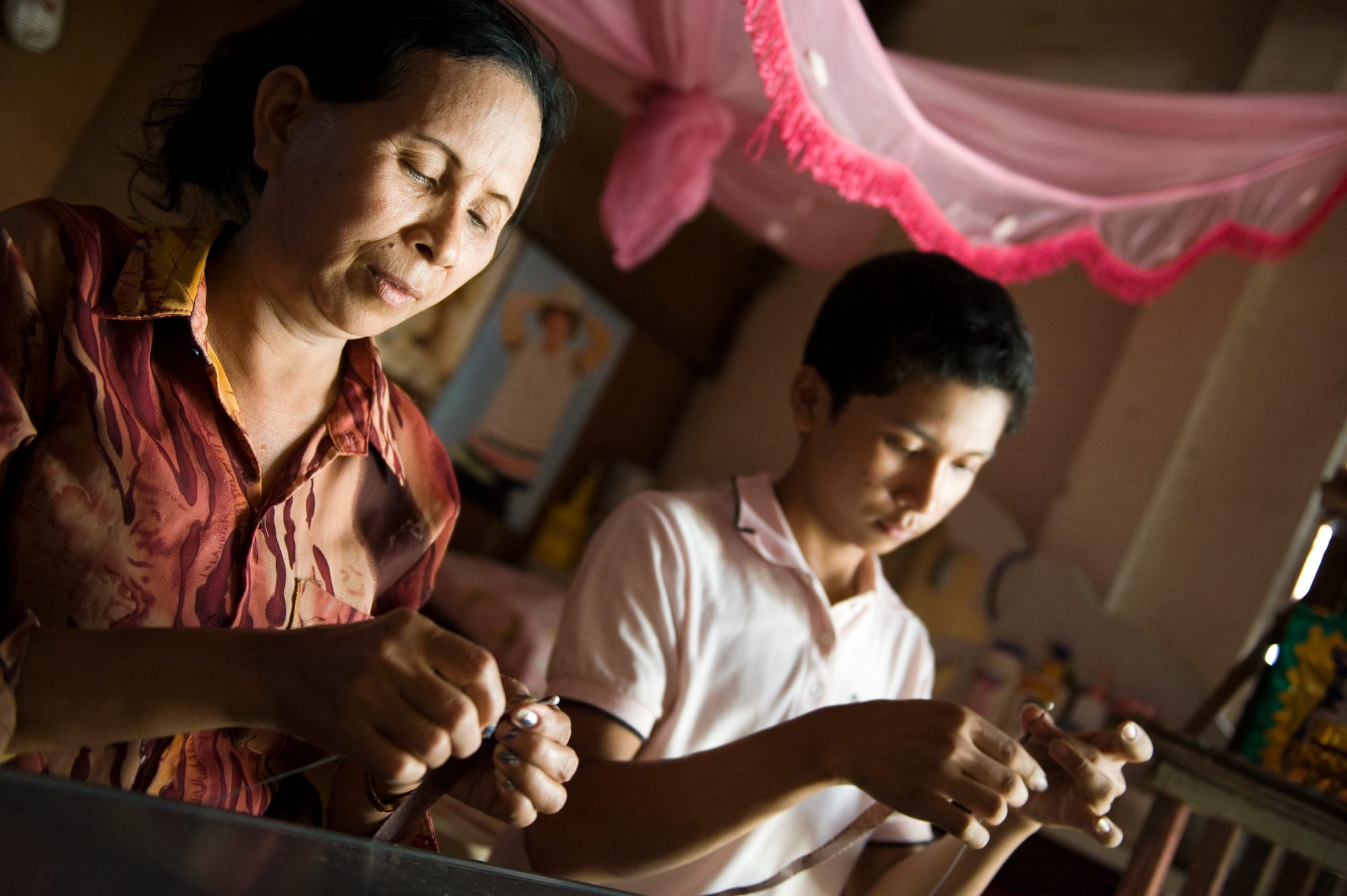
Later in the day I visit Nimul’s penurious home to meet her family and find out a little more about Davy’s home-worker employees. The tuk tuk driver drops us off on the street outside the ‘Kolab I’ community, close to the Japanese Friendship Bridge in Phnom Penh. We enter a dismal passageway: immediately I duck down to avoid the jagged corrugated tin roofing protruding from above as we teeter carefully along the rutted ground of the narrow, litter strewn gennel for maybe 100m. We pass dark rooms where women street vendors are preparing their wares for the evening shift; we pass caged chickens stressfully clucking; we pass grimy children eyeing us warily and young men relaxing in the heat of the day. Eventually we arrive at the dark furnace, the twin roomed residence where Nimul’s family live. I’m greeted by the smiling faces of Chim Soiy, Nimul’s mother who is 53-years-old, and by her 17-year-old brother Rasmey Sambath. I return their greeting with a smile, acutely aware of sweat droplets tracking over my face and arms, drenching my whole body. I wonder in total awe, in disbelief, how anyone can live and work in this heat with no fan or air movement? Soon the penny drops: you need money to pay for the electricity to power a cooling fan.
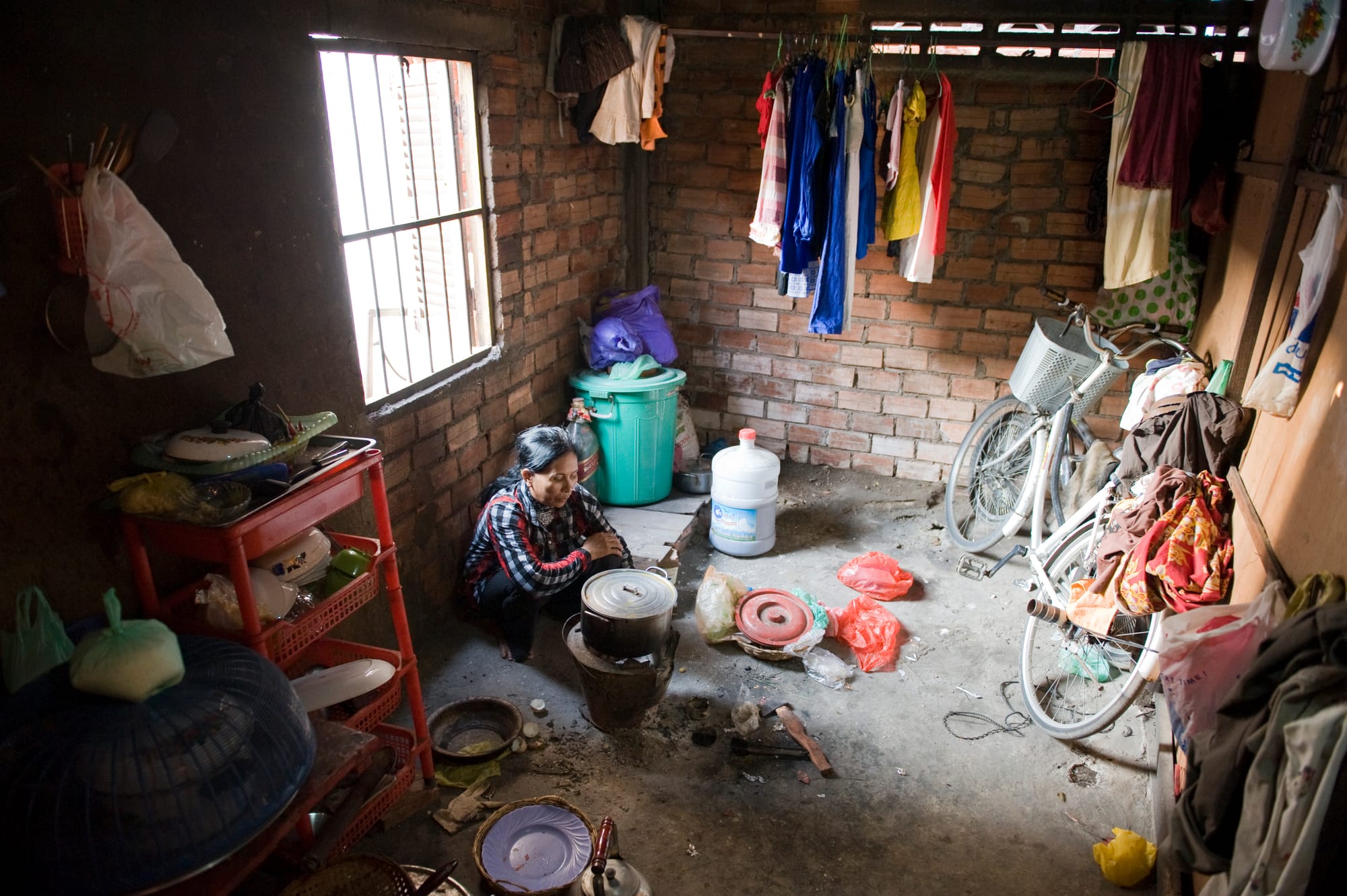
Chim tells me: “I have worked for Davy for around one month. I was made redundant from my work as a public cleaner and I had no money for rice. My daughter introduced me to Davy. I asked Davy if she could help me by giving me some work.” She reheats a pan of last night’s rice on a tiny heater on the floor in her kitchen and adds: “Today we have finished making the flowers and I hope that Davy can bring us some more work soon. We need money to buy some rice.”
Nimul’s quietly spoken brother Rasmey tells me: “I want to go to school every evening. If we do not have money to pay for my school I will have to stop. I want to go to school to get a good job but food for today is more important. I am sure that soon I will have to leave school.”
As we leave the home I ask Davy how much work she gives them? “It’s difficult at the moment as many families around Phnom Penh need and want work. I try to give work but sometimes we don’t need more flowers to sell. Sometimes I give people work even if we don’t need the flowers [stock] because I know they have no food to feed their family,” she replies.
Around one month later I revisit the Sambath family with Davy as she collects some artificial flower parts which they have fabricated for her. In their room, again unbearably hot and dingy, their sticky fingers glue material to wire flower stems on a small table located in front of the family bed. They appear to be delighted to be earning a little money for food, and for Rasmey’s education, by making flowers for Davy to sell in her shop. Rasmey’s friend also helps them today, perhaps in the hope that Davy will pass on some work to his family in the future?
Other girls pictured at work in Davy’s shop are all consistent in their complimentary comments and praise regarding their employment. Takeo Khim, 20 years old, tells me: “The work is clean. The environment is not dirty. We have a chance to make our own business in the future with the skills we learn. We can study [English] at school in the evenings.”
Kunthear Chuob, the youngest girl working here today, is 15 years old. She tells me: “I enjoy working in the shop. It’s better than other work and every evening I learn English at school. I pay 1000 Riel (0.25$) for 1 hours study.”
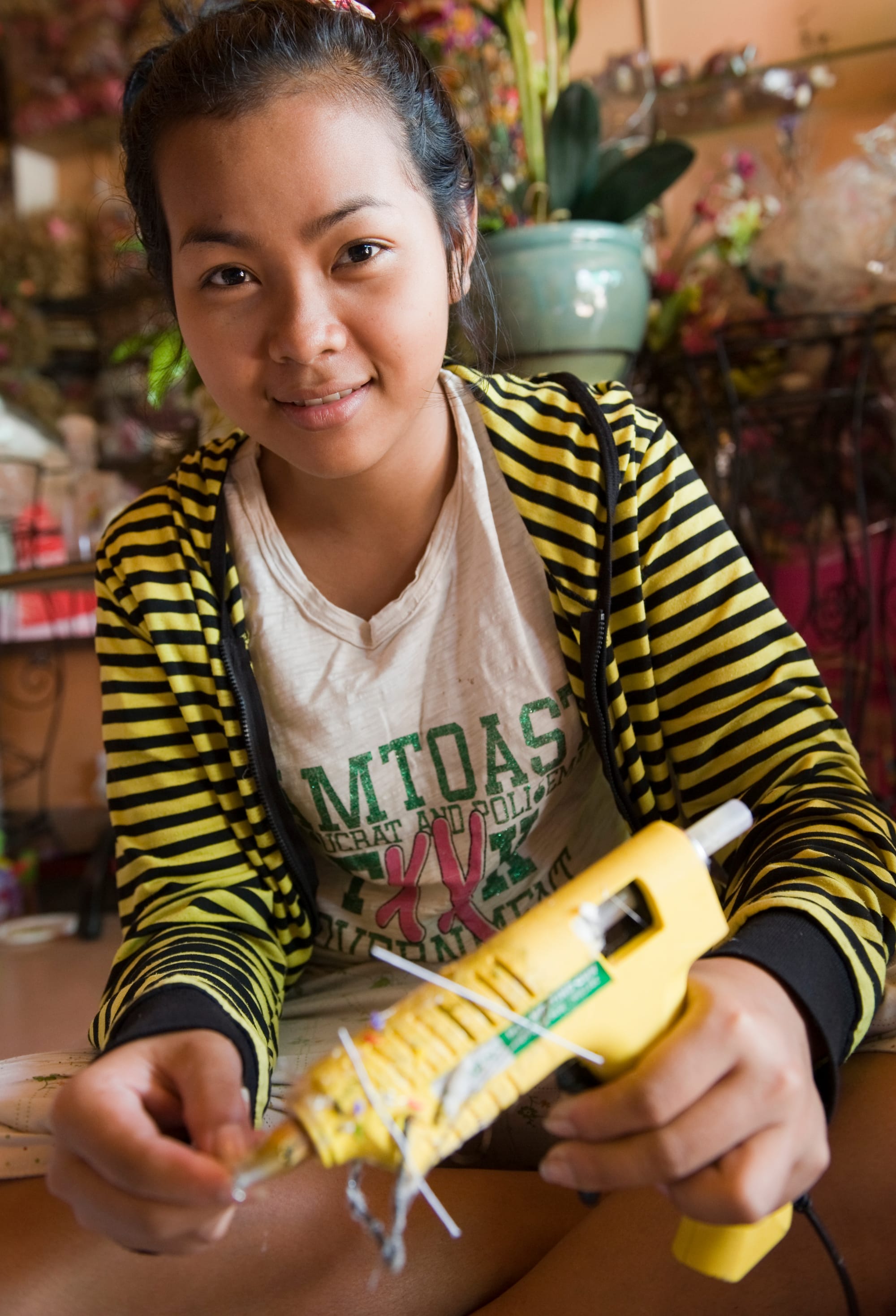
Working next to Kunthear is her friend Pisei Ron, aged 16. They are neighbours, living in the Hamcheat Community slum in central Phnom Penh together with 108 other families.
The tuk tuk driver takes us to visit the homes of the young employee’s Kunthear and Pisei. A worried look clouds his eyes, as he drops us off outside the Hamcheat community building at a narrow alleyway, which is the only entrance to this decrepit and long derelict 1970’s cinema complex.
Davy tells me to: “Wait here Steve,” as she moves forward to explain our presence to the menacing young men, partially drunk I suspect, playing some card game, gambling what little they have to gamble with. These men are the guardians of the slum. I wait whilst she calls someone to ensure that it’s safe for us to climb to the rooftop homes where Pisei and Kunthear live.
Davy informs me that it is: “Ok we can go to visit the girls’ mothers in their rooms.” We move down the entrance hall, which quickly darkens as we distance ourselves from the sun-bleached street. The uneven, chipped and broken concrete steps in the rear stairwell of the old cinema are damp from the wastewater that flows down them. In western parlance a ‘real trip hazard’. No windows to illuminate our ascent, just tentative and precise foot placements in the darkness to avoid the almost inevitable stumble. A 180 degree direction change and the ascent continues to the first floor, to a claustrophobic corridor illuminated by a couple of football sized holes punched through the concrete skin of the building. A wrinkled old woman washes her long grey hair and cleans herself with a bucket of water here in the gloom for some privacy. We continue and pass entrances to some of the dwelling areas spaces on this level. Homes or cells or coffins you may debate: The best are wooden boxes crudely nailed together; the lesser class, and the more usual, are rotting cardboard gazebos bound with tape and twine around bamboo poles. Rats roam through the cinema complex feeding on the detritus of their symbiotic human community.
The climb to the top floor is now obvious as it continues upwards via two external metal ladders, old fire escapes I presume. The ironwork is perilously decayed, with some steps having completely rotted away, but at least we can now see our feet and track their progress avoiding the numerous ‘mauvais pas’. Clearly these ladders would fail any building legislation in the West and officials would condemn the building, probably describing it with authoritative jargon as ‘unsuitable for dwelling’.
In central Phnom Penh, this building will remain as slum housing for the 108 families, with no protection from governmental legislation, until perhaps an unfortunate and intense fire – source unknown – razes the structure and renders the families homeless. Afterwards, it’s probable that some governmental or city law will prevent the occupants from re-habiting the area, enabling a wealthy developer access and legal rights to build fashionable dwellings, shops or nightclubs in this prime location in the capital. These destructive firebombs, rather frequent over the last few years in central Phnom Penh, have caused many families living in the city’s slum areas to be relocated to distant communities far from any possible employment opportunities, in villages lacking any municipal infrastructure. Later in my time with Davy we will visit some of these displaced families for whom she provides employment in their homes.
My musings during our climb fade out as we reach the rooftop accommodation area, developed into homes for some tens of families. Pisei and Kunthear live opposite each other. Kunthear’s mother is at home in her hot, fusty sepulchral room, the atmosphere rendered only slightly bearable by a small fan, powered by thin decaying wire cables coupled to some archaic electrical distribution system in the cinema. The room is stuffed full with the family’s worldly possessions.
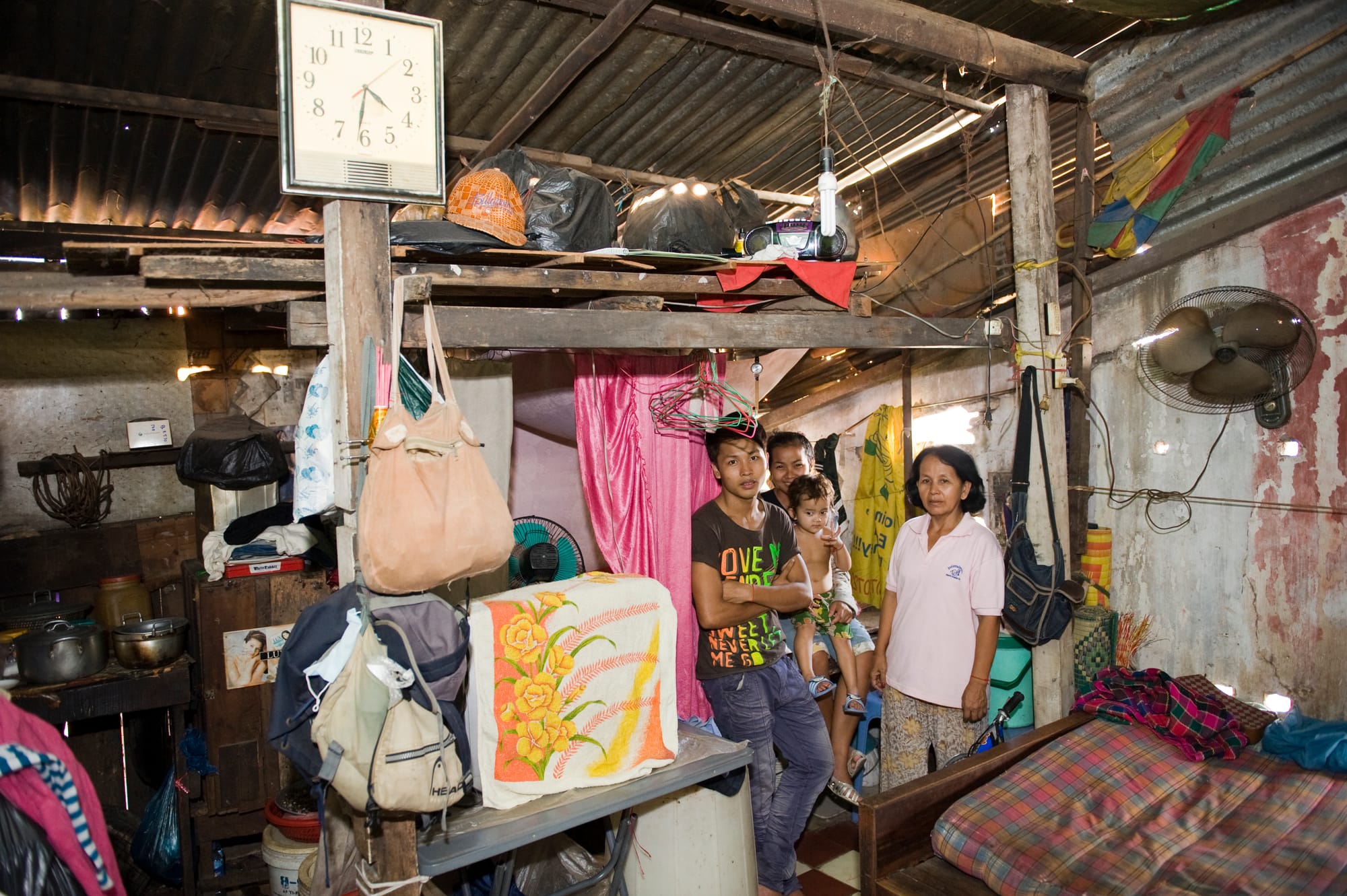
“I am happy that Kunthear has work making flowers in Davy’s shop,” says her mother, as they sit together in the corner of the room, which is unbelievably home to the seven members of her family. “We need money for food and it is better than some other work she can do in Phnom Penh. I worry that she may get HIV in some work in PP,” she continues.
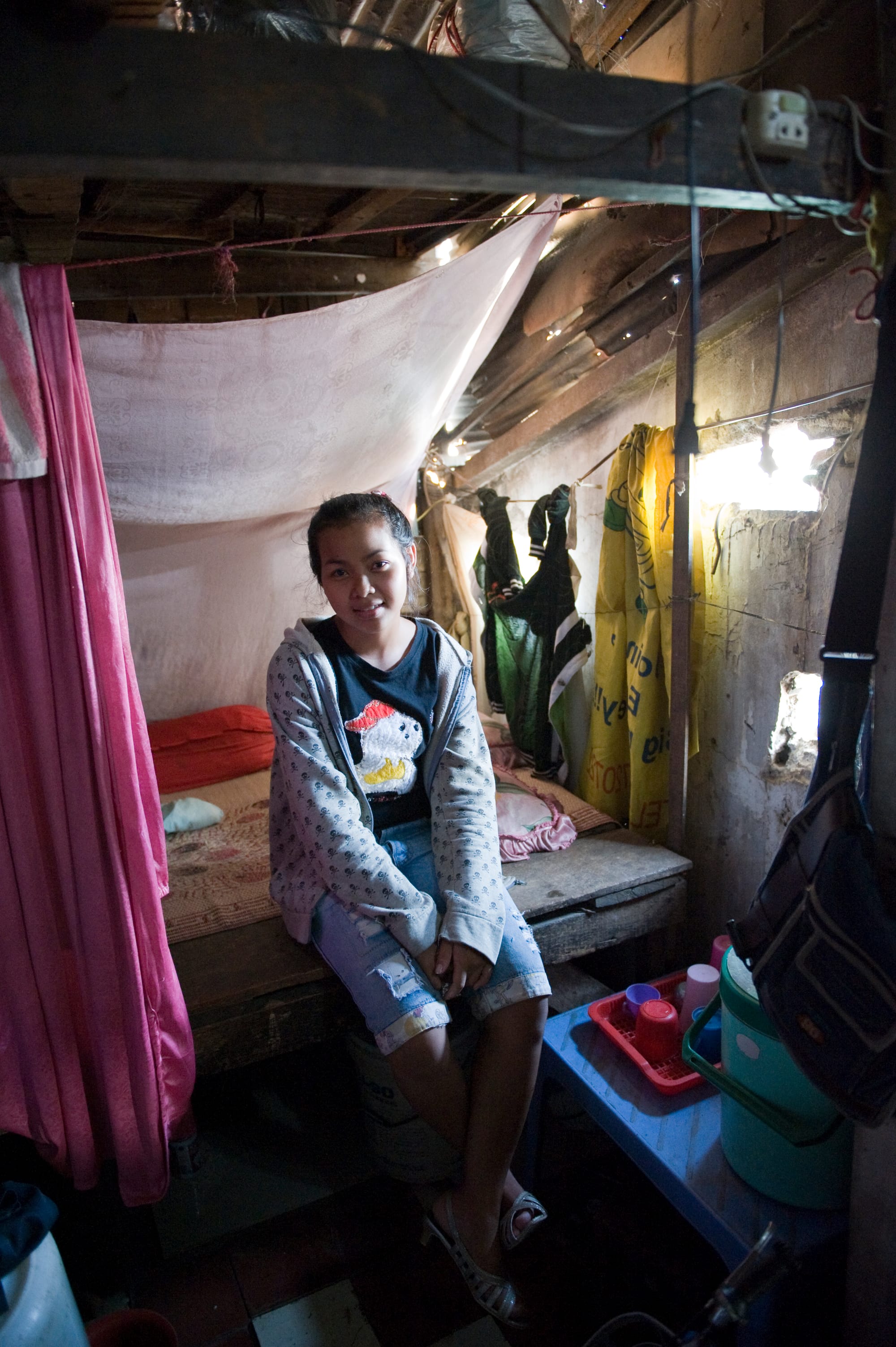
We step across the corridor straight into Pisei’ home, comprising of one poky room perhaps less than 10 square meters area, a small window overlooking the city together with an original yellow tiled floor in need of renovation. Although it was not easy to talk for long to Pisei’s mother, as her mind appeared to be focused elsewhere, she did comment that she: “wants Pisei to earn money to help her [mother] and for them to move to a better house. We need money to live a better life.”
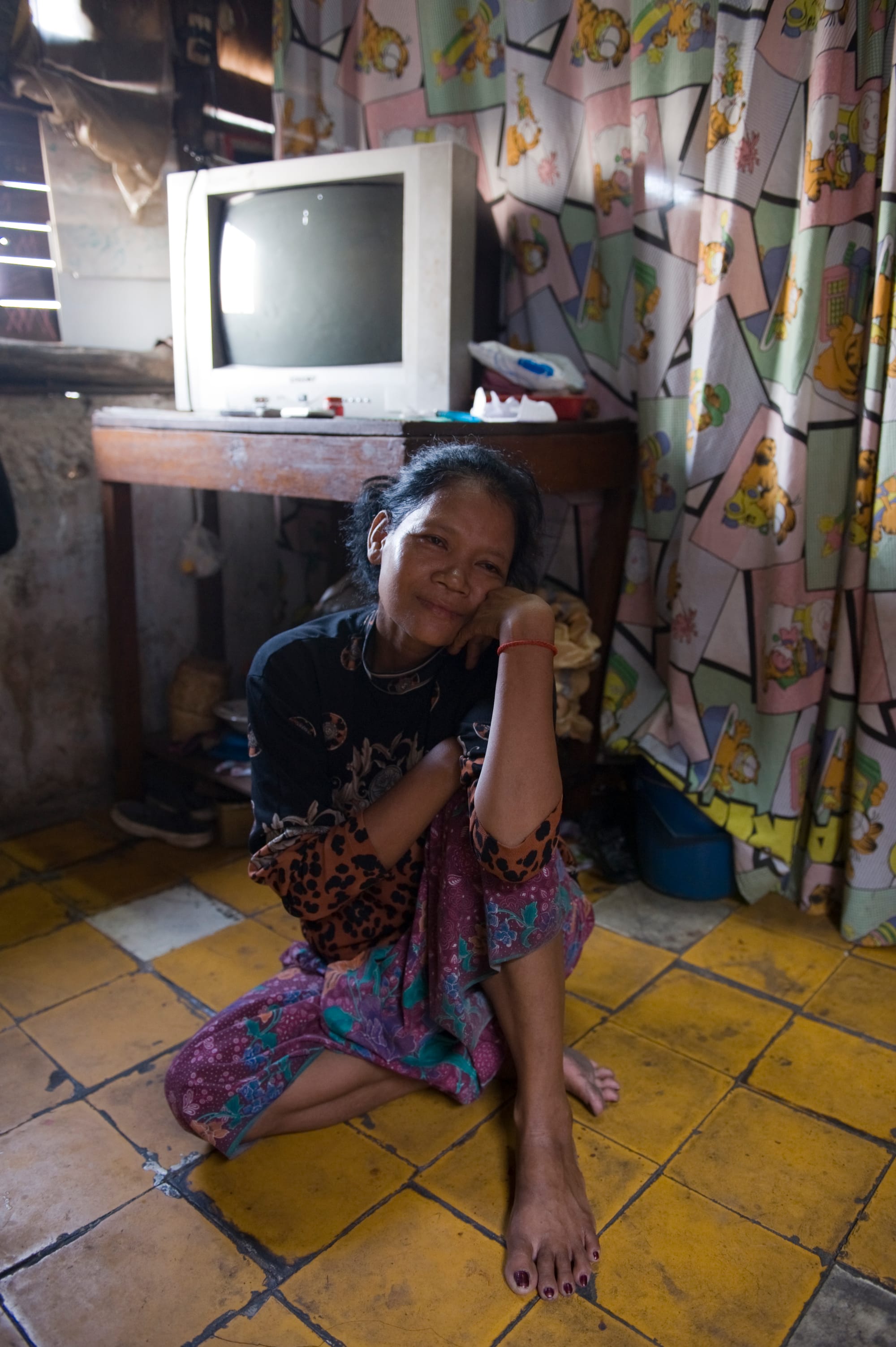
It’s late afternoon as we carefully descend the stairs and steps to the ground floor. We again pass the living spaces where now young girls dress in provocative apparel and paint their faces for the evening shift, probably in the bars and clubs which litter the tourist as well as local areas of Phnom Penh. I ponder that there must often be an ineluctable, intolerable pressure on many young girls from these dispossessed, destitute and wretched slum communities to earn money from prostitution, sex work, or as a ‘Beer Girl’ in a local bar.
“HIV and AIDS are rife in this community,” comments Davy sadly as we step cautiously past the drunken young men guarding the building, still gambling, drinking and smoking. She opines that: “Many men in Cambodia are very lazy and do not want to work. They rely on their wives and daughters to earn money.”
Shortly after my last visit there, Davy told me that the two girls, Pisei Ron and Kunthear Chuob, have left their employment with Davy. It is rumoured, by those who know her, that the young and pretty Pisei, still sixteen years old, has been ‘married’ to a high ranking Government official and she now lives in a grand house alongside her mother in an exclusive and wealthy area of Phnom Penh.
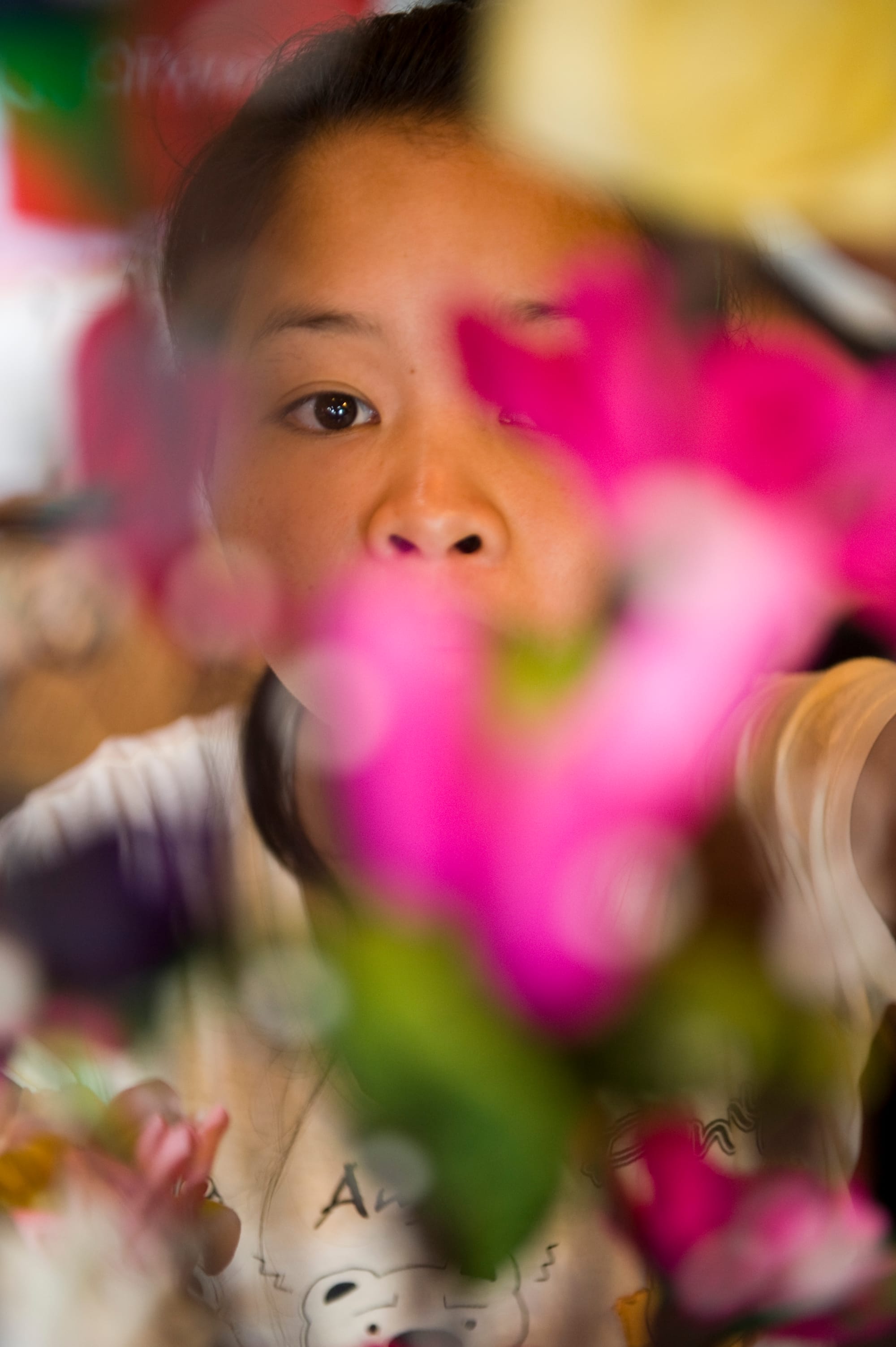
Two more girls that Davy has supports are 13-year-old Ty Van and 15-year-old Srey Oun.
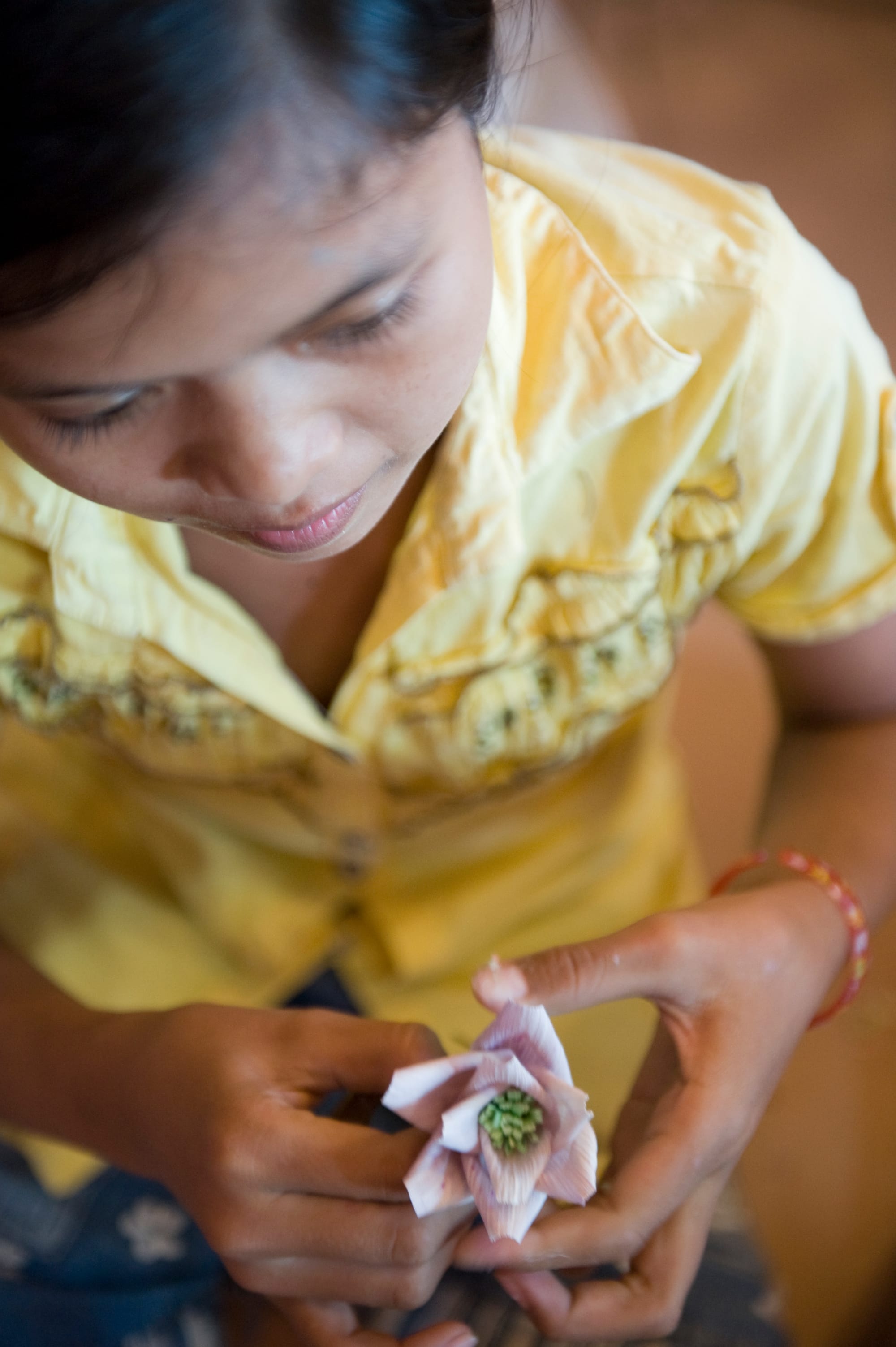
Both lived in a tiny village in the middle of a forest in the Kampong Cham province of Cambodia, along with 3 other siblings and ageing parents. They had little if any contact with formal education as the closest community school was 8km distant from their farm. Their parents asked Davy for help when she was visiting the area with her older brother who is a doctor. She offered to feed them, to clothe them, to educate them at a school in Phnom Penh, and to provide medical treatment for them; in return they work for a few hours each week in her shop making flower petals and some work in her house. Davy does not pay the young girls for the work they do but clearly funds all they’re living and schooling expenses.
“I will support them until school is completed and they have trained with me,” she tells me proudly. The quiet and shy Ty Van whispers that: “The work is easy in the shop. If I lived on the farm I would plant fields all day which is very hard work and tiring.”
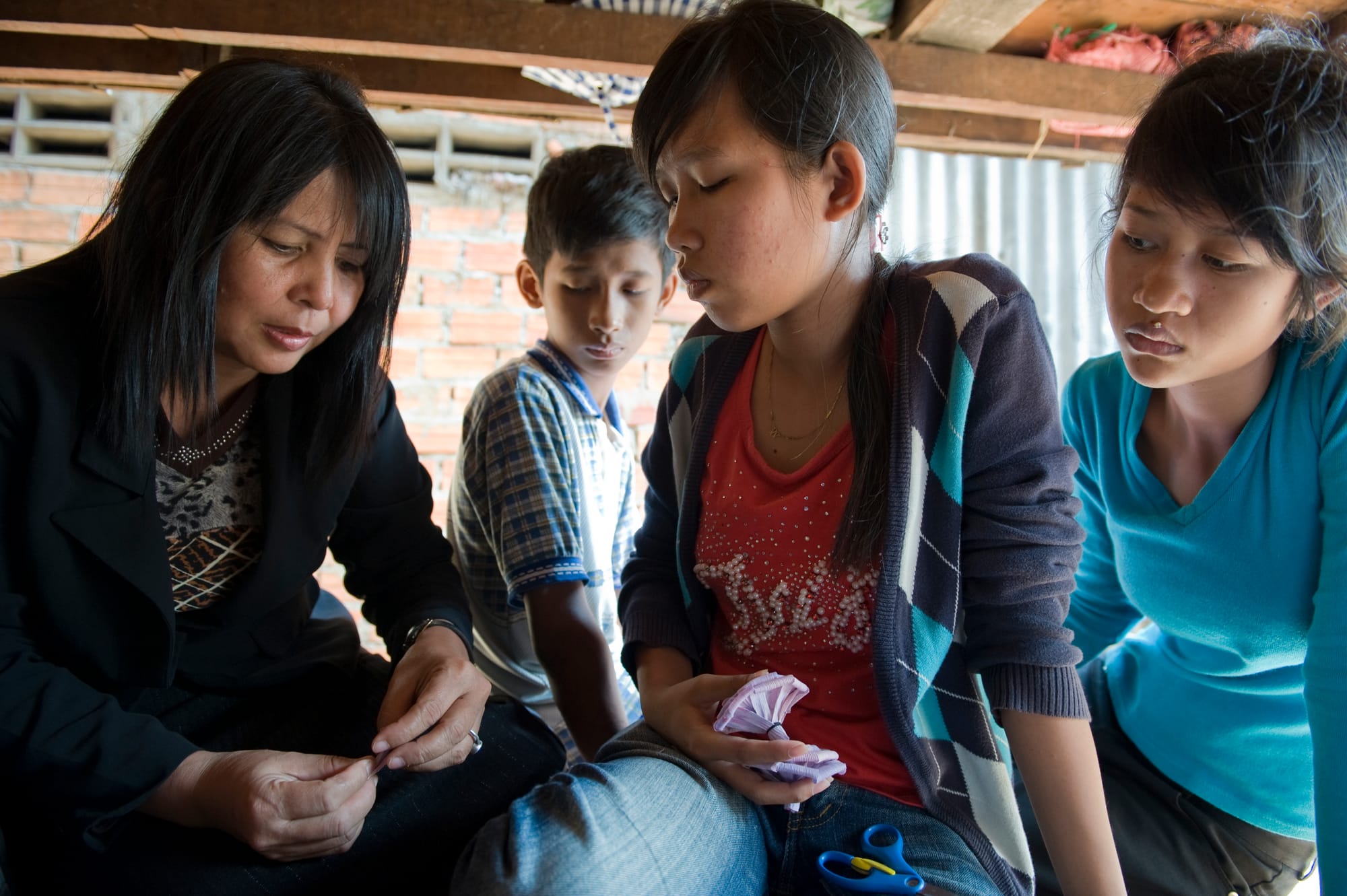
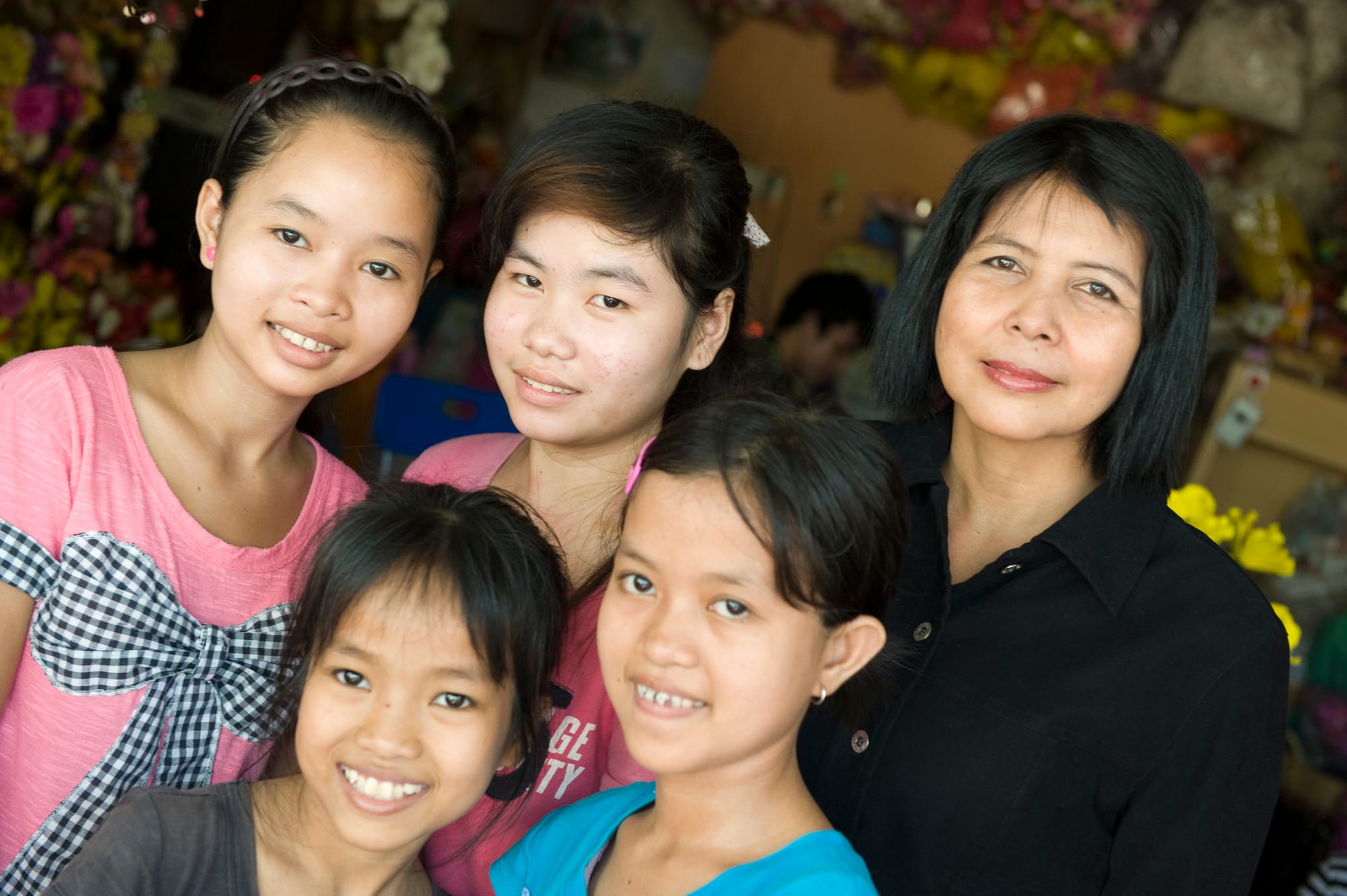
On a subsequent visit to the shop I again meet Srey and Ty alongside two new girls from the rural ‘provinces’ whom Davy has taken into her unofficial education, training and welfare programme for young girls. Rack Smey, 18, and Te Ven, 14 smile for a photograph with Davy, clearly bolstered by the security and support which her ‘apprenticeship scheme’ provides and they now participate in. Again, both these girls were living in poverty stricken rural farming villages with no hope of any gainful employment on their farms.
It is a silently reported that some girls from remote rural communities are sold, enslaved and trafficked. Firstly, as young sex slaves to rich businessmen in Phnom Penh who desire an untainted young girl for their pleasure, and then into forced prostitution in the ‘local’ brothels of Cambodia before they move to work in the tourist bars of Phnom Penh when they are maybe 18 years old.
As her business grew Davy looked for workers who could produce her flowers in their own homes, as she wanted women living in the suburbs who could not afford to travel to Phnom Penh to benefit from her employment opportunities. We spent a day together touring dusty roads to visit some of the local homes and communities to which Davy outsources her business. Davy translates as we talk with the some of the people she employs.
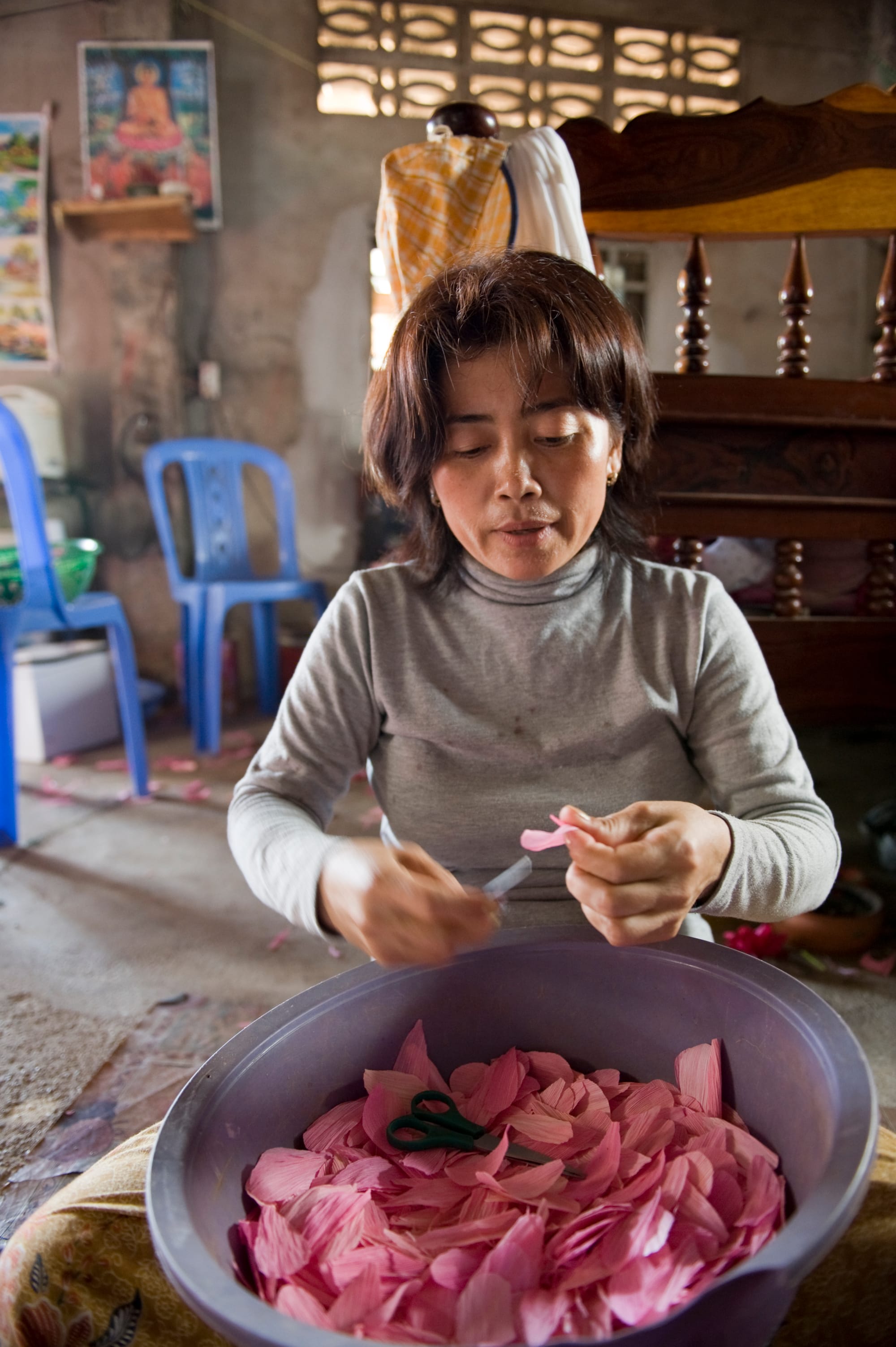
Srey Cheam, her husband Son Ty and their 3 children live in a small home in a community village called ‘Samaki 2’. They were forced to relocate there in 2001, when their room in a notorious slum building in Phnom Penh was razed by a fireball, a routine procedure in the capital, it seems, when ‘someone’ wishes to redevelop land situated in a prime city location. The government compensated the family with a 15m by 7m plot of land on a waterlogged rice field with no infrastructure – no water, electricity or road access - some 20km from Phnom Penh. With no finances to build a house on the land, they turned to a Non Government Organisation called ‘Solidarity’ for help. Solidarity loaned them money to deposit with the bank so that they could mortgage their land and build a home.
Srey Cheam tells us: “I was a hairdresser in PP [Phnom Penh] and my husband was a tuk tuk [motor cycle taxi] driver. In this village there is no work and it’s too far to travel to PP.”
“I found work making clothes in a German owned factory. The work was horrible. Many workers become ill from the chemicals they use to make the clothes for Europe,” she continues. Interestingly the only local work available to the new villagers relocated from their destroyed homes in Phnom Penh to Samaki 2 was work in this conveniently located clothing factory.
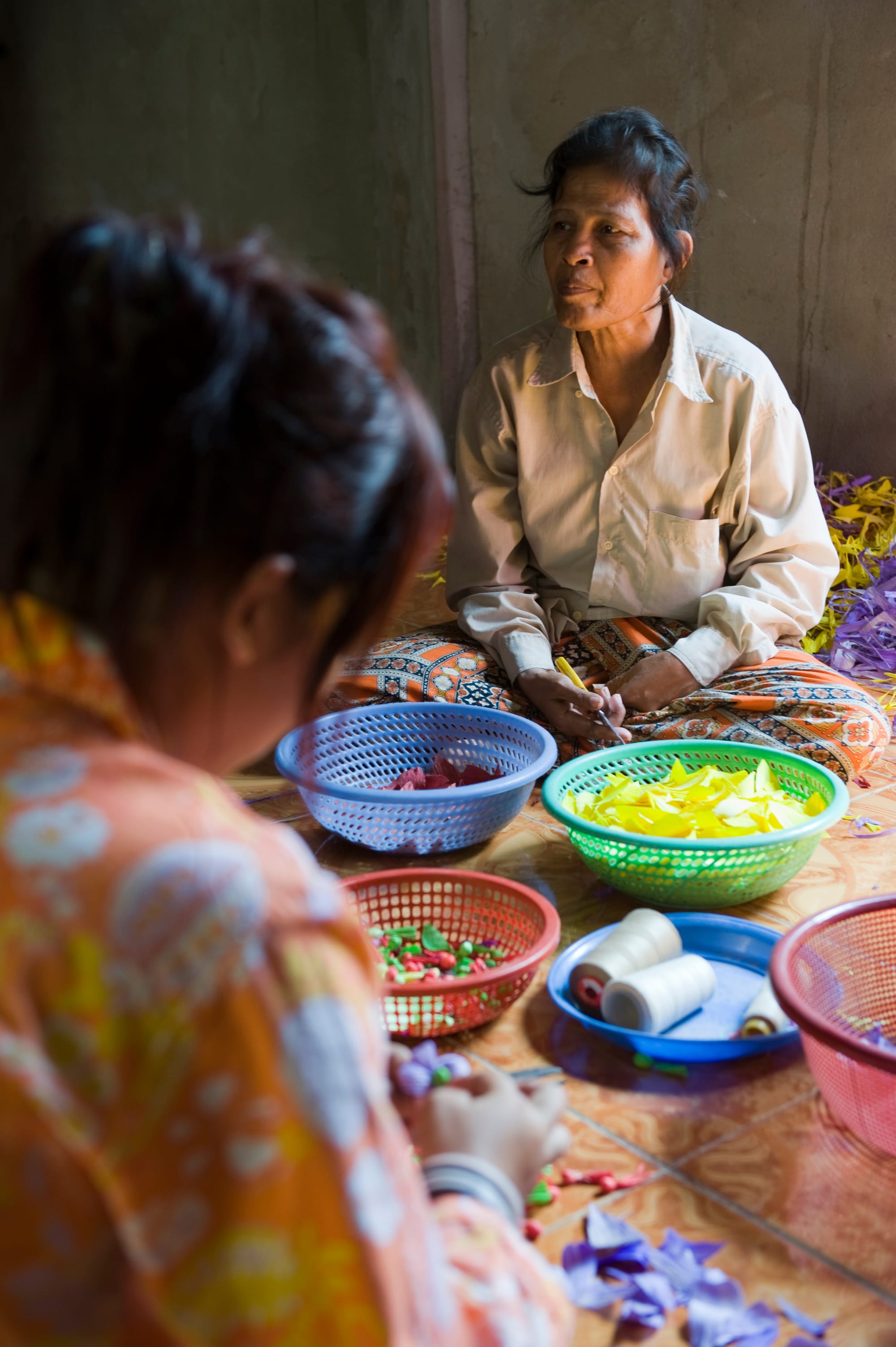
“For three years now I work for Davy by making flowers. The work is easy and I work at home. I make good money, sometimes $200 or $250 each month, to help my husband and children. Sometimes I find it difficult to keep up the production so my family and husband help,” she says, adding: “My husband [Son Ty] used to drive moto taxi in PP but here there is very little work. Too far from PP and nobody needs a moto taxi in this community. He helps me cut the corn leaves so that we can make the petals for the flowers from them.” She casts a glance to her husband sitting outside their home clipping corn leaves to emphasise her comment.
57-year-old Saren Cheam and her 20-year-old daughter Oun Chandarany live close to Srey and her family in Samaki 2 village. Development and training of staff features strongly in Davy’s strategy, with the aim of empowering them to better direct and to have more self-control of their destiny. Today she teaches the mother and daughter team to construct a new flower style, which she has recently designed.
As they focus on their work we chat about their lives. “I used to work in a clothing factory earning around $60 or $70 a month,” says Chandarany. “The factory work made me feel ill. The stuff they put onto the clothes makes many people ill. For the last 2 years I have worked making flowers at home for Davy and I’m no longer ill.”
Chandarany explains to me why she also prefers her current employment compared to the work in the Bangladesh owned clothing factory, Ocean Garment Co. Ltd. located in Phnom Penh, which makes trousers and exports them to Europe and the USA. “The bosses were always complaining. All the time they tell us to stop talking and make us work more quickly. Every problem that occurs the bosses blames the workers for it,” she continues. “The factory is a long way from here and sometimes I had to work until 10pm at night. The factory give us no security to get home so I could not use a moto [motorcycle scooter] for transport because many people want to kill you to steal your moto at night time. I had to come home on my bicycle, which is very difficult. Working at home I have much more freedom and safety.”
Sok Yin and his wife Luk (52) moved to their room in the ‘Samaki 5’ village around 5 years ago when their home, together with the homes of all the other residents in the ‘Basa’ area of Phnom Penh, was destroyed by a fire ball. The cause of this fire yet again unknown. The relocation package followed a similar route to all the others with many of the homeless families being awarded a small plot of land distant from the city as compensation.
“There was nothing here when we were forced to move to this community just an old rice field, “Sok, now 62 years old, tells me.
“I was no longer able to work in the Ministry of Transport at the Port as it was far too far to travel. My wife a street vendor and can no longer sell food from the front of our home in Phnom Penh,” he adds. Sok and Luk were thus forced to move from Phnom Penhto the Samaki 5 relocation village without work or any prospect of obtaining employment locally.
“We work now for the Phnom Penh Flower and Souvenir shop. I make and colour the bamboo flower stands and my wife cuts flower petals from corn leaves,” adds Sok, as he stains the bamboo holders over a boiling pot of dye in front of his house.
“Unfortunately now though she is very ill,” he informs me quietly. Sadly his wife’s creased face reflects her pain as she scissors the flower leaves in the pool of light projected through the open window aperture into the dark room.
“We earn around $100 every month but most of this money goes on medicine for my wife. If we do not pay for doctor and medicine she dies,” he whispers while nodding his head gently towards his wife adding: “Davy sometimes gives Luk medicine and interest free loans or [advances] to help us.”
“There is no free Health Care here in Cambodia for women like Luk. She has problems with her breasts, arms and now in her legs,” Davy wearily comments as we walk down the rutted and pot holed road towards our waiting tuk tuk.
Davy does not only limit her home worker locations to villages that are too far from her shop for the women to commute. Phanna is 18 years old and lives in the Beong Salang community, a slum area adjacent to an open sewage route through the city. It stinks here and is so unbearably hot in the sun that the family work underneath their small wooden home, sitting on strips of highly patinated bamboo as it’s somewhat cooler here. Phanna wants to work alongside her mother and father at home whilst looking after her baby and her younger siblings. Davy takes me to visit the home on one of her visits to provide training for the family.
Demonstrating petal cutting, encouraging high levels of quality control and giving feedback on the work done by Phanna and her family are the salient features of this master class. Davy tells me she wishes to ensure that she: “Can send work for the family so they can soon earn some money whilst working at home.” Three generations of Phanna’s family sit outside their home later in the day cutting the corn leaves to make petals, desperate to sell their product to the flower shop to buy food.
Concluding my visits to her shop and home-workers, Davy wanted to clarify some of her reflections on the business and it’s impact on the community after the first 10 years, outlining her objectives and aspirations for the future, as well as defining some of the challenges she faces.
For Davy a day of only 24 hours is just too short. Simultaneously running a business, fulfilling her paid employment at the Phnom Penh City Hall as ‘Chief Officer for Community Development and Poverty Reduction’ and caring for her family would stretch most people to well beyond their endurance limit. Perhaps due to the journey of her early life living through the terrorism of Pol Pot, or perhaps due to her ambition to empower the women she observes living in poverty to reboot their lives, she has developed a work ethic and tenacity comparable, it appears, to many of the most successful world leaders and corporation chiefs.
To strengthen her network of contacts throughout Cambodia and further afield, she took on the role of Vice President of the Woman’s Association of Small and Medium Business in Cambodia, a government supported association of mainly wealthy businesswomen. I believe that through this organisation she wishes to address structural and governmental problems when exporting craft items from Cambodia: “It is very difficult to export any products from Cambodia. Many officials need payments. We cannot export some of our plant based products,” she informs me.
Somewhat disillusioned with the lack of support this group gives to small and rural handicraft workers, she subsequently established and became chairperson of the [non-governmental] ‘Handicraft Federation of Cambodia’ an association promoting the work of tiny inchoate craft businesses throughout the country.
“The Federation meets regularly to discuss issues such as new markets and the development of handicraft workers in Cambodia. We want to improve the quality of all craft products made here and help the workers to exhibit their work. Although the government does support some craft exhibitions they are much too expensive for poor workers to obtain a stall. Many stalls cost between $200 and $400. We will try and enable handicraft workers to exhibit they work more cheaply,” she explains.
“What I am trying to do for my shop in the future is to develop new flower designs and to improve the overall quality of the product. After ten years there is much local competition for our flowers and we are working very hard to stay in business. Different families make different flower styles but I want them to learn many new designs and skills to make us more competitive. It is very difficult for some of the women who work for me to understand this retraining procedure, although I am persevering with it so they can continue to work when the local market changes,” she states unequivocally.
“Around 60 families benefit from employment from my business. They earn money to live. What is sad though is sometimes when mothers are desperate for food and have no money they will just bring flowers to the shop when I did not ask them too. This is very difficult for cash flow but the people need rice!” she exclaims.
Let’s hope that Davy’s altruism alongside her business acumen enables the Phnom Penh Flower and Gift shop to continue to develop; to provide a strengthened and broader support mechanism enabling more and more women - glued into a quagmire of poverty, neglect and without hope - to extricate themselves, through their own efforts, without the need to sell their souls or to compromise their beliefs or ethical code, or to be forced into working for exploitative organisations who will so readily prey on their vulnerable situation.
Words and images all copyright Stephen Ford 2011.